## Diagram: LLM-Python Code Generation Workflow
### Overview
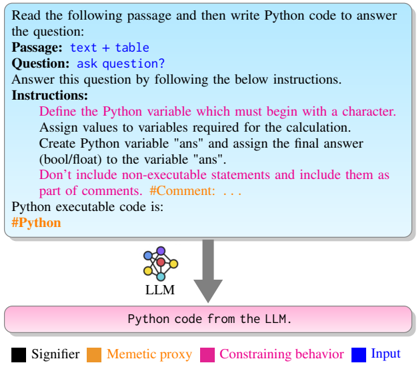
The image depicts a structured workflow for generating Python code using a Large Language Model (LLM). It outlines the input requirements, processing steps, and output format, with color-coded elements to denote different components.
### Components/Axes
1. **Input Section (Blue Box)**:
- Contains the task description:
- `Passage: text + table`
- `Question: ask question?`
- `Instructions`:
- Define variables starting with a character.
- Assign values to variables.
- Create variable "ans" for the final answer.
- Include non-executable statements as comments.
- Color-coded elements:
- **Signifier** (black): Key instructions (e.g., "Assign values...").
- **Mnemonic proxy** (orange): Variable names (e.g., "ans").
- **Constraining behavior** (pink): Formatting rules (e.g., "Don't include non-executable statements").
- **Input** (blue): Task description text.
2. **Output Section (Pink Box)**:
- Labeled "Python code from the LLM."
- Contains a placeholder for executable Python code.
3. **Legend (Bottom Right)**:
- Color-key for elements:
- **Signifier** (black): Highlights critical steps.
- **Mnemonic proxy** (orange): Represents variables.
- **Constraining behavior** (pink): Enforces formatting rules.
- **Input** (blue): Denotes task description.
### Detailed Analysis
- **Textual Content**:
- The blue box provides a template for input, specifying that the LLM must process a passage (text + table) and answer a question using strict instructions.
- The pink box represents the output, emphasizing that the LLM must generate valid Python code.
- The legend clarifies the purpose of color-coding, linking visual elements to their functional roles.
- **Spatial Grounding**:
- The legend is positioned at the bottom right, ensuring visibility without obstructing the main workflow.
- The blue box (input) is at the top, followed by the legend, and the pink box (output) at the bottom, creating a top-to-bottom flow.
### Key Observations
1. **Color Consistency**:
- All elements in the blue box (input) are labeled as "Input" (blue) in the legend.
- The pink box (output) aligns with "Constraining behavior" (pink) in the legend, as it enforces code formatting rules.
2. **Missing Data**:
- No numerical values, charts, or tables are present. The diagram focuses on textual and structural guidance rather than quantitative data.
### Interpretation
This workflow illustrates how an LLM processes structured input (task description, question, and instructions) to generate Python code. The color-coding system helps users distinguish between:
- **Critical steps** (Signifier: black),
- **Variables** (Mnemonic proxy: orange),
- **Formatting constraints** (Constraining behavior: pink),
- **Input text** (blue).
The absence of numerical data suggests the diagram prioritizes procedural clarity over statistical analysis. The LLM’s role is to parse the input, adhere to constraints, and produce executable code, emphasizing the importance of precise instruction design for automated code generation.