\n
## Bar Charts: CiteAgent Command Frequency Comparison
### Overview
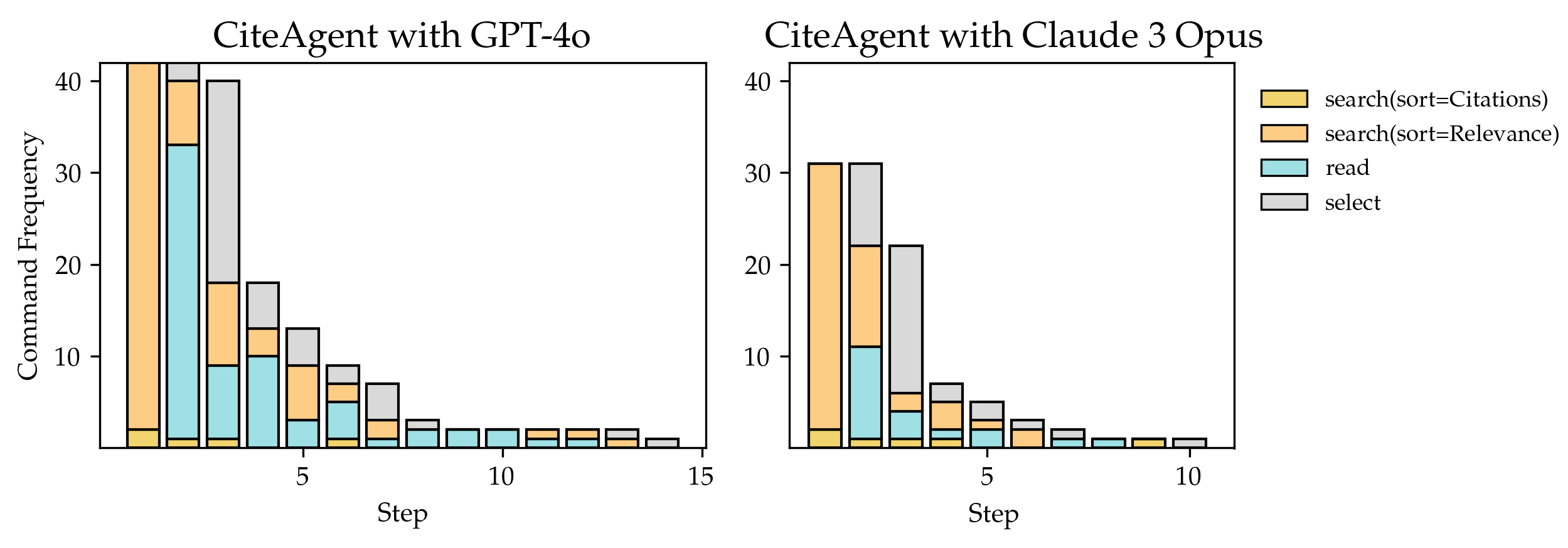
The image presents two side-by-side bar charts comparing the command frequency of a "CiteAgent" system when used with two different Large Language Models (LLMs): GPT-4o and Claude 3 Opus. The charts display the frequency of three commands – "search(sort=Citations)", "search(sort=Relevance)", "read", and "select" – across different steps (1 to 15). The y-axis represents "Command Frequency", while the x-axis represents "Step".
### Components/Axes
* **Titles:**
* Left Chart: "CiteAgent with GPT-4o"
* Right Chart: "CiteAgent with Claude 3 Opus"
* **X-axis Label:** "Step" (ranging from 1 to 15)
* **Y-axis Label:** "Command Frequency" (ranging from 0 to 40)
* **Legend:** Located in the top-right corner of the right chart.
* "search(sort=Citations)" - represented by a yellow color.
* "search(sort=Relevance)" - represented by an orange color.
* "read" - represented by a light grey color.
* "select" - represented by a white color.
### Detailed Analysis or Content Details
**Chart 1: CiteAgent with GPT-4o**
* **search(sort=Citations) (Yellow):** The frequency starts at approximately 30 at Step 1, decreases to around 10 at Step 5, and continues to decline to approximately 2 at Step 15.
* **search(sort=Relevance) (Orange):** The frequency starts at approximately 20 at Step 1, decreases to around 10 at Step 5, and continues to decline to approximately 2 at Step 15.
* **read (Light Grey):** The frequency starts at approximately 10 at Step 1, decreases to around 5 at Step 5, and continues to decline to approximately 2 at Step 15.
* **select (White):** The frequency starts at approximately 40 at Step 1, decreases to around 20 at Step 5, and continues to decline to approximately 4 at Step 15.
**Chart 2: CiteAgent with Claude 3 Opus**
* **search(sort=Citations) (Yellow):** The frequency starts at approximately 25 at Step 1, decreases to around 12 at Step 5, and continues to decline to approximately 2 at Step 15.
* **search(sort=Relevance) (Orange):** The frequency starts at approximately 30 at Step 1, decreases to around 15 at Step 5, and continues to decline to approximately 2 at Step 15.
* **read (Light Grey):** The frequency starts at approximately 10 at Step 1, decreases to around 5 at Step 5, and continues to decline to approximately 2 at Step 15.
* **select (White):** The frequency starts at approximately 20 at Step 1, decreases to around 10 at Step 5, and continues to decline to approximately 2 at Step 15.
### Key Observations
* Both charts exhibit a similar trend: all command frequencies decrease as the step number increases. This suggests that the CiteAgent system requires fewer commands as it progresses through the task.
* The "select" command consistently has the highest frequency at the beginning of the process for both LLMs.
* GPT-4o initially shows higher frequencies for all commands compared to Claude 3 Opus, particularly for "select" and "search(sort=Citations)".
* The relative frequencies of the commands are similar between the two LLMs, with "select" being the most frequent, followed by "search(sort=Relevance)", "search(sort=Citations)", and then "read".
### Interpretation
The data suggests that the CiteAgent system, regardless of the underlying LLM (GPT-4o or Claude 3 Opus), becomes more efficient as the process unfolds. The initial high frequency of the "select" command likely indicates the initial stages involve identifying relevant information. The subsequent decline in all command frequencies suggests that the system refines its search and selection criteria with each step, requiring less intervention.
The higher initial frequencies observed with GPT-4o might indicate that it requires more initial prompting or exploration to achieve the same level of efficiency as Claude 3 Opus. However, both models converge towards similar command frequencies at later steps. This could imply that both models ultimately achieve comparable levels of task completion, but through slightly different approaches.
The consistent ranking of command frequencies (select > search(relevance) > search(citations) > read) provides insight into the workflow of the CiteAgent system. It highlights the importance of initial selection, followed by relevance-based and citation-based searches, with "read" being the least frequent command, suggesting it's primarily used for final verification or detailed analysis.