\n
## Screenshot: Code Editor Window with Mathematical Theorems
### Overview
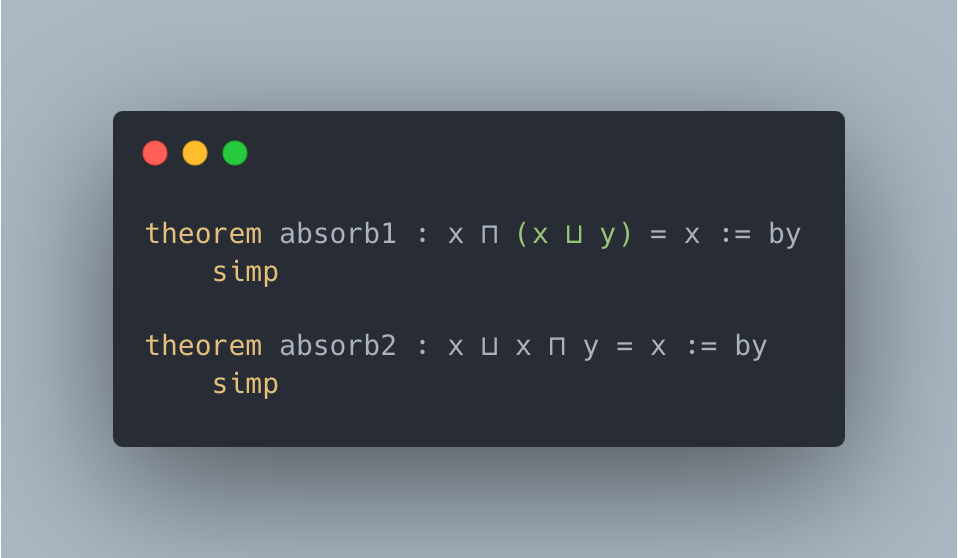
The image is a screenshot of a dark-themed code editor or terminal window displaying two lines of formal mathematical theorem statements written in a proof assistant language (likely Lean or a similar system). The window is centered against a neutral gray gradient background.
### Components/Axes
- **Window Frame**: A dark gray (`#2d2d2d` approx.) rounded rectangle with a subtle drop shadow, giving it a floating appearance.
- **Window Controls**: Three colored circles in the top-left corner of the window, from left to right: red, yellow, green. These are standard macOS-style window control buttons (close, minimize, maximize).
- **Text Content Area**: The main body of the window contains two lines of code, formatted with syntax highlighting. The text is in a monospaced font.
- **Background**: The area outside the window is a smooth, light-to-medium gray gradient.
### Detailed Analysis
The window contains two distinct theorem definitions. The text is transcribed below with its original formatting and symbols.
**Line 1 (Top Theorem):**
- **Text**: `theorem absorb1 : x ∩ (x ∪ y) = x := by simp`
- **Syntax Highlighting**:
- `theorem` and `by`: Displayed in a yellow/gold color.
- `absorb1`: Displayed in a light blue/cyan color.
- `x`, `y`: Displayed in a green color.
- `∩`, `∪`, `=`, `:`, `(`, `)`: Displayed in a light gray/white color.
- `simp`: Displayed in the same yellow/gold as `theorem` and `by`.
**Line 2 (Bottom Theorem):**
- **Text**: `theorem absorb2 : x ∪ x ∩ y = x := by simp`
- **Syntax Highlighting**: Follows the same pattern as the first line.
- `theorem` and `by`: Yellow/gold.
- `absorb2`: Light blue/cyan.
- `x`, `y`: Green.
- `∪`, `∩`, `=`, `:`: Light gray/white.
- `simp`: Yellow/gold.
**Mathematical Symbols Identified:**
- `∩`: Set intersection operator (Unicode: U+2229).
- `∪`: Set union operator (Unicode: U+222A).
### Key Observations
1. **Content**: The text presents two fundamental absorption laws from set theory or lattice theory.
2. **Structure**: Both theorems follow an identical syntactic structure: `theorem [name] : [mathematical identity] := by simp`.
3. **Proof Tactic**: The proof for both theorems is concluded with the tactic `simp`, which is short for "simplification." This indicates these are likely basic, foundational identities that a proof assistant can verify automatically.
4. **Visual Design**: The syntax highlighting is consistent and aids in parsing the code structure. The color scheme is a common dark theme variant.
### Interpretation
The image displays formal, machine-verifiable statements of two core algebraic properties.
- **Theorem `absorb1`**: `x ∩ (x ∪ y) = x`. This is the **first absorption law**. It states that the intersection of a set `x` with the union of `x` and any other set `y` is simply `x`. Intuitively, since `x` is already contained within `(x ∪ y)`, taking the intersection with `x` yields `x` itself.
- **Theorem `absorb2`**: `x ∪ x ∩ y = x`. This is the **second absorption law**. It states that the union of a set `x` with the intersection of `x` and any other set `y` is simply `x`. Intuitively, since `(x ∩ y)` is a subset of `x`, adding it to `x` via a union does not change `x`.
**Significance**: These laws are fundamental in Boolean algebra, set theory, and the theory of lattices. They demonstrate how one operation (intersection or union) can "absorb" a more complex expression involving the other operation, simplifying it to a single variable. The fact they are presented in a proof assistant context highlights their role as axiomatic or easily derivable truths within a formal system, serving as building blocks for more complex proofs. The use of `simp` confirms their status as canonical simplification rules.