## Diagram: Hierarchical vs. Unified Reasoning Architectures
### Overview
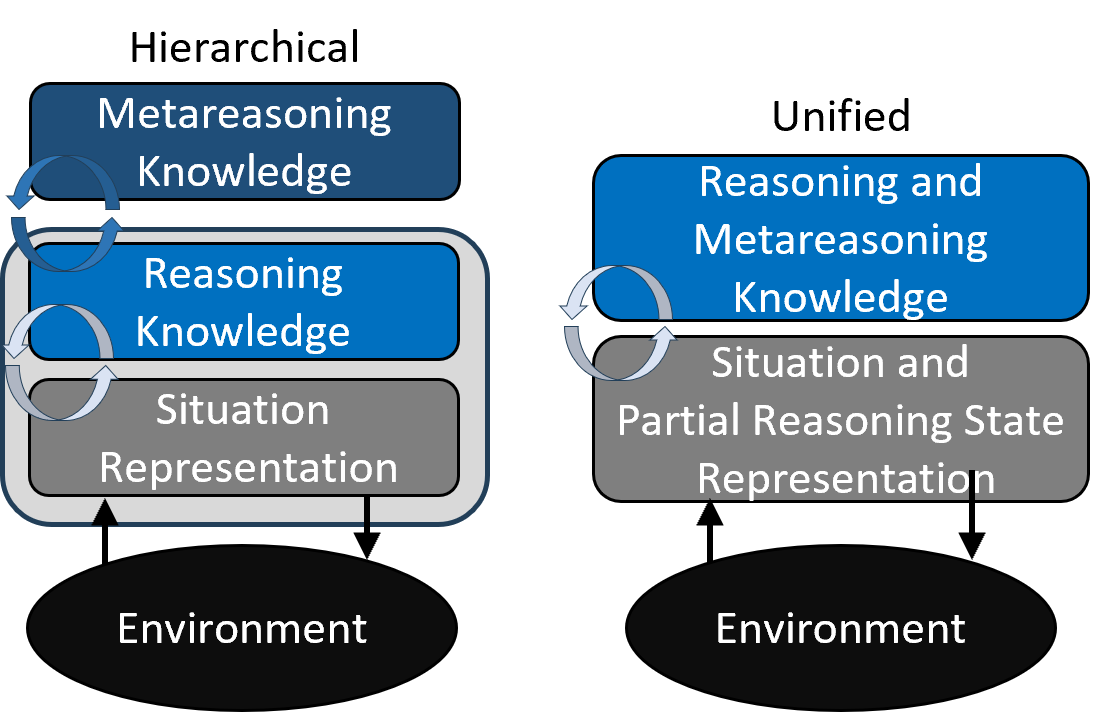
The image presents a comparative diagram illustrating two different architectures for reasoning systems: Hierarchical and Unified. Each architecture depicts the flow of information and the relationship between different components, including knowledge representation, reasoning processes, and interaction with the environment.
### Components/Axes
**Hierarchical Architecture (Left Side):**
* **Title:** Hierarchical
* **Top Layer:** "Metareasoning Knowledge" (Blue rectangle)
* **Middle Layer:** "Reasoning Knowledge" (Blue rectangle)
* **Bottom Layer:** "Situation Representation" (Gray rectangle)
* **Environment:** "Environment" (Black oval at the bottom)
* **Flow:**
* A circular arrow indicates feedback from "Reasoning Knowledge" to "Metareasoning Knowledge".
* A circular arrow indicates feedback from "Situation Representation" to "Reasoning Knowledge".
* Downward arrows indicate information flow from "Situation Representation" to "Environment".
**Unified Architecture (Right Side):**
* **Title:** Unified
* **Top Layer:** "Reasoning and Metareasoning Knowledge" (Blue rectangle)
* **Bottom Layer:** "Situation and Partial Reasoning State Representation" (Gray rectangle)
* **Environment:** "Environment" (Black oval at the bottom)
* **Flow:**
* A circular arrow indicates feedback from "Situation and Partial Reasoning State Representation" to "Reasoning and Metareasoning Knowledge".
* Downward arrows indicate information flow from "Situation and Partial Reasoning State Representation" to "Environment".
### Detailed Analysis
**Hierarchical Architecture:**
* The architecture is structured in a layered manner, with "Metareasoning Knowledge" at the top, followed by "Reasoning Knowledge," and then "Situation Representation."
* Feedback loops exist between the top two layers and the middle and bottom layers, suggesting iterative refinement or adjustment of reasoning processes.
* The "Environment" receives information from the "Situation Representation."
**Unified Architecture:**
* The "Reasoning and Metareasoning Knowledge" are combined into a single layer.
* The "Situation and Partial Reasoning State Representation" are combined into a single layer.
* A single feedback loop exists between the two layers.
* The "Environment" receives information from the "Situation and Partial Reasoning State Representation."
### Key Observations
* The key difference between the two architectures lies in the organization and separation of knowledge and reasoning processes.
* The Hierarchical architecture emphasizes a clear distinction between metareasoning and reasoning, while the Unified architecture integrates them.
* The feedback loops in both architectures suggest an iterative or adaptive reasoning process.
### Interpretation
The diagram illustrates two contrasting approaches to designing reasoning systems. The Hierarchical architecture allows for a more modular and potentially more explainable system, where metareasoning can explicitly influence the reasoning process. The Unified architecture, on the other hand, may offer a more efficient and streamlined approach by integrating different aspects of reasoning into a single layer. The choice between these architectures depends on the specific requirements and constraints of the application. The presence of feedback loops in both architectures highlights the importance of iterative refinement and adaptation in reasoning systems.