## Diagram: Comparison of Hierarchical vs. Unified Architectures
### Overview
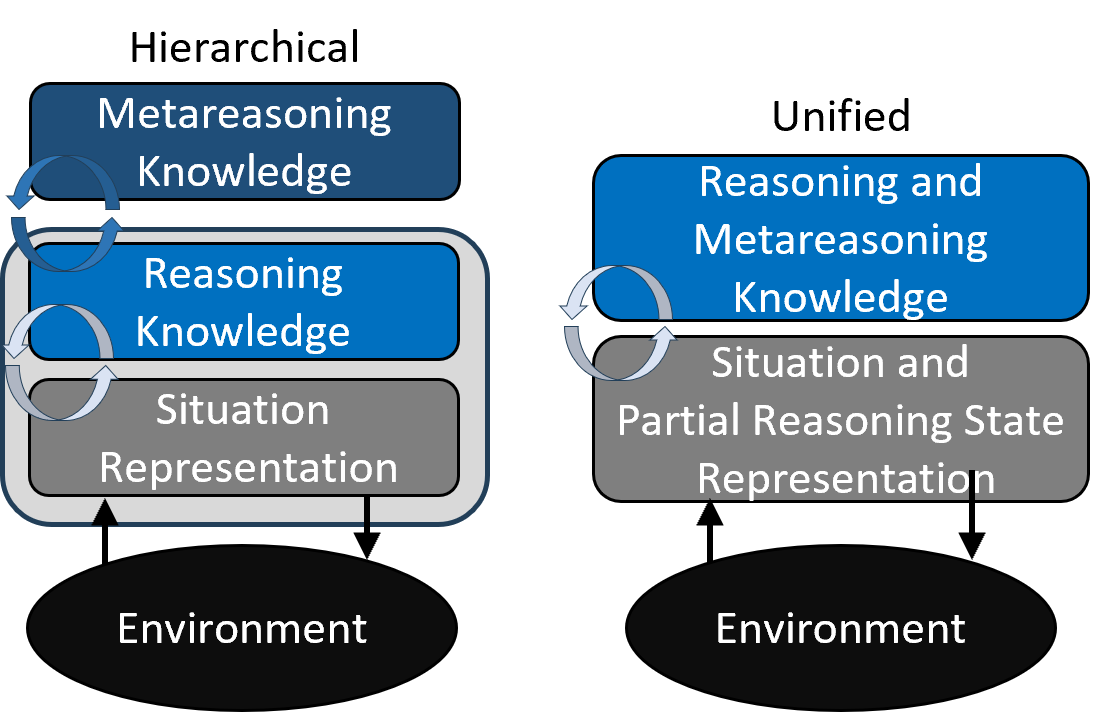
The image displays two architectural diagrams side-by-side, labeled "Hierarchical" and "Unified." These diagrams illustrate the structural organization of cognitive or AI system components—specifically how knowledge, reasoning, and situational awareness interact with an environment. The diagrams contrast a multi-layered, modular approach (Hierarchical) with a consolidated, integrated approach (Unified).
### Components/Axes
**Left Diagram: Hierarchical**
* **Top Box (Dark Blue):** "Metareasoning Knowledge"
* **Middle Box (Medium Blue):** "Reasoning Knowledge"
* **Bottom Box (Grey):** "Situation Representation"
* **Container:** A light-grey rounded rectangle encloses both the "Reasoning Knowledge" and "Situation Representation" boxes.
* **Base (Black Oval):** "Environment"
* **Flow Indicators:**
* Circular arrow between "Metareasoning Knowledge" and "Reasoning Knowledge."
* Circular arrow between "Reasoning Knowledge" and "Situation Representation."
* Vertical arrows connecting "Environment" to the "Situation Representation" box (Upward arrow for input, Downward arrow for output).
**Right Diagram: Unified**
* **Top Box (Medium Blue):** "Reasoning and Metareasoning Knowledge"
* **Bottom Box (Grey):** "Situation and Partial Reasoning State Representation"
* **Base (Black Oval):** "Environment"
* **Flow Indicators:**
* Circular arrow between the Top Box and Bottom Box.
* Vertical arrows connecting "Environment" to the bottom box (Upward arrow for input, Downward arrow for output).
### Detailed Analysis
**Hierarchical Model (Left):**
* **Structure:** This model is stratified into three distinct functional layers.
* **Flow:** The system implies a top-down or supervisory relationship. The "Metareasoning Knowledge" acts as a distinct layer above the "Reasoning Knowledge." The grouping of the lower two layers suggests that "Reasoning" and "Situation Representation" operate within a specific operational boundary, distinct from the "Metareasoning" layer.
* **Interaction:** The circular arrows indicate bidirectional feedback loops between adjacent layers. The environment interacts exclusively with the lowest layer ("Situation Representation").
**Unified Model (Right):**
* **Structure:** This model is condensed into two functional layers.
* **Flow:** The system implies an integrated approach. "Reasoning" and "Metareasoning" are combined into a single block, suggesting that the distinction between the two is either removed or handled internally within that block.
* **Interaction:** The "Situation Representation" is expanded to include "Partial Reasoning State," suggesting that the representation layer now carries more information (the state of the reasoning process itself) than in the Hierarchical model. The environment interacts with this combined representation layer.
### Key Observations
* **Consolidation:** The Unified model reduces the architectural complexity by collapsing three layers into two.
* **Boundary Shift:** In the Hierarchical model, there is a clear visual boundary (the light-grey container) separating the "Metareasoning" layer from the rest of the system. This boundary is absent in the Unified model.
* **Information Density:** The Unified model shifts the "Partial Reasoning State" from the reasoning layer down into the representation layer, suggesting a tighter coupling between the state of the reasoning process and the representation of the environment.
### Interpretation
The data suggests a fundamental trade-off between **modularity** and **integration**:
* **Hierarchical (Modular):** This architecture likely prioritizes separation of concerns. By isolating "Metareasoning," the system can theoretically perform high-level oversight or self-correction without being bogged down by the immediate "Reasoning" or "Situation" processing. It implies a "Controller-Worker" relationship where the controller (Metareasoning) is distinct from the operational layers.
* **Unified (Integrated):** This architecture likely prioritizes efficiency and reduced latency. By merging "Reasoning" and "Metareasoning," the system may avoid the overhead of inter-layer communication. Furthermore, by including "Partial Reasoning State" in the "Situation Representation," the system likely aims to create a more holistic "world model" that includes the system's own internal state, potentially allowing for faster, more reactive decision-making.
In essence, the Hierarchical model represents a system designed for structured, deliberate control, while the Unified model represents a system designed for fluid, integrated, and potentially more reactive performance.