\n
## Diagram: Comparison of Hierarchical vs. Unified Reasoning Architectures
### Overview
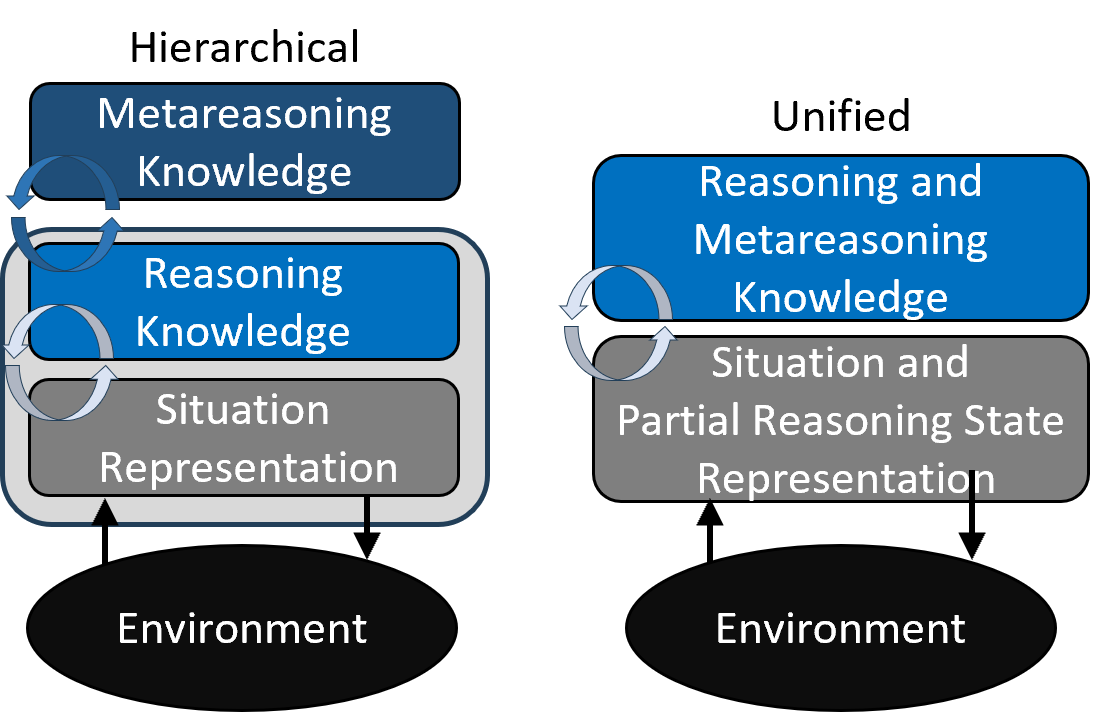
The image presents a comparative diagram illustrating two reasoning architectures: a Hierarchical approach and a Unified approach. Both architectures depict a flow of information originating from the "Environment" and progressing through layers of knowledge representation and reasoning. The diagram uses rectangular blocks to represent knowledge layers and circular arrows to indicate information flow.
### Components/Axes
The diagram consists of two main sections, positioned side-by-side. Each section represents a different architecture. The components within each architecture are:
* **Environment:** Represented by a black oval at the bottom of each section.
* **Situation Representation:** A light blue rectangle above the "Environment". In the Unified architecture, this is labeled "Situation and Partial Reasoning State Representation".
* **Reasoning Knowledge:** A dark blue rectangle above the "Situation Representation". In the Unified architecture, this is combined with the Metareasoning Knowledge layer.
* **Metareasoning Knowledge:** A dark grey rectangle at the top of the Hierarchical architecture.
* **Reasoning and Metareasoning Knowledge:** A single dark blue rectangle at the top of the Unified architecture.
* **Arrows:** Light blue circular arrows indicate the flow of information between the layers.
### Detailed Analysis or Content Details
**Hierarchical Architecture (Left Side):**
* The "Environment" feeds information to the "Situation Representation".
* The "Situation Representation" feeds information to the "Reasoning Knowledge".
* The "Reasoning Knowledge" feeds information to the "Metareasoning Knowledge".
* The "Metareasoning Knowledge" feeds back to both the "Reasoning Knowledge" and the "Situation Representation", creating a looped flow.
**Unified Architecture (Right Side):**
* The "Environment" feeds information to the "Situation and Partial Reasoning State Representation".
* The "Situation and Partial Reasoning State Representation" feeds information to the "Reasoning and Metareasoning Knowledge".
* The "Reasoning and Metareasoning Knowledge" feeds back to the "Situation and Partial Reasoning State Representation", creating a looped flow.
### Key Observations
The key difference between the two architectures is the separation of reasoning and metareasoning in the Hierarchical approach versus their unification in the Unified approach. The Hierarchical architecture has a more layered and potentially complex flow of information, with feedback loops at multiple levels. The Unified architecture appears more streamlined, with a single layer handling both reasoning and metareasoning.
### Interpretation
The diagram illustrates a conceptual comparison of two different approaches to building intelligent systems. The Hierarchical architecture suggests a more modular design, where different types of reasoning are handled by separate components. This could offer greater flexibility and control, but also potentially introduce complexity and communication overhead. The Unified architecture suggests a more integrated approach, where reasoning and metareasoning are handled by a single component. This could lead to a more efficient and coherent system, but might also be less flexible and harder to debug. The diagram highlights a trade-off between modularity and integration in the design of reasoning systems. The looped arrows indicate a dynamic and iterative process, where reasoning is constantly refined based on feedback from the environment and higher-level reasoning processes. The diagram does not provide quantitative data, but rather a qualitative comparison of architectural principles.