## Diagram: Hierarchical vs. Unified Knowledge Processing Models
### Overview
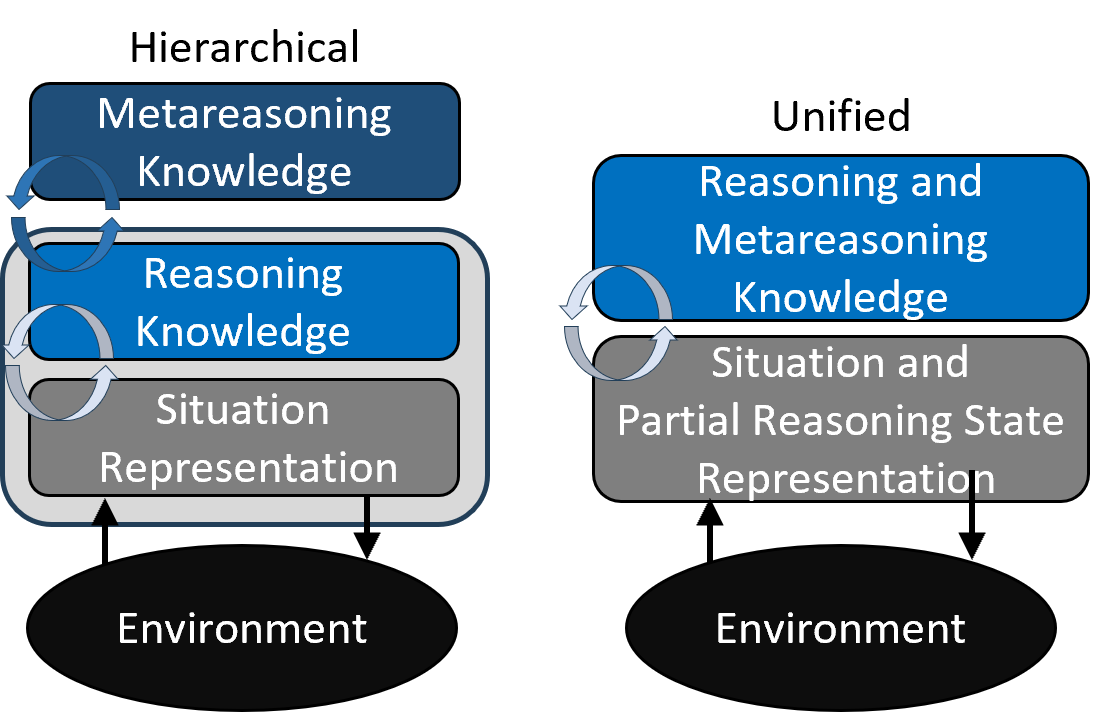
The image compares two knowledge processing architectures: **Hierarchical** (left) and **Unified** (right). Both models depict layered systems interacting with an **Environment**, with bidirectional feedback loops and unidirectional downward arrows indicating information flow.
### Components/Axes
- **Hierarchical Model (Left)**:
- **Top Layer**: *Metareasoning Knowledge* (dark blue rectangle, bidirectional arrows).
- **Middle Layer**: *Reasoning Knowledge* (medium blue rectangle, bidirectional arrows).
- **Bottom Layer**: *Situation Representation* (gray rectangle, bidirectional arrows).
- **Environment**: Black oval at the base, connected by unidirectional arrows from all three layers.
- **Unified Model (Right)**:
- **Top Layer**: *Reasoning and Metareasoning Knowledge* (blue rectangle, bidirectional arrows).
- **Bottom Layer**: *Situation and Partial Reasoning State Representation* (gray rectangle, bidirectional arrows).
- **Environment**: Black oval at the base, connected by unidirectional arrows from both layers.
- **Legend**:
- Dark blue: *Metareasoning Knowledge* (Hierarchical).
- Medium blue: *Reasoning Knowledge* (Hierarchical).
- Gray: *Situation Representation* (Hierarchical) and *Situation and Partial Reasoning State Representation* (Unified).
- Black: *Environment* (shared).
### Detailed Analysis
- **Hierarchical Model**:
- Three distinct layers with isolated bidirectional feedback loops.
- *Metareasoning Knowledge* (dark blue) sits above *Reasoning Knowledge* (medium blue), which sits above *Situation Representation* (gray).
- Unidirectional arrows from all layers point downward to the *Environment*.
- **Unified Model**:
- Two layers merged into a single system:
- *Reasoning and Metareasoning Knowledge* (blue) combines the top two layers of the Hierarchical model.
- *Situation and Partial Reasoning State Representation* (gray) merges the bottom layer with additional reasoning state data.
- Bidirectional arrows within layers and unidirectional arrows to the *Environment*.
### Key Observations
1. **Integration vs. Segregation**:
- The Hierarchical model separates knowledge into discrete layers, while the Unified model integrates *Reasoning* and *Metareasoning* into a single layer.
- The Unified model also combines *Situation Representation* with *Partial Reasoning State Representation*, suggesting a more holistic approach.
2. **Environment Interaction**:
- Both models share a unidirectional connection to the *Environment*, implying that processed knowledge is applied externally but not directly influenced by environmental feedback in this representation.
3. **Feedback Loops**:
- Bidirectional arrows within layers indicate internal refinement of knowledge (e.g., *Metareasoning Knowledge* refining itself).
### Interpretation
- The **Hierarchical Model** emphasizes modularity, with specialized layers for metareasoning, reasoning, and situational awareness. This could reflect systems where knowledge is processed in stages (e.g., high-level strategy → tactical reasoning → environmental perception).
- The **Unified Model** suggests a flattened architecture where reasoning and metareasoning are co-located, potentially enabling faster or more adaptive decision-making by reducing layering overhead.
- The shared *Environment* connection implies both models prioritize applying processed knowledge to external contexts, but the Unified model’s merged layers might better handle dynamic or overlapping tasks.
- The absence of environmental feedback loops raises questions about how these models handle real-time adaptation, as the Environment’s influence appears one-way.
This diagram highlights trade-offs between hierarchical specialization and unified integration in knowledge processing systems.