## Chart: Proportion of Flips vs. Iterations for Qwen2.5-3B
### Overview
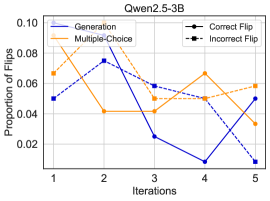
The image is a line chart comparing the proportion of flips (correct and incorrect) across iterations for two methods: Generation and Multiple-Choice, using the Qwen2.5-3B model. The x-axis represents iterations (1 to 5), and the y-axis represents the proportion of flips (0.00 to 0.10).
### Components/Axes
* **Title:** Qwen2.5-3B
* **X-axis:** Iterations (labeled 1, 2, 3, 4, 5)
* **Y-axis:** Proportion of Flips (labeled 0.02, 0.04, 0.06, 0.08, 0.10)
* **Legend:** Located at the top-left and top-right of the chart.
* **Generation:** Solid blue line
* **Multiple-Choice:** Solid orange line
* **Correct Flip:** Solid black line with circle markers
* **Incorrect Flip:** Dashed black line with square markers
### Detailed Analysis
* **Generation:**
* Trend: Generally decreasing over iterations.
* Data Points:
* Iteration 1: ~0.05
* Iteration 2: ~0.075
* Iteration 3: ~0.025
* Iteration 4: ~0.01
* Iteration 5: ~0.008
* **Multiple-Choice:**
* Trend: Fluctuating, with peaks at iterations 1 and 4.
* Data Points:
* Iteration 1: ~0.09
* Iteration 2: ~0.042
* Iteration 3: ~0.042
* Iteration 4: ~0.067
* Iteration 5: ~0.03
* **Correct Flip:**
* Trend: Fluctuating, with a peak at iteration 1.
* Data Points:
* Iteration 1: ~0.07
* Iteration 2: ~0.04
* Iteration 3: ~0.05
* Iteration 4: ~0.05
* Iteration 5: ~0.06
* **Incorrect Flip:**
* Trend: Fluctuating, with a peak at iteration 2.
* Data Points:
* Iteration 1: ~0.05
* Iteration 2: ~0.08
* Iteration 3: ~0.06
* Iteration 4: ~0.05
* Iteration 5: ~0.05
### Key Observations
* The "Generation" method shows a decreasing trend in the proportion of flips as iterations increase.
* The "Multiple-Choice" method fluctuates more, with no clear trend.
* The proportion of "Correct Flips" and "Incorrect Flips" are relatively close to each other across all iterations.
### Interpretation
The chart suggests that the "Generation" method becomes more stable and potentially more accurate (fewer flips) as the model iterates. The "Multiple-Choice" method, however, does not show a similar improvement and remains more variable. The proximity of "Correct Flip" and "Incorrect Flip" proportions indicates that the model is making both types of adjustments throughout the iterations, with no clear dominance of one over the other. The data implies that the "Generation" method might be a more effective approach for this particular task with the Qwen2.5-3B model, as it demonstrates a tendency to converge towards a more stable state.