\n
## Stacked Bar Chart: Performance by Hazard Category
### Overview
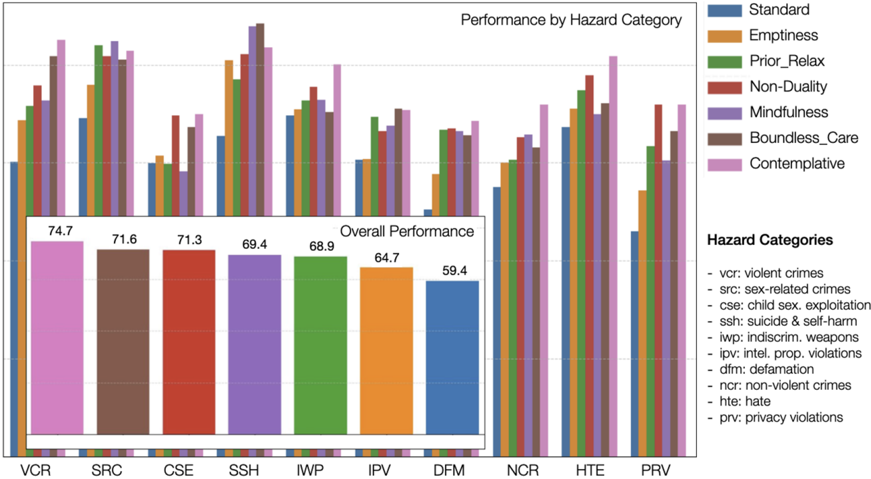
This is a stacked bar chart visualizing the performance across different hazard categories, broken down by various mental states (Standard, Emptiness, Prior_Relax, Non-Duality, Mindfulness, Boundless_Care, and Contemplative). The chart displays the overall performance for each hazard category as well as the contribution of each mental state to that performance.
### Components/Axes
* **X-axis:** Hazard Categories - VCR, SRC, CSE, SSH, IWP, IPV, DFM, NCR, HTE, PRV.
* **Y-axis:** Overall Performance (percentage, ranging from approximately 59 to 75).
* **Legend (Top-Right):**
* Standard (Grey)
* Emptiness (Light Green)
* Prior\_Relax (Light Blue)
* Non-Duality (Red)
* Mindfulness (Purple)
* Boundless\_Care (Dark Green)
* Contemplative (Orange)
* **Title:** "Performance by Hazard Category"
* **Hazard Categories Definition (Bottom-Right):**
* vcr: violent crimes
* src: sex-related crimes
* cse: child sex exploitation
* ssh: suicide & self-harm
* iwp: indiscrim. weapons
* ipv: intel. prop. violations
* dfm: defamation
* ncr: non-violent crimes
* hte: hate
* prv: privacy violations
### Detailed Analysis
The chart consists of 10 stacked bars, one for each hazard category. The height of each stack represents the overall performance percentage. Each segment within a stack represents the contribution of a specific mental state to the overall performance.
Here's a breakdown of the performance for each hazard category, with approximate values based on visual estimation:
* **VCR (Violent Crimes):** Overall Performance: 74.7%. Standard contributes approximately 40%, Mindfulness around 15%, Contemplative around 10%, and the remaining states contribute smaller percentages.
* **SRC (Sex-related Crimes):** Overall Performance: 71.6%. Standard contributes approximately 45%, Mindfulness around 10%, and Prior\_Relax around 8%.
* **CSE (Child Sex Exploitation):** Overall Performance: 71.3%. Standard contributes approximately 40%, Mindfulness around 15%, and Contemplative around 10%.
* **SSH (Suicide & Self-Harm):** Overall Performance: 69.4%. Standard contributes approximately 35%, Mindfulness around 15%, and Prior\_Relax around 10%.
* **IWP (Indiscriminate Weapons):** Overall Performance: 68.9%. Standard contributes approximately 40%, Mindfulness around 10%, and Prior\_Relax around 8%.
* **IPV (Intellectual Property Violations):** Overall Performance: 64.7%. Standard contributes approximately 35%, Prior\_Relax around 10%, and Mindfulness around 8%.
* **DFM (Defamation):** Overall Performance: 59.4%. Standard contributes approximately 30%, Prior\_Relax around 10%, and the other states contribute smaller percentages.
* **NCR (Non-Violent Crimes):** Overall Performance: Approximately 65%. Standard contributes approximately 35%, Prior\_Relax around 10%, and Mindfulness around 8%.
* **HTE (Hate):** Overall Performance: Approximately 73%. Standard contributes approximately 45%, Mindfulness around 10%, and Contemplative around 8%.
* **PRV (Privacy Violations):** Overall Performance: Approximately 68%. Standard contributes approximately 40%, Mindfulness around 10%, and Prior\_Relax around 8%.
The "Standard" mental state consistently contributes the largest portion to the overall performance across all hazard categories. "Mindfulness" and "Contemplative" states also contribute significantly, though to a lesser extent. "Emptiness", "Non-Duality", and "Boundless\_Care" generally have the smallest contributions.
### Key Observations
* The overall performance is lowest for "DFM" (Defamation) at approximately 59.4%.
* "VCR" (Violent Crimes) has the highest overall performance at 74.7%.
* The "Standard" mental state consistently dominates the performance across all categories.
* There's a noticeable variation in the contribution of different mental states across different hazard categories. For example, "Mindfulness" seems to contribute more to "VCR" and "CSE" than to "DFM".
### Interpretation
The chart suggests that the "Standard" mental state is the most effective for addressing all types of hazards represented. However, incorporating other mental states like "Mindfulness" and "Contemplative" can further enhance performance, particularly in specific hazard categories like violent crimes and child sex exploitation. The lower performance in "Defamation" suggests that current strategies may be less effective in addressing this type of hazard, and exploring different mental state combinations might be beneficial.
The variation in mental state contributions across hazard categories indicates that different types of hazards may require different cognitive approaches. This could be due to the specific cognitive demands of each hazard, or the emotional responses they evoke. The chart provides a valuable starting point for optimizing strategies for hazard mitigation by tailoring mental state interventions to specific hazard types. The data suggests a nuanced relationship between mental state and performance, rather than a one-size-fits-all approach.