## Screenshot: Prompt for Scoring Error Reasons
### Overview
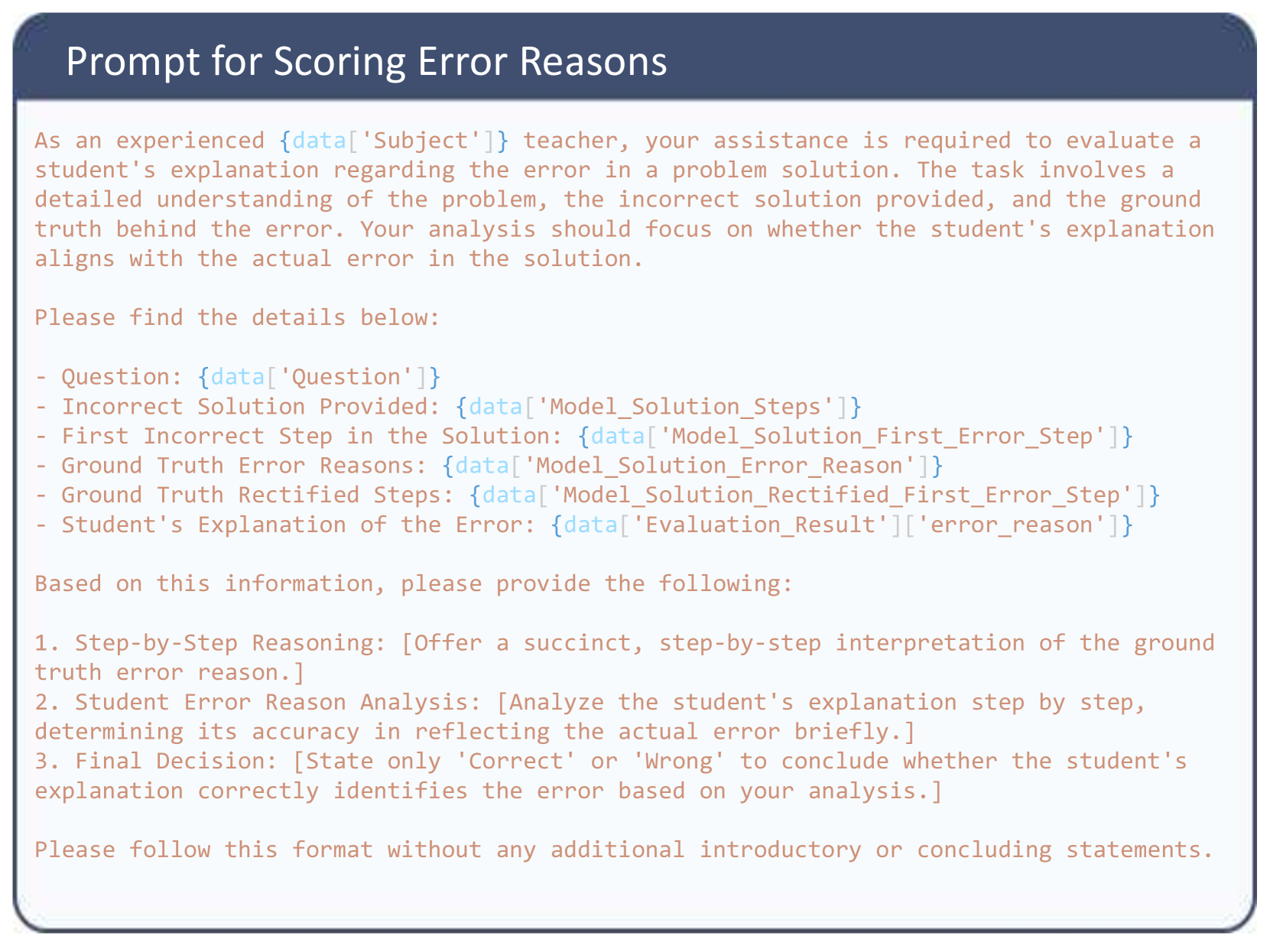
The image displays a structured prompt template designed for evaluating a student's explanation of an error in a problem solution. The prompt is formatted with placeholders (e.g., `{data['Subject']}`) and instructions for an experienced teacher to assess alignment between the student's reasoning and ground truth data.
### Components/Axes
- **Header**: Dark blue banner with white text reading "Prompt for Scoring Error Reasons."
- **Main Text**: Light gray background with brown text containing:
- Instructions for evaluating a student's explanation.
- Placeholders for dynamic data (e.g., `{data['Question']}`, `{data['Model_Solution_Steps']}`).
- Three numbered tasks with specific output requirements.
- **Placeholders**: Blue text within curly braces (e.g., `{data['Subject']}`) indicating variables to be replaced with actual data.
### Detailed Analysis
1. **Title**: "Prompt for Scoring Error Reasons" (top-center, dark blue header).
2. **Main Content**:
- **Instructions**:
- Evaluate a student's explanation of an error in a problem solution.
- Focus on alignment between the student's reasoning and ground truth data.
- **Data Structure**:
- **Question**: `{data['Question']}`
- **Incorrect Solution Provided**: `{data['Model_Solution_Steps']}`
- **First Incorrect Step**: `{data['Model_Solution_First_Error_Step']}`
- **Ground Truth Error Reasons**: `{data['Model_Solution_Error_Reason']}`
- **Rectified Steps**: `{data['Model_Solution_Rectified_First_Error_Step']}`
- **Student's Explanation**: `{data['Evaluation_Result']['error_reason']}`
- **Tasks**:
1. **Step-by-Step Reasoning**: Succinct interpretation of the ground truth error.
2. **Student Error Reason Analysis**: Analyze the student's explanation step-by-step.
3. **Final Decision**: Output only "Correct" or "Wrong" based on analysis.
### Key Observations
- The prompt uses placeholders to dynamically inject data (e.g., questions, solutions, errors).
- Tasks are explicitly structured to guide evaluators through a systematic analysis.
- Placeholders are color-coded (blue) to distinguish variables from static text.
### Interpretation
This prompt serves as a template for automated or manual evaluation of student error explanations. It ensures consistency by requiring evaluators to:
1. Compare the student's reasoning to ground truth data.
2. Identify discrepancies in the student's explanation.
3. Determine whether the student's analysis accurately reflects the actual error.
The use of placeholders suggests integration with a system that dynamically populates data (e.g., from a database or API). The final decision ("Correct"/"Wrong") implies a binary scoring mechanism, likely for grading or feedback purposes. The structured tasks emphasize critical thinking and alignment with objective criteria, reducing subjectivity in evaluation.