## Diagram: Neural Network Training Strategies
### Overview
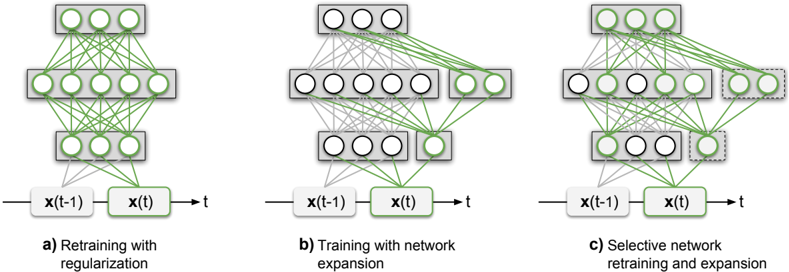
The image presents three diagrams illustrating different strategies for training neural networks: retraining with regularization, training with network expansion, and selective network retraining and expansion. Each diagram depicts a neural network architecture with input layers, hidden layers, and connections between neurons, highlighting the changes and adaptations made during each training strategy.
### Components/Axes
* **Neural Network Architecture:** Each diagram shows a neural network with multiple layers of neurons. The layers are represented as rectangular blocks containing circles, which represent individual neurons.
* **Connections:** Lines connecting the neurons in different layers represent the connections between them. Green lines indicate active or strengthened connections, while gray lines indicate inactive or weakened connections.
* **Input Layer:** The input layer is labeled as "x(t-1)" and "x(t)", representing the input at time t-1 and time t, respectively.
* **Time Axis:** A horizontal line labeled "t" represents the time axis, indicating the progression of training.
* **Subtitles:** Each diagram has a subtitle describing the training strategy:
* a) Retraining with regularization
* b) Training with network expansion
* c) Selective network retraining and expansion
### Detailed Analysis
**a) Retraining with regularization:**
* **Network Structure:** The network consists of three hidden layers, each containing five neurons.
* **Connections:** All neurons in adjacent layers are connected. The connections from x(t-1) are gray, while the connections from x(t) are green, indicating that the network is being retrained using the input at time t.
* **Regularization:** The term "regularization" in the subtitle suggests that a regularization technique is applied during retraining to prevent overfitting.
**b) Training with network expansion:**
* **Network Structure:** The network initially has two hidden layers. The first layer contains five neurons, and the second layer contains three neurons.
* **Expansion:** The network is expanded by adding two neurons to the second hidden layer.
* **Connections:** Connections from x(t-1) are gray, while connections from x(t) are green. The connections to the newly added neurons are also green, indicating that these neurons are being trained.
**c) Selective network retraining and expansion:**
* **Network Structure:** The network has two hidden layers. The first layer contains five neurons, and the second layer contains two neurons.
* **Expansion:** The network is expanded by adding a neuron to each hidden layer. The added neurons are indicated by dashed lines.
* **Connections:** Connections from x(t-1) are gray, while connections from x(t) are green. The connections to the newly added neurons are also green, indicating that these neurons are being trained.
### Key Observations
* The diagrams illustrate different approaches to adapting neural networks during training.
* Retraining with regularization focuses on adjusting the weights of existing connections.
* Training with network expansion involves adding new neurons to the network.
* Selective network retraining and expansion combines both approaches by selectively retraining existing neurons and adding new neurons.
### Interpretation
The diagrams demonstrate different strategies for adapting neural networks to new data or changing conditions. Retraining with regularization is a common technique for preventing overfitting and improving generalization performance. Training with network expansion allows the network to learn more complex patterns by increasing its capacity. Selective network retraining and expansion offers a flexible approach that combines the benefits of both techniques. The choice of training strategy depends on the specific application and the characteristics of the data.