## Diagram: One Model vs. Many Models
### Overview
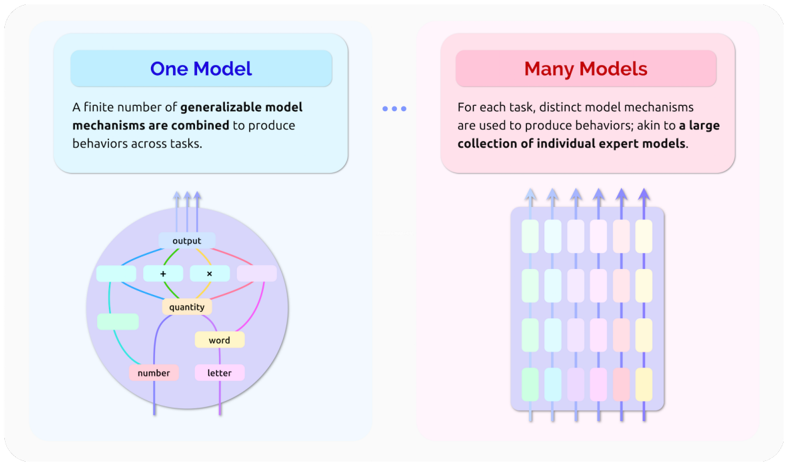
The image presents a conceptual diagram comparing a "One Model" approach to a "Many Models" approach in the context of machine learning or AI. The diagram uses visual representations to illustrate how each approach processes information and generates outputs.
### Components/Axes
* **Titles:**
* Left: "One Model" (contained in a light blue rounded rectangle)
* Right: "Many Models" (contained in a light red rounded rectangle)
* **Text Descriptions:**
* Under "One Model": "A finite number of generalizable model mechanisms are combined to produce behaviors across tasks."
* Under "Many Models": "For each task, distinct model mechanisms are used to produce behaviors; akin to a large collection of individual expert models."
* **Diagrams:**
* "One Model": A circular diagram containing several rounded rectangles representing different components or processes. These components are connected by colored lines with arrows, indicating the flow of information. The components are labeled as: "output", "+", "x", "quantity", "word", "number", "letter".
* "Many Models": A grid of rounded rectangles, each representing a distinct model. The rectangles are colored in various pastel shades. Arrows indicate input and output.
* **Connectors:** Three dots connect the "One Model" and "Many Models" sections.
### Detailed Analysis
**"One Model" Diagram:**
* **Central Circle:** A light purple circle encompasses the components and connections.
* **Components (Rounded Rectangles):**
* "output" (light blue): Located at the top of the circle.
* "+" (light blue): Located to the left of "output".
* "x" (light blue): Located to the right of "output".
* "quantity" (light yellow): Located below "+" and "x".
* "word" (light yellow): Located to the right of "quantity".
* "number" (light pink): Located below "quantity".
* "letter" (light pink): Located to the right of "number".
* Two unlabeled light green rounded rectangles are present on the left side of the diagram.
* **Connections (Colored Lines):**
* "number" to "quantity": Purple line.
* "letter" to "word": Purple line.
* "quantity" to "+": Yellow line.
* "word" to "x": Yellow line.
* "+" to "output": Green line.
* "x" to "output": Green line.
* Unlabeled component to "quantity": Green line.
* Unlabeled component to "+": Blue line.
* "quantity" to "x": Pink line.
* "number" to unlabeled component: Blue line.
* "letter" to unlabeled component: Green line.
* **Input/Output Arrows:** Three blue arrows point upwards from the top of the circle, representing the output.
**"Many Models" Diagram:**
* **Grid Structure:** A 4x6 grid of rounded rectangles.
* **Model Representation:** Each rectangle represents an individual model.
* **Color Variation:** The rectangles are colored in various pastel shades (light blue, light green, light yellow, light pink, etc.).
* **Input/Output Arrows:** Four blue arrows point upwards from the top of the grid, representing the output.
### Key Observations
* The "One Model" approach combines different mechanisms within a single model to handle various tasks.
* The "Many Models" approach uses distinct models for each task, creating a collection of specialized experts.
* The diagrams visually represent the flow of information and the relationships between components in each approach.
### Interpretation
The image illustrates two contrasting approaches to building AI systems. The "One Model" approach emphasizes generalization and efficiency by combining multiple mechanisms into a single model. This model can handle a variety of tasks by leveraging shared knowledge and resources. The "Many Models" approach, on the other hand, prioritizes specialization and performance by using distinct models for each task. This approach allows for fine-tuning and optimization of each model for its specific domain.
The choice between these approaches depends on the specific requirements of the application. The "One Model" approach may be suitable for tasks that require broad knowledge and adaptability, while the "Many Models" approach may be preferred for tasks that demand high accuracy and efficiency in a specific area.