## Diagram: Binary Value Reinterpretation with Sign Transformation
### Overview
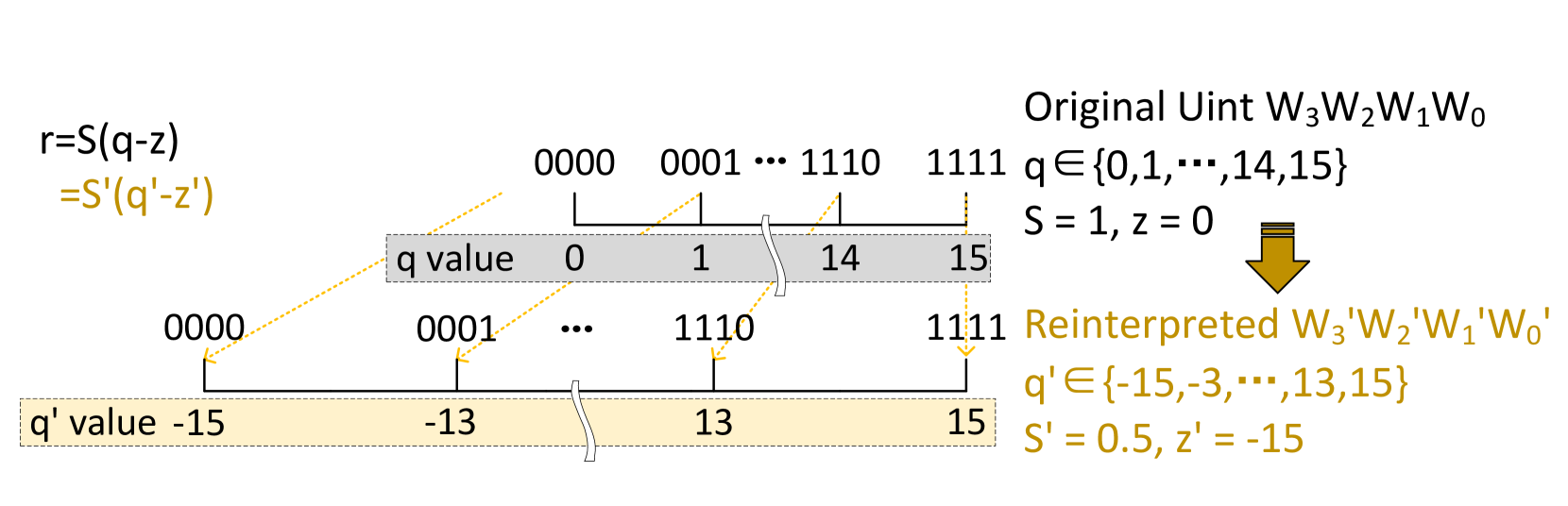
The diagram illustrates a binary-to-decimal reinterpretation process involving sign manipulation and offset transformation. It shows two parallel number lines: one representing original unsigned 4-bit binary values (0-15) and another showing reinterpreted values with negative ranges (-15 to 15). Mathematical equations and arrows demonstrate the transformation logic.
### Components/Axes
1. **Original Uint Section**:
- Binary values: 0000 (0) to 1111 (15)
- Decimal range: 0-15
- Labels: "Original Uint W3W2W1W0", "q ∈ {0,1,...,14,15}"
2. **Reinterpreted Section**:
- Binary values: 0000 (-15) to 1111 (15)
- Decimal range: -15 to 15
- Labels: "Reinterpreted W3'W2'W1'W0'", "q' ∈ {-15,-3,...,13,15}"
3. **Transformation Equations**:
- r = S(q - z)
- S' = 0.5, z' = -15
- S = 1, z = 0
4. **Legend**:
- Original Uint: Gray color
- Reinterpreted: Yellow color
- Arrows: Dashed lines connecting original to reinterpreted values
### Detailed Analysis
1. **Binary Mapping**:
- Original: 0000 (0) → 1111 (15)
- Reinterpreted: 0000 (-15) → 1111 (15)
- Midpoint shift: Original 7.5 → Reinterpreted -7.5
2. **Transformation Logic**:
- Original values (q) are transformed using r = S(q - z)
- When S=1 and z=0, r = q (identity transformation)
- Reinterpreted values use S'=0.5 and z'=-15, creating a scaled and offset version
3. **Key Arrows**:
- 0000 (0) → -15 (q'=-15)
- 1111 (15) → 15 (q'=15)
- 0111 (7) → 13 (q'=13)
- 1000 (8) → -3 (q'=-3)
### Key Observations
1. **Range Expansion**: Reinterpreted values span -15 to 15 vs original 0-15
2. **Midpoint Shift**: Original midpoint (7.5) becomes -7.5 in reinterpreted
3. **Non-linear Mapping**: Values like 7→13 and 8→-3 show non-linear transformation
4. **Sign Bit Manipulation**: The reinterpretation appears to use the MSB (W3) as a sign bit
### Interpretation
This diagram demonstrates a binary reinterpretation technique that:
1. **Expands Value Range**: By redefining the sign bit (W3), the system can represent both positive and negative values
2. **Applies Offset Transformation**: The z'=-15 offset suggests a two's complement-like system but with different scaling
3. **Uses Fractional Scaling**: S'=0.5 indicates a halving of the original value range
4. **Maintains Symmetry**: The reinterpreted range (-15 to 15) is symmetric around zero, unlike the original (0-15)
The transformation appears to be a custom encoding scheme that allows representation of both positive and negative values while maintaining some relationship to the original unsigned values. The specific choice of S'=0.5 and z'=-15 suggests a deliberate design choice to balance positive/negative representation while preserving certain arithmetic properties.