## Diagram: Multi-Agent System Architecture with Self-Evolution Module
### Overview
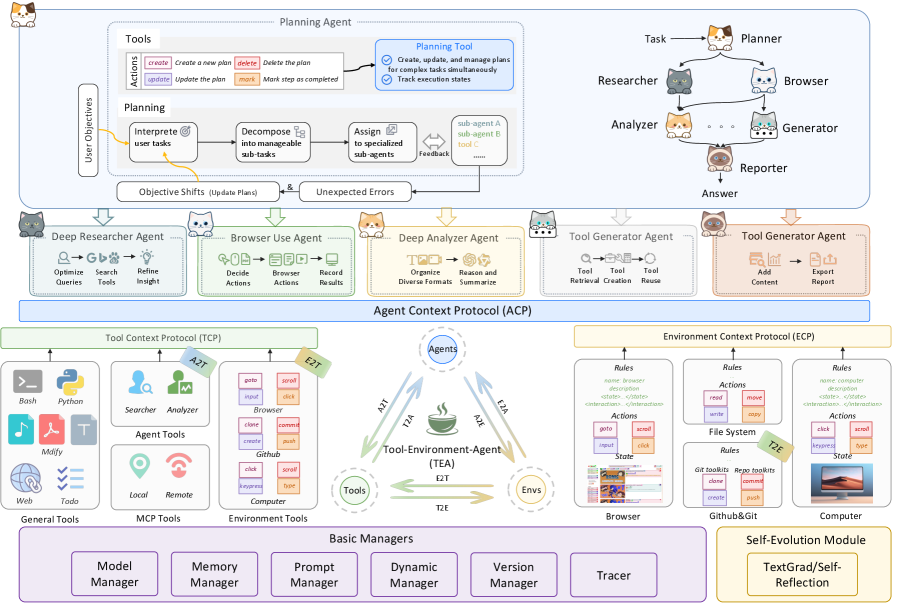
The diagram illustrates a complex multi-agent system architecture designed for task planning, execution, and self-improvement. It features hierarchical agents, modular protocols, and feedback loops for error handling and adaptability. Key components include planning agents, specialized sub-agents, context protocols, and a self-evolution module.
### Components/Axes
1. **Top Section: Planning Agent**
- **Tools**: Create, Delete, Update, Mark steps
- **Actions**: Interpret user tasks → Decompose into sub-tasks → Assign to specialized sub-agents
- **Sub-Agents**: Deep Researcher, Browser Use, Deep Analyzer, Tool Generator
- **Flow**: User Objectives → Planning → Sub-agent execution → Feedback/Errors
2. **Middle Section: Context Protocols**
- **Tool Context Protocol (TCP)**: General Tools (Bash, Python), MPC Tools (Searcher, Analyzer), Environment Tools (Browser, GitHub)
- **Agent Context Protocol (ACP)**: Inter-agent communication (A2T, T2A, E2T)
- **Environment Context Protocol (ECP)**: Browser, GitHub, Computer rules/actions
3. **Bottom Section: Managers & Self-Evolution**
- **Basic Managers**: Model, Memory, Prompt, Dynamic, Version, Tracer
- **Self-Evolution Module**: TextGrad/Self-Reflection
### Detailed Analysis
- **Planning Agent**:
- Tools are color-coded (red: create, blue: delete, etc.) with explicit action labels.
- Sub-agents are visually distinct (e.g., "Deep Researcher" with magnifying glass icon).
- Feedback loops connect "Unexpected Errors" and "Objective Shifts" back to planning.
- **Context Protocols**:
- TCP includes 12 tools across three categories (General, MPC, Environment).
- ACP shows bidirectional communication between agents (e.g., A2T: Agent-to-Tool).
- ECP defines 9 rules/actions for Browser, GitHub, and Computer environments.
- **Self-Evolution Module**:
- Contains two core components: TextGrad (text processing) and Self-Reflection (feedback integration).
### Key Observations
1. **Modular Design**: Clear separation between planning, execution, and self-improvement modules.
2. **Feedback Mechanisms**: Errors and objective changes trigger plan updates.
3. **Protocol Complexity**: TCP has the most tools (12), while ECP focuses on environmental interactions.
4. **Agent Specialization**: Each sub-agent has distinct roles (e.g., Browser Use handles web interactions).
### Interpretation
This architecture demonstrates a sophisticated AI system capable of:
1. **Task Decomposition**: Breaking complex objectives into manageable sub-tasks.
2. **Adaptive Execution**: Using specialized agents for different domains (research, browsing, analysis).
3. **Self-Improvement**: The TextGrad/Self-Reflection module suggests continuous learning from execution outcomes.
4. **Protocol-Driven Interaction**: Standardized communication (ACP) and environmental interaction (ECP) ensure system coherence.
The system's strength lies in its hierarchical structure, which balances specialization with coordination. However, the complexity of protocols and feedback loops may introduce implementation challenges. The self-evolution component implies potential for autonomous system optimization over time.