## Line Graphs: Performance Metrics vs. Number of Interferers
### Overview
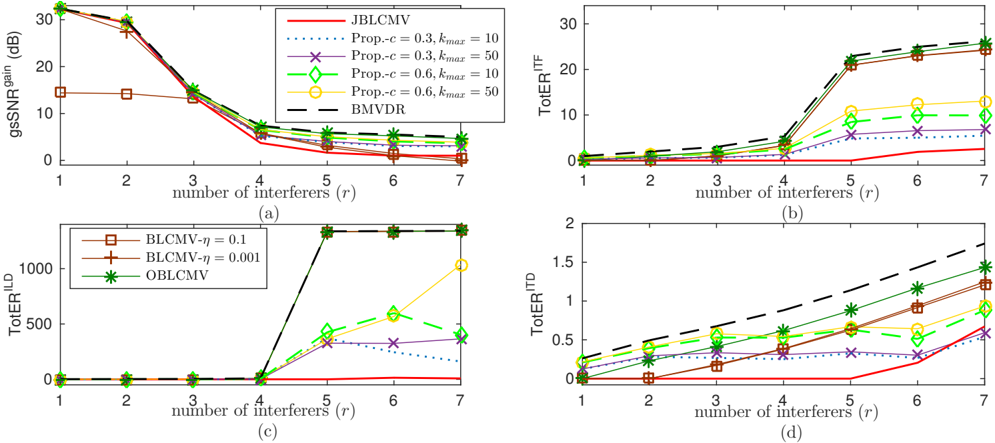
The image contains four line graphs (a-d) analyzing the impact of increasing interferers (r = 1–7) on communication system performance. Key metrics include gSNR gain, ToIER_ILD, ToIER_ITF, and ToIER_ITD, with comparisons across different modulation/processing configurations (JBLCMV, Prop-c variants, BMVDR, BLCMV-η, OBLCMV).
---
### Components/Axes
#### Common Elements:
- **X-axis**: Number of interferers (r), integer values 1–7.
- **Y-axes**:
- (a): gSNR gain (dB)
- (b): ToIER_ITF (dB)
- (c): ToIER_ILD (dB)
- (d): ToIER_ITD (dB)
- **Legends**: Positioned on the right of each graph, with distinct line styles/markers for each configuration.
#### Graph-Specific Details:
- **(a) gSNR Gain**:
- **Lines**: Red (JBLCMV), dotted blue (Prop-c=0.3, k_max=10), purple (Prop-c=0.3, k_max=50), green diamonds (Prop-c=0.6, k_max=10), yellow circles (Prop-c=0.6, k_max=50), black dashed (BMVDR).
- **Markers**: Stars (JBLCMV), diamonds (Prop-c=0.6), circles (Prop-c=0.3), squares (BMVDR).
- **(b) ToIER_ITF**:
- Similar legend structure to (a), with markers for each configuration.
- **(c) ToIER_ILD**:
- **Lines**: Brown squares (BLCMV-η=0.1), brown crosses (BLCMV-η=0.001), green stars (OBLCMV).
- **(d) ToIER_ITD**:
- **Lines**: Black dashed (BMVDR), brown squares (BLCMV-η=0.1), brown crosses (BLCMV-η=0.001), green stars (OBLCMV).
---
### Detailed Analysis
#### (a) gSNR Gain
- **Trend**: All configurations show a **decreasing trend** as interferers increase. JBLCMV (red) starts highest (~30 dB at r=1) and drops sharply to ~5 dB at r=7. Prop-c=0.3 (blue/purple) and Prop-c=0.6 (green/yellow) follow similar declines but with slower rates. BMVDR (black dashed) remains relatively flat (~15 dB).
- **Key Data Points**:
- At r=1: JBLCMV ≈ 30 dB, BMVDR ≈ 15 dB.
- At r=7: JBLCMV ≈ 5 dB, BMVDR ≈ 12 dB.
#### (b) ToIER_ITF
- **Trend**: All configurations exhibit a **gradual increase** with more interferers. BMVDR (black dashed) rises steeply from ~0 dB (r=1) to ~25 dB (r=7). Prop-c=0.6 (green/yellow) shows moderate growth (~10–15 dB), while Prop-c=0.3 (blue/purple) remains lower (~5–10 dB).
- **Key Data Points**:
- At r=5: BMVDR ≈ 20 dB, Prop-c=0.6 ≈ 12 dB.
- At r=7: BMVDR ≈ 25 dB, Prop-c=0.3 ≈ 8 dB.
#### (c) ToIER_ILD
- **Trend**: BLCMV-η=0.1 (brown squares) spikes sharply at r=3 (~1000 dB) and plateaus. BLCMV-η=0.001 (brown crosses) remains near-zero. OBLCMV (green stars) shows minimal growth (~10–50 dB).
- **Key Data Points**:
- At r=3: BLCMV-η=0.1 ≈ 1000 dB, OBLCMV ≈ 10 dB.
- At r=7: BLCMV-η=0.1 ≈ 1000 dB, OBLCMV ≈ 50 dB.
#### (d) ToIER_ITD
- **Trend**: All configurations increase with interferers. BMVDR (black dashed) rises steeply (~0.5–1.5), while BLCMV-η=0.1 (brown squares) and OBLCMV (green stars) show moderate growth (~0.2–1.2).
- **Key Data Points**:
- At r=5: BMVDR ≈ 1.0, BLCMV-η=0.1 ≈ 0.8.
- At r=7: BMVDR ≈ 1.5, OBLCMV ≈ 1.2.
---
### Key Observations
1. **Interference Impact**: All metrics degrade with more interferers, except ToIER_ILD for BLCMV-η=0.001, which remains stable.
2. **Configuration Performance**:
- JBLCMV and Prop-c=0.3 outperform BMVDR in gSNR gain but underperform in ToIER metrics.
- BLCMV-η=0.1 causes extreme ToIER_ILD spikes, suggesting instability.
- OBLCMV maintains low ToIER_ILD/ITD but lags in gSNR gain.
3. **BMVDR Baseline**: Consistently higher ToIER values but stable gSNR gain.
---
### Interpretation
The data highlights trade-offs between interference resilience and performance metrics:
- **JBLCMV/Prop-c**: Optimized for gSNR gain but vulnerable to ToIER degradation.
- **BLCMV-η=0.1**: High gSNR gain but catastrophic ToIER_ILD spikes, indicating potential over-sensitivity to interference.
- **OBLCMV**: Balanced performance with minimal ToIER but lower gSNR gain.
- **BMVDR**: Acts as a reference, showing moderate gSNR gain and predictable ToIER growth.
The results suggest that system design must prioritize either interference mitigation (e.g., JBLCMV) or error resilience (e.g., OBLCMV), depending on operational requirements. The extreme ToIER_ILD for BLCMV-η=0.1 warrants further investigation into its practical feasibility.