\n
## Image Collection: Dataset Examples
### Overview
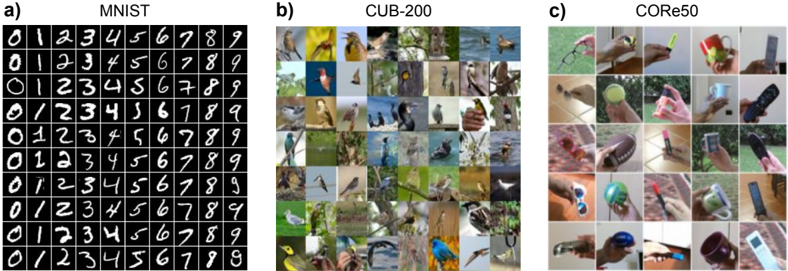
The image presents a collection of examples from three different datasets used in machine learning, specifically for image recognition and classification tasks. The datasets are labeled as MNIST, CUB-200, and CORE50. Each dataset is displayed as a grid of images representing the variety of samples within it.
### Components/Axes
The image is divided into three sections, labeled a), b), and c), each representing a different dataset.
* **a) MNIST:** Displays a grid of handwritten digits (0-9).
* **b) CUB-200:** Displays a grid of bird images.
* **c) CORE50:** Displays a grid of images depicting human hands interacting with common objects.
There are no explicit axes or legends in the traditional sense, but the labels (MNIST, CUB-200, CORE50) serve as identifiers for each dataset.
### Detailed Analysis or Content Details
**a) MNIST:**
The MNIST dataset consists of a 7x9 grid of handwritten digits. Each row represents a different instance of a digit from 0 to 9. The digits are grayscale. The grid appears to be a representative sample of the dataset, showing variations in handwriting style.
**b) CUB-200:**
The CUB-200 dataset displays a grid of approximately 6x8 images of birds. The images show a diverse range of bird species, poses, and backgrounds. The birds are of varying sizes and colors. The images appear to be photographs.
**c) CORE50:**
The CORE50 dataset displays a grid of approximately 6x6 images of human hands interacting with everyday objects. The objects include items like tennis balls, remote controls, water bottles, and sunglasses. The images show different hand poses and object orientations. The images appear to be photographs.
### Key Observations
* **MNIST:** The dataset is relatively simple, consisting of clean, grayscale images of digits.
* **CUB-200:** The dataset is more complex, with variations in bird species, lighting, and backgrounds.
* **CORE50:** The dataset is the most complex, involving interactions between humans and objects, requiring the model to understand both object recognition and pose estimation.
* The datasets vary significantly in their complexity and the types of visual features they require a machine learning model to learn.
### Interpretation
The image illustrates the increasing complexity of datasets used in machine learning research. MNIST is a foundational dataset often used for introductory machine learning tasks. CUB-200 represents a more challenging dataset requiring fine-grained image recognition. CORE50 represents a highly complex dataset that requires understanding of object interactions and human pose. The image demonstrates the progression from simple, controlled datasets to more realistic and challenging datasets, reflecting the evolution of machine learning research towards more complex and real-world applications. The datasets are chosen to represent different levels of difficulty in image recognition tasks. MNIST is designed for basic digit recognition, CUB-200 for identifying specific bird species, and CORE50 for understanding human-object interactions. This progression allows researchers to test and improve the capabilities of machine learning models in increasingly complex scenarios.