## Choropleth Map: European DCCA Coefficients
### Overview
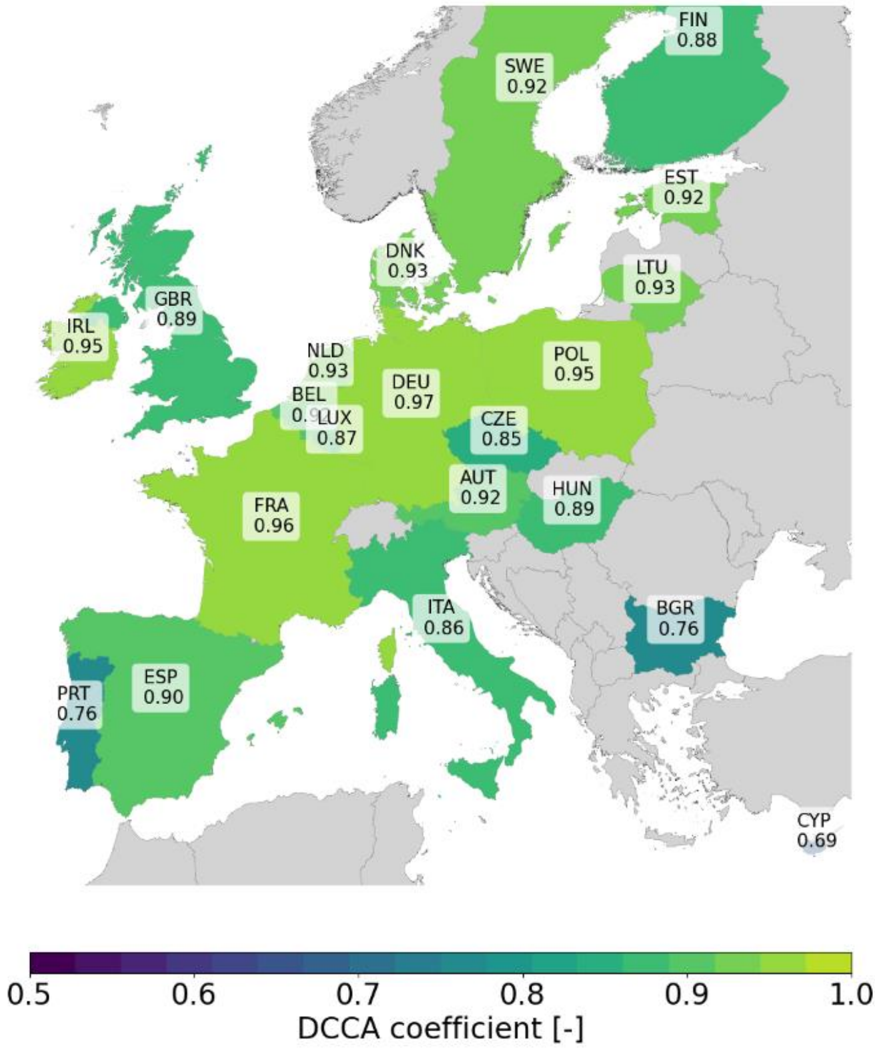
The image is a choropleth map of Europe displaying the "DCCA coefficient" for various countries. The map uses a color gradient to represent numerical values, with each labeled country showing its ISO 3166-1 alpha-3 code and a corresponding coefficient value. A color legend is provided at the bottom.
### Components/Axes
* **Map Type:** Choropleth map of Europe.
* **Legend/Color Scale:** Located at the bottom of the image. It is a horizontal gradient bar labeled "DCCA coefficient [-]". The scale runs from **0.5** on the left (dark blue/purple) to **1.0** on the right (bright yellow-green). Key markers are at 0.5, 0.6, 0.7, 0.8, 0.9, and 1.0.
* **Data Labels:** Each colored country has a white box containing its 3-letter ISO country code and a numerical value (the DCCA coefficient). The text is in English.
* **Geographic Scope:** The map includes EU/EEA countries and the United Kingdom. Countries not labeled (e.g., Norway, Switzerland, Western Balkans, Ukraine, Belarus, Russia, Turkey) are shown in light grey, indicating no data is presented for them.
### Detailed Analysis
**Country Data (Listed roughly North to South, West to East):**
* **FIN (Finland):** 0.88. Located in the top-right (Northeast). Color is a medium green.
* **SWE (Sweden):** 0.92. Located in the top-center (North). Color is a bright green.
* **EST (Estonia):** 0.92. Located east of the Baltic Sea. Color is a bright green.
* **LTU (Lithuania):** 0.93. Located south of Estonia. Color is a bright green.
* **DNK (Denmark):** 0.93. Located in the center-north. Color is a bright green.
* **IRL (Ireland):** 0.95. Located in the top-left (Northwest). Color is a very bright, yellowish green.
* **GBR (United Kingdom):** 0.89. Located west of the mainland. Color is a medium green.
* **NLD (Netherlands):** 0.93. Located on the northwest mainland coast. Color is a bright green.
* **BEL (Belgium):** Value is partially obscured, appears to be **0.** (likely 0.9x based on color). Located south of the Netherlands. Color is a bright green.
* **LUX (Luxembourg):** 0.87. A small country between Belgium, France, and Germany. Color is a medium green.
* **DEU (Germany):** 0.97. Located in the center of the map. Color is the brightest yellow-green on the map, indicating the highest value.
* **POL (Poland):** 0.95. Located east of Germany. Color is a very bright, yellowish green.
* **CZE (Czechia):** 0.85. Located south of Poland. Color is a medium-dark green.
* **AUT (Austria):** 0.92. Located south of Germany and Czechia. Color is a bright green.
* **HUN (Hungary):** 0.89. Located east of Austria. Color is a medium green.
* **FRA (France):** 0.96. Located in the west-central area. Color is a very bright, yellowish green.
* **ITA (Italy):** 0.86. The boot-shaped peninsula in the south-central area. Color is a medium-dark green.
* **ESP (Spain):** 0.90. Located in the southwest. Color is a bright green.
* **PRT (Portugal):** 0.76. Located on the far southwest coast. Color is a dark teal/blue-green.
* **BGR (Bulgaria):** 0.76. Located in the southeast. Color is a dark teal/blue-green.
* **CYP (Cyprus):** 0.69. An island in the bottom-right (Southeast) corner. Color is a dark blue, representing the lowest value on the map.
**Visual Trend Verification:**
* The highest coefficients (brightest yellow-green, >0.95) are concentrated in Western and Central Europe: **DEU (0.97), FRA (0.96), IRL (0.95), POL (0.95)**.
* A band of high values (bright green, 0.92-0.93) runs across Northern/Central Europe: **SWE, EST, LTU, DNK, NLD, AUT**.
* Moderate values (medium green, 0.85-0.90) are found in the UK, Iberia, and parts of Central Europe: **GBR (0.89), ESP (0.90), HUN (0.89), FIN (0.88), LUX (0.87), ITA (0.86), CZE (0.85)**.
* The lowest values (dark blue/teal, <0.80) are outliers on the geographic periphery: **PRT (0.76), BGR (0.76), CYP (0.69)**.
### Key Observations
1. **Highest Value:** Germany (DEU) has the highest DCCA coefficient at 0.97.
2. **Lowest Value:** Cyprus (CYP) has the lowest DCCA coefficient at 0.69.
3. **Regional Clustering:** There is a clear geographic pattern. Western/Central European core economies show very high synchronization (high DCCA). Nordic and Baltic states also show high values. The lowest values are found at the southwestern (Portugal), southeastern (Bulgaria), and eastern Mediterranean (Cyprus) edges of the mapped region.
4. **Notable Outliers:** Portugal (0.76) is a significant outlier compared to its neighbor Spain (0.90). Cyprus (0.69) is the most distinct outlier, being the only country below 0.75.
5. **Data Gaps:** Major European economies like Norway, Switzerland, and the UK (though GBR is present) are not fully represented. The entire Eastern European block east of Poland/Bulgaria/Hungary is greyed out.
### Interpretation
The "DCCA coefficient" (likely Detrended Cross-Correlation Analysis) is a statistical measure often used in econophysics and complex systems to quantify the long-range correlation or synchronization between two time series. In this context, it probably measures the degree of synchronization between a country's economy (or another metric like stock markets, energy prices, etc.) and a reference system (possibly the EU aggregate or a major economy like Germany).
* **What the Data Suggests:** The map demonstrates a core-periphery structure in European integration or economic coupling. The high values in the Franco-German core and connected economies suggest deep integration and similar cyclical behavior. The lower values in peripheral states like Portugal, Bulgaria, and especially Cyprus indicate their economic dynamics are less synchronized with the European core, potentially due to different industrial structures, economic policies, or exposure to different global markets.
* **Relationship Between Elements:** The color gradient directly translates the numerical coefficient into a visual pattern, making the core-periphery divide immediately apparent. The placement of country labels directly on the geography allows for instant identification.
* **Anomalies and Implications:** The stark contrast between Spain and Portugal is noteworthy and could reflect differing economic resilience or recovery paths post-crisis. Cyprus's very low value might be linked to its unique economic structure (e.g., reliance on tourism, shipping, financial services) or its geopolitical situation. This map would be crucial for policymakers studying economic integration, risk contagion, or the effectiveness of EU-wide policies, as it visually identifies which economies move in lockstep with the core and which follow more independent trajectories.