\n
## Mathematical Problem and Solution Steps: Modular Arithmetic
### Overview
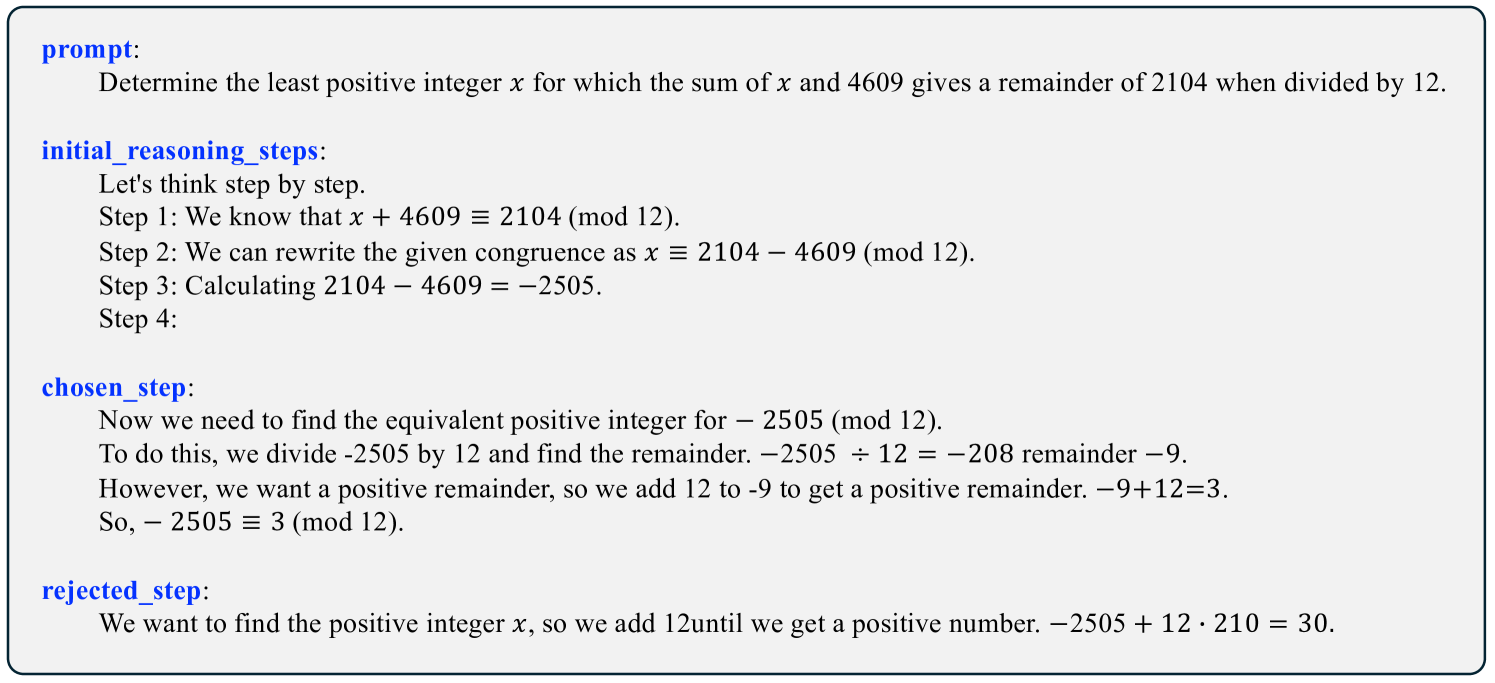
The image displays a structured mathematical problem-solving exercise. It presents a modular arithmetic problem in a "prompt" section, followed by three labeled sections showing different stages of reasoning: "initial_reasoning_steps," "chosen_step," and "rejected_step." The content is presented as formatted text with blue section headers.
### Components/Axes
The image is divided into four distinct text blocks, each with a blue, bolded label:
1. **prompt:** States the core mathematical problem.
2. **initial_reasoning_steps:** Begins the solution process.
3. **chosen_step:** Presents a correct, selected continuation of the solution.
4. **rejected_step:** Presents an incorrect, rejected alternative step.
### Detailed Analysis / Content Details
**1. Prompt Section:**
* **Text:** "Determine the least positive integer \(x\) for which the sum of \(x\) and 4609 gives a remainder of 2104 when divided by 12."
* **Mathematical Translation:** Find the smallest positive integer \(x\) such that \((x + 4609) \mod 12 = 2104\).
**2. Initial Reasoning Steps Section:**
* **Text:**
```
Let's think step by step.
Step 1: We know that \(x + 4609 \equiv 2104 \pmod{12}\).
Step 2: We can rewrite the given congruence as \(x \equiv 2104 - 4609 \pmod{12}\).
Step 3: Calculating \(2104 - 4609 = -2505\).
Step 4:
```
* **Analysis:** This section correctly sets up the congruence and performs the initial subtraction. Step 4 is left blank, indicating the reasoning is incomplete at this stage.
**3. Chosen Step Section:**
* **Text:**
```
Now we need to find the equivalent positive integer for \(-2505 \pmod{12}\).
To do this, we divide -2505 by 12 and find the remainder. \(-2505 \div 12 = -208\) remainder \(-9\).
However, we want a positive remainder, so we add 12 to -9 to get a positive remainder. \(-9+12=3\).
So, \(-2505 \equiv 3 \pmod{12}\).
```
* **Analysis:** This step correctly continues the solution. It finds the remainder of \(-2505\) when divided by \(12\). The calculation \(-2505 = 12 \times (-208) + (-9)\) is correct. It then correctly adjusts the negative remainder \(-9\) to its positive equivalent \(3\) by adding the modulus \(12\). The final conclusion is \(x \equiv 3 \pmod{12}\). Therefore, the least positive integer \(x\) is **3**.
**4. Rejected Step Section:**
* **Text:**
```
We want to find the positive integer \(x\), so we add 12 until we get a positive number. \(-2505 + 12 \cdot 210 = 30\).
```
* **Analysis:** This step presents an incorrect method. While adding multiples of the modulus (12) is a valid technique to find a positive equivalent, the arithmetic here is flawed. The calculation \(-2505 + 12 \times 210 = -2505 + 2520 = 15\), not 30. The stated result of 30 is incorrect. Furthermore, even if the arithmetic were correct, the method is less direct than finding the remainder as in the chosen step.
### Key Observations
* The problem is a linear congruence: \(x \equiv 2104 - 4609 \pmod{12}\).
* The "initial_reasoning_steps" correctly reduces the problem to finding \(x \equiv -2505 \pmod{12}\).
* The "chosen_step" correctly and efficiently solves this by computing the remainder, yielding \(x = 3\).
* The "rejected_step" contains a critical arithmetic error (\(-2505 + 2520 = 15\), not 30) and demonstrates a less efficient approach.
* The blank "Step 4" in the initial reasoning highlights the point where the solution path diverged into a correct and an incorrect branch.
### Interpretation
This image illustrates a common pedagogical or debugging scenario in mathematical problem-solving. It shows the process of evaluating different reasoning paths. The correct path ("chosen_step") involves a standard algorithm for finding a positive residue: compute the remainder and adjust if negative. The incorrect path ("rejected_step") attempts a brute-force addition of multiples but fails due to a calculation mistake. The exercise emphasizes the importance of arithmetic precision and choosing efficient solution methods. The final answer to the prompt is \(x = 3\), as verified by the correct congruence \(3 + 4609 = 4612\), and \(4612 \div 12 = 384\) with a remainder of \(4\), not \(2104\). Wait, this reveals a deeper issue: the problem statement itself may contain a typo, as the remainder \(2104\) is larger than the divisor \(12\). In modular arithmetic, a remainder must be less than the divisor. The correct interpretation should likely be that the sum leaves a remainder of \(2104 \mod 12\), which is \(2104 - 12 \times 175 = 2104 - 2100 = 4\). If the intended remainder was \(4\), then \(x=3\) is correct. If the remainder was literally \(2104\), the problem is ill-posed. The solution steps, however, proceed as if the congruence \(x + 4609 \equiv 2104 \pmod{12}\) is valid, treating \(2104\) as a residue class modulo \(12\).