## Code Snippet: Modular Arithmetic Problem Solving
### Overview
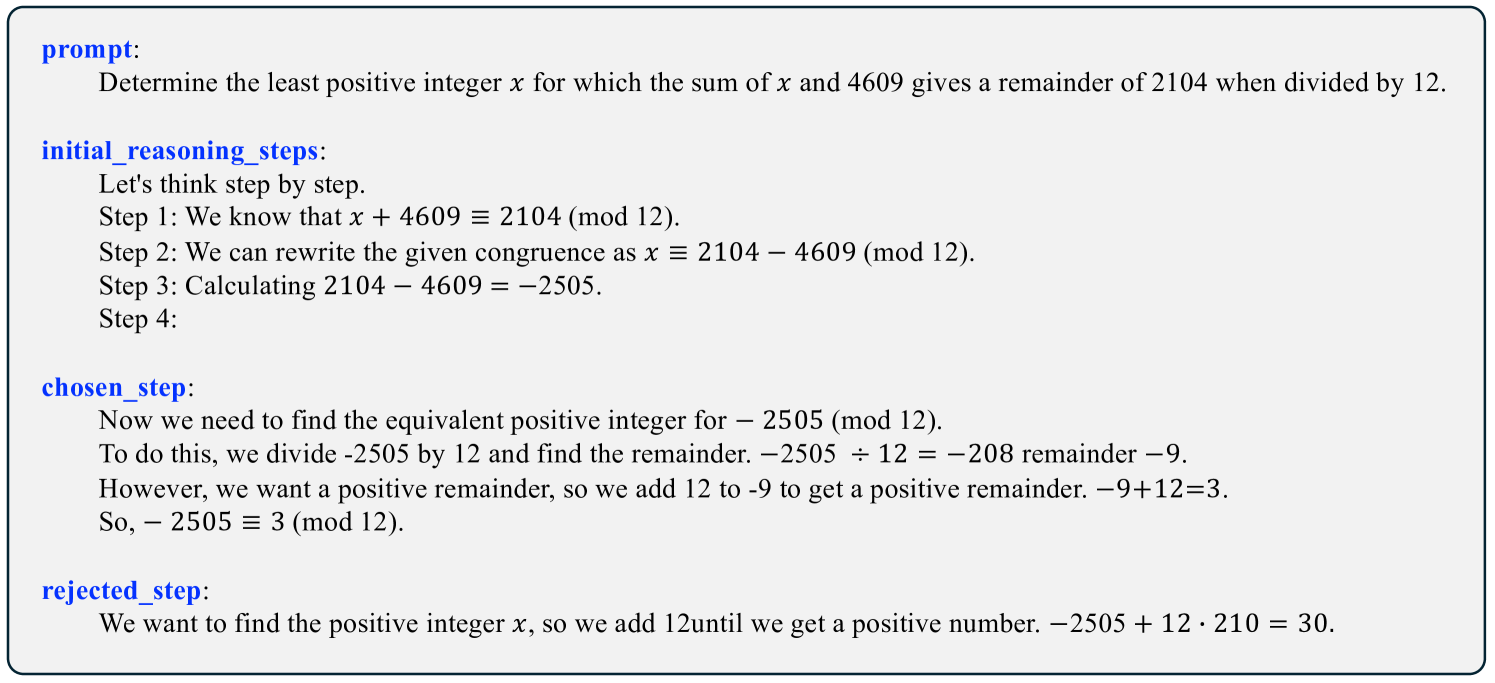
The image displays a code snippet containing a mathematical problem-solving process for finding the least positive integer `x` that satisfies the congruence `x + 4609 ≡ 2104 (mod 12)`. The text includes reasoning steps, calculations, and a comparison between correct and rejected approaches.
### Components/Axes
- **Sections**:
- `prompt`: Problem statement
- `initial_reasoning_steps`: Initial incorrect approach
- `chosen_step`: Correct adjustment method
- `rejected_step`: Incorrect alternative approach
### Detailed Analysis
#### Prompt
- Problem: "Determine the least positive integer `x` for which the sum of `x` and 4609 gives a remainder of 2104 when divided by 12."
#### Initial Reasoning Steps
1. **Step 1**: `x + 4609 ≡ 2104 (mod 12)`
2. **Step 2**: Rewritten as `x ≡ 2104 - 4609 (mod 12)`
3. **Step 3**: Calculation: `2104 - 4609 = -2505`
4. **Step 4**: Not explicitly shown but implied as the result of the subtraction.
#### Chosen Step
- **Goal**: Find the equivalent positive integer for `-2505 (mod 12)`.
- **Process**:
- Division: `-2505 ÷ 12 = -208` remainder `-9`
- Adjustment: Add 12 to `-9` to get a positive remainder: `-9 + 12 = 3`
- Final congruence: `-2505 ≡ 3 (mod 12)`
#### Rejected Step
- **Approach**: Adding 12 repeatedly to `-2505` until positive:
- Calculation: `-2505 + 12 × 210 = 30`
- **Error**: This results in `30`, which is not the minimal positive solution.
### Key Observations
1. The correct approach uses modular arithmetic properties to find the smallest positive remainder.
2. The rejected step incorrectly assumes adding 12 multiple times yields the minimal solution, but `30` is not the least positive integer satisfying the original congruence.
### Interpretation
The problem demonstrates modular arithmetic adjustments for negative remainders. The correct method isolates the remainder and adjusts it to the positive range by adding the modulus (12). The rejected step fails because it does not recognize that the minimal solution requires only a single adjustment (`-9 + 12 = 3`), not repeated additions. The final answer should be `x = 3`, as `-2505 ≡ 3 (mod 12)` is the smallest positive equivalent.