## Diagram: Reader-Writer Lock Mechanism
### Overview
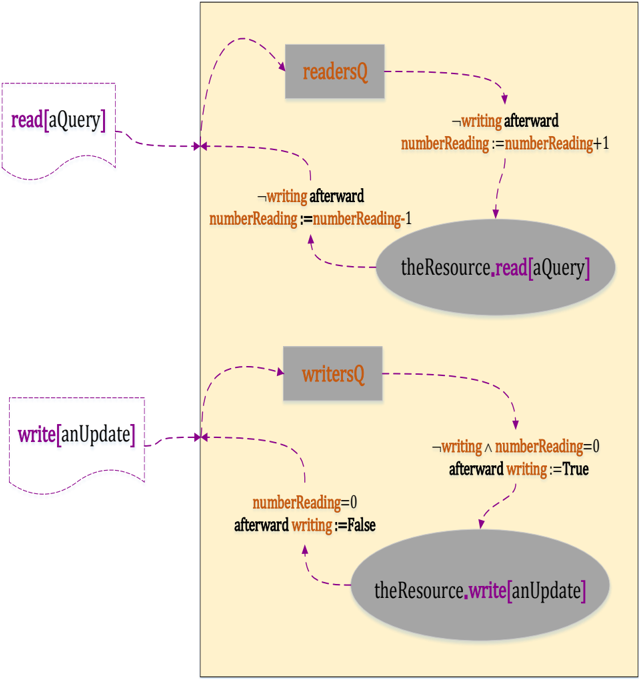
The image illustrates a reader-writer lock mechanism, a concurrency control primitive that allows multiple readers to access a shared resource simultaneously, but requires exclusive access for writers. The diagram depicts the flow of read and write requests, the management of reader and writer queues, and the conditions under which access is granted.
### Components/Axes
* **Nodes:**
* `read[aQuery]`: Represents a read request with a query parameter.
* `readersQ`: Represents the queue of readers waiting for access.
* `theResource, read[aQuery]`: Represents the shared resource being read.
* `write[anUpdate]`: Represents a write request with an update parameter.
* `writersQ`: Represents the queue of writers waiting for access.
* `theResource, write[anUpdate]`: Represents the shared resource being written.
* **Edges:** Dashed purple lines indicate the flow of requests and control signals.
* **Conditions/Actions (Orange Text):**
* `-writing afterward numberReading := numberReading + 1`: If not writing, increment the number of readers.
* `-writing afterward numberReading := numberReading - 1`: If not writing, decrement the number of readers.
* `numberReading = 0 afterward writing := False`: If no readers, writing is set to false.
* `-writing ^ numberReading = 0 afterward writing := True`: If not writing and no readers, writing is set to true.
### Detailed Analysis
**Read Request Flow:**
1. A `read[aQuery]` request arrives.
2. It is enqueued in `readersQ`.
3. If no writer is active (`-writing afterward`), the number of readers (`numberReading`) is incremented (`numberReading := numberReading + 1`).
4. The resource is accessed for reading (`theResource, read[aQuery]`).
5. After reading, if no writer is active (`-writing afterward`), the number of readers is decremented (`numberReading := numberReading - 1`).
**Write Request Flow:**
1. A `write[anUpdate]` request arrives.
2. It is enqueued in `writersQ`.
3. If no writer is active and no readers are present (`-writing ^ numberReading = 0`), writing is set to true (`afterward writing := True`).
4. The resource is accessed for writing (`theResource, write[anUpdate]`).
5. After writing, if there are no readers (`numberReading = 0`), writing is set to false (`afterward writing := False`).
### Key Observations
* The diagram highlights the priority given to writers. A writer can only access the resource if there are no active readers or writers.
* The `numberReading` variable tracks the number of active readers.
* The `writing` variable indicates whether a writer is currently active.
* The diagram uses negated conditions (`-writing`) to indicate that certain actions can only occur if a writer is not active.
### Interpretation
The diagram illustrates a common implementation of a reader-writer lock. The mechanism ensures that multiple readers can access the resource concurrently, but writers have exclusive access. The `readersQ` and `writersQ` queues manage the order in which requests are processed. The conditions and actions associated with each transition ensure that the lock is acquired and released correctly, preventing race conditions and data corruption. The use of `numberReading` and `writing` variables allows the system to track the state of the lock and make appropriate decisions about granting access to the resource.