\n
## Diagram: Resource Access Control with Readers and Writers
### Overview
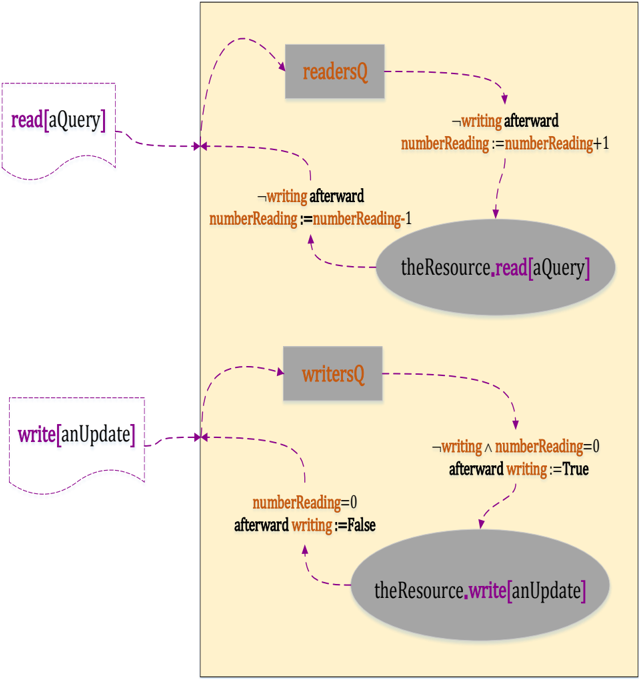
This diagram illustrates a resource access control mechanism using queues for readers and writers, designed to manage concurrent access to a shared resource ("theResource"). It depicts the flow of operations for reading and writing, including queueing, resource access, and state updates. The diagram uses rounded rectangles to represent queues and operations, and dashed arrows to indicate the flow of control and data.
### Components/Axes
The diagram consists of the following components:
* **readersQ:** A queue for read requests.
* **writersQ:** A queue for write requests.
* **theResource.read[aQuery]:** The operation of reading from the resource.
* **theResource.write[anUpdate]:** The operation of writing to the resource.
* **read[aQuery]:** The initial read request.
* **write[anUpdate]:** The initial write request.
* **numberReading:** A variable tracking the number of active readers.
* **afterward:** A boolean variable indicating whether a write operation has occurred.
### Detailed Analysis or Content Details
The diagram shows two primary paths: one for reading and one for writing.
**Read Path:**
1. A `read[aQuery]` request is initiated.
2. The request is placed into the `readersQ` queue.
3. From `readersQ`, the flow proceeds to `theResource.read[aQuery]`.
4. Before accessing the resource, `numberReading` is incremented by 1 (`numberReading := numberReading + 1`). This is labeled as occurring "afterward" the queueing step.
5. After reading, `numberReading` is decremented by 1 (`numberReading := numberReading - 1`). This is also labeled as occurring "afterward".
6. The flow returns to `readersQ`.
**Write Path:**
1. A `write[anUpdate]` request is initiated.
2. The request is placed into the `writersQ` queue.
3. From `writersQ`, the flow proceeds to `theResource.write[anUpdate]`.
4. Before writing, `numberReading` is set to 0 (`numberReading := 0`).
5. `afterward` is set to `True` (`afterward := True`).
6. After writing, `numberReading` is set to 0 (`numberReading := 0`).
7. `afterward` is set to `False` (`afterward := False`).
8. The flow returns to `writersQ`.
The diagram also shows a bidirectional flow between `readersQ` and `writersQ`. A dashed arrow indicates that a write request can block read requests, and vice versa. The label on this arrow is "→writing afterward".
### Key Observations
* The diagram illustrates a form of reader-writer lock. Multiple readers can access the resource concurrently, but only one writer can access it at a time.
* The `numberReading` variable is used to track the number of active readers, ensuring that no writers can access the resource while readers are present.
* The `afterward` variable seems to indicate whether a write operation has recently occurred, potentially for synchronization or caching purposes.
* The queues (`readersQ` and `writersQ`) manage the order of requests, preventing contention and ensuring fairness.
### Interpretation
This diagram represents a concurrency control mechanism for a shared resource. The use of queues and the `numberReading` variable suggests a strategy to allow concurrent read access while ensuring exclusive write access. The `afterward` variable hints at a potential mechanism for invalidating caches or triggering other actions after a write operation.
The diagram demonstrates a common pattern in concurrent programming: separating read and write operations to optimize performance while maintaining data consistency. The queues act as buffers, smoothing out bursts of requests and preventing the resource from being overwhelmed. The reader-writer lock pattern is frequently used in databases, file systems, and other applications where concurrent access to shared data is required.
The bidirectional arrow between the queues suggests a priority or blocking mechanism. Writes likely have priority, as they can block readers. This is a common approach to ensure data consistency, as writes typically need exclusive access to modify the resource. The diagram doesn't specify the exact blocking behavior, but it implies that writes can prevent new reads from starting until the write operation is complete.