TECHNICAL ASSET FINGERPRINT
fb3feb7b13321014b3283d86
Click to view fullscreen
Press ESC or click to close
FOUND IN PAPERS
EXPERT: healer-alpha-free VERSION 1
RUNTIME: free/openrouter/healer-alpha
INTEL_VERIFIED
## Diagram: Readers-Writers Synchronization Flowchart
### Overview
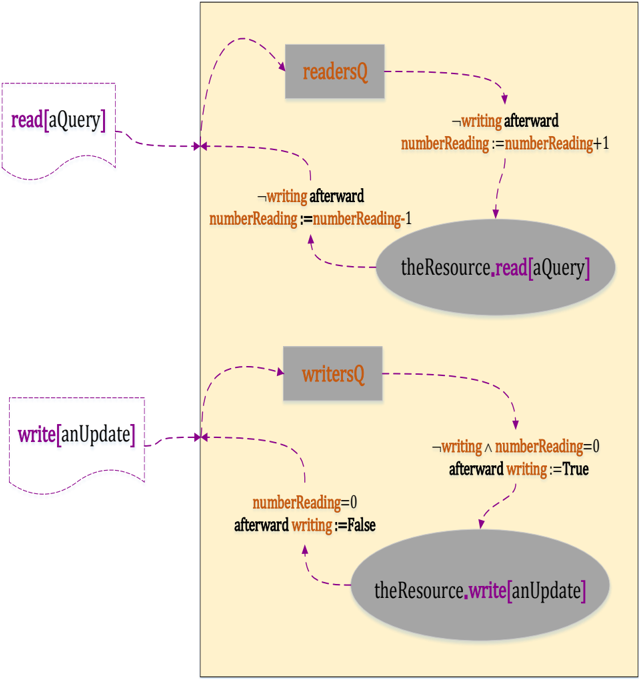
The image is a technical flowchart illustrating a synchronization mechanism for managing concurrent read and write access to a shared resource. It depicts two parallel processes: one for handling read requests (`read[aQuery]`) and one for handling write requests (`write[anUpdate]`). The diagram uses queues (`readersQ`, `writersQ`) and state variables (`numberReading`, `writing`) to coordinate access, ensuring data consistency. The visual style is a simple block diagram with dashed purple arrows indicating control flow and state transitions.
### Components/Axes
The diagram is structured into two main horizontal flows within a light beige rectangular container.
**Top Flow (Read Path):**
* **Input (Top-Left):** A wavy-edged box labeled `read[aQuery]`.
* **Queue (Top-Center):** A gray rectangle labeled `readersQ`.
* **Resource Access (Top-Right):** A gray oval labeled `theResource.read[aQuery]`.
* **Annotations (Purple Text):** Pseudocode describing state changes and conditions.
**Bottom Flow (Write Path):**
* **Input (Bottom-Left):** A wavy-edged box labeled `write[anUpdate]`.
* **Queue (Bottom-Center):** A gray rectangle labeled `writersQ`.
* **Resource Access (Bottom-Right):** A gray oval labeled `theResource.write[anUpdate]`.
* **Annotations (Purple Text):** Pseudocode describing state changes and conditions.
**Flow Indicators:** Dashed purple arrows connect the components, showing the sequence of operations. The arrows are annotated with the pseudocode that governs the transition.
### Detailed Analysis / Content Details
**1. Read Operation Flow (`read[aQuery]`):**
* **Step 1:** The process begins at the `read[aQuery]` input (top-left).
* **Step 2:** A dashed arrow points to the `readersQ` queue (top-center).
* **Step 3:** From `readersQ`, an arrow points down to the resource access oval `theResource.read[aQuery]` (top-right). The annotation on this arrow reads: `¬writing afterward numberReading := numberReading+1`.
* **Interpretation:** This means a read can proceed if the condition `¬writing` (not writing) is true. Upon proceeding, the `numberReading` counter is incremented by 1.
* **Step 4:** After the read operation, an arrow loops back from the resource oval towards the input side. The annotation on this return path reads: `¬writing afterward numberReading := numberReading-1`.
* **Interpretation:** After the read completes, the `numberReading` counter is decremented by 1. The condition `¬writing` is reiterated, likely as a guard for the state change.
**2. Write Operation Flow (`write[anUpdate]`):**
* **Step 1:** The process begins at the `write[anUpdate]` input (bottom-left).
* **Step 2:** A dashed arrow points to the `writersQ` queue (bottom-center).
* **Step 3:** From `writersQ`, an arrow points down to the resource access oval `theResource.write[anUpdate]` (bottom-right). The annotation on this arrow reads: `¬writing ∧ numberReading=0 afterward writing := True`.
* **Interpretation:** This means a write can proceed only if two conditions are met: `¬writing` (no other write is active) AND `numberReading=0` (no active readers). Upon proceeding, the state variable `writing` is set to `True`.
* **Step 4:** After the write operation, an arrow loops back from the resource oval towards the input side. The annotation on this return path reads: `numberReading=0 afterward writing := False`.
* **Interpretation:** After the write completes, the `writing` state variable is set to `False`. The condition `numberReading=0` is checked again, ensuring no readers have entered during the write (which should be impossible given the entry condition).
**Transcribed Text Elements (All in English):**
* `read[aQuery]`
* `readersQ`
* `¬writing afterward numberReading := numberReading+1`
* `theResource.read[aQuery]`
* `¬writing afterward numberReading := numberReading-1`
* `write[anUpdate]`
* `writersQ`
* `¬writing ∧ numberReading=0 afterward writing := True`
* `theResource.write[anUpdate]`
* `numberReading=0 afterward writing := False`
### Key Observations
1. **Mutual Exclusion for Writers:** The write operation has a strict entry condition (`¬writing ∧ numberReading=0`), ensuring exclusive access. It sets a `writing` flag to `True` to block other writers and new readers.
2. **Reader Counting:** Readers are tracked via a `numberReading` counter. Multiple readers can presumably access the resource concurrently as long as `writing` is `False`.
3. **Queue Abstraction:** The use of `readersQ` and `writersQ` suggests that requests may be queued if the entry conditions are not met, though the queuing logic itself is not detailed.
4. **State Variable Consistency:** The diagram carefully shows state variables (`numberReading`, `writing`) being updated both before (`afterward`) and after resource access, creating a clear pre- and post-condition protocol.
5. **Potential Race Condition:** The return path for the read operation (`¬writing afterward numberReading := numberReading-1`) checks `¬writing` again. This might be a safeguard, but if a writer sets `writing:=True` immediately after a reader increments the count, this check could fail unexpectedly. The logic assumes the writer cannot start while `numberReading > 0`.
### Interpretation
This diagram models a classic solution to the **Readers-Writers Problem** in concurrent programming. It prioritizes data consistency through a set of rules encoded in the state variables and transition conditions.
* **What it demonstrates:** It shows a protocol where:
* **Readers** can share access as long as no writer is active. Their entry is guarded by `¬writing`.
* **Writers** require exclusive access. Their entry is guarded by both `¬writing` and `numberReading=0`.
* The system uses a **writer-preference** or **strong writer-preference** scheme implicitly, because once a writer is queued (`writersQ`), new readers would be blocked if the writer eventually acquires the lock (sets `writing:=True`), even if `numberReading` was temporarily zero.
* **Relationships:** The two flows are interdependent through the shared state variables `writing` and `numberReading`. The `writersQ` and `readersQ` act as synchronization points, likely implementing a waiting mechanism (e.g., threads sleeping) until the conditions on the outgoing arrows are satisfied.
* **Anomalies/Notes:** The diagram is a high-level logical flowchart. It does not specify the implementation of the queues (e.g., FIFO, priority) or the exact mechanism for checking conditions (e.g., mutexes, semaphores). The pseudocode uses a mathematical/logical notation (`¬` for NOT, `∧` for AND, `:=` for assignment). The design appears sound for preventing data corruption but may lead to writer starvation if readers are continuously arriving, as the `¬writing` condition for readers does not consider pending writers.
DECODING INTELLIGENCE...