## Diagram: Concurrent Resource Access Control
### Overview
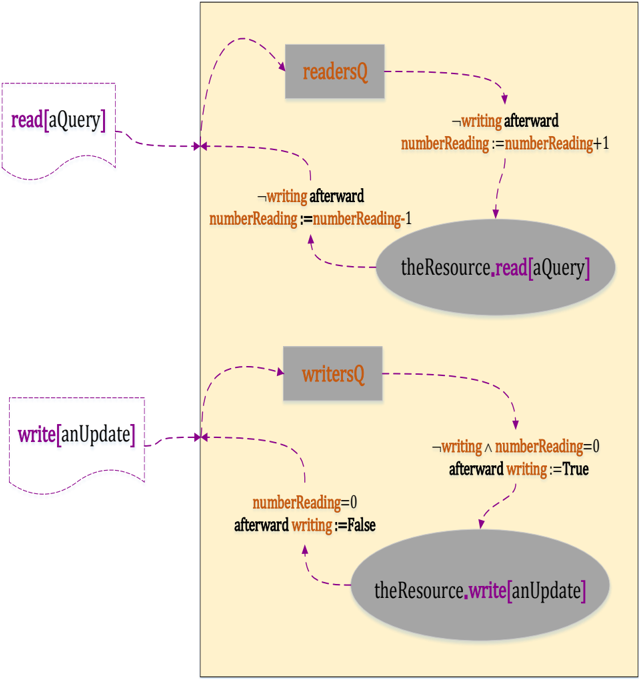
The diagram illustrates a concurrency control mechanism for managing access to a shared resource (`theResource`) by multiple readers (`readersQ`) and writers (`writersQ`). It uses conditional logic and state variables (`numberReading`, `writing`) to enforce synchronization rules, preventing race conditions during read/write operations.
---
### Components/Axes
1. **Key Elements**:
- **`readersQ`**: A group of reader processes attempting to access the resource via `read[aQuery]`.
- **`writersQ`**: A group of writer processes attempting to access the resource via `write[anUpdate]`.
- **`theResource`**: The shared resource with methods `read[aQuery]` and `write[anUpdate]`.
- **State Variables**:
- `numberReading`: Tracks active reader processes (incremented on read start, decremented on read end).
- `writing`: Boolean flag indicating if a writer is currently writing (`True`/`False`).
2. **Arrows and Conditions**:
- **Reader Flow**:
- `read[aQuery]` → `readersQ` → `theResource.read[aQuery]`.
- Conditions:
- `numberReading := numberReading + 1` (on read start).
- `numberReading := numberReading - 1` (on read end).
- **Writer Flow**:
- `write[anUpdate]` → `writersQ` → `theResource.write[anUpdate]`.
- Conditions:
- `numberReading := 0` (reset reader count before writing).
- `writing := True` (mark writer as active).
- `writing := False` (mark writer as inactive after completion).
3. **Color Coding**:
- **Purple Arrows**: Represent reader actions (`read[aQuery]`).
- **Orange Arrows**: Represent writer actions (`write[anUpdate]`).
---
### Detailed Analysis
1. **Reader Logic**:
- When a reader initiates `read[aQuery]`, `numberReading` is incremented by 1.
- After completing the read, `numberReading` is decremented by 1.
- Readers can proceed only if `numberReading > 0` (implied by the decrement logic).
2. **Writer Logic**:
- Writers must first set `numberReading := 0` (blocking all active readers).
- `writing` is set to `True` during the write operation and `False` afterward.
- Writers cannot proceed if `writing` is `True` (prevents concurrent writes).
3. **Synchronization**:
- Readers do not block each other (multiple reads allowed).
- Writers block all readers and other writers until the resource is free.
---
### Key Observations
1. **Concurrency Control**:
- The system ensures **mutual exclusion** for writers but allows **shared access** for readers.
- Writers must wait for all readers to finish (`numberReading = 0`) before proceeding.
2. **State Transitions**:
- `numberReading` acts as a counter for active readers.
- `writing` serves as a lock for writers.
3. **Edge Cases**:
- If a writer arrives while readers are active, it must wait until `numberReading` reaches 0.
- Readers can enter the critical section even if a writer is waiting (no priority inversion).
---
### Interpretation
This diagram models a **reader-writer lock** mechanism, a common pattern in concurrent programming. The use of `numberReading` and `writing` ensures:
- **Readers** can access the resource concurrently without interfering with each other.
- **Writers** are granted exclusive access only after all readers have exited, preventing data corruption.
The conditions on the arrows enforce strict ordering:
1. Readers increment/decrement `numberReading` to track active readers.
2. Writers reset `numberReading` to 0 and toggle `writing` to claim exclusive access.
This design prioritizes **high throughput for readers** while ensuring **data consistency for writers**, a trade-off critical in systems like databases or shared-memory applications.