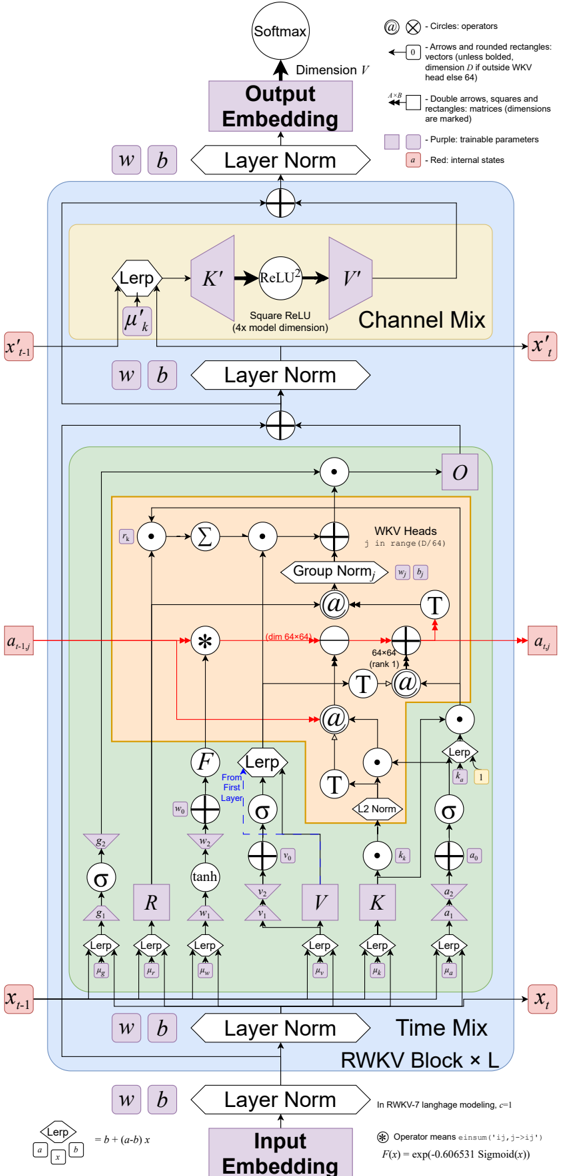
## Diagram: Transformer-Based Neural Network Architecture
### Overview
The diagram illustrates a multi-layered neural network architecture with distinct sections for input/output embedding and intermediate processing. It features color-coded components (purple, yellow, green, orange, red, blue) representing different operations and parameters. The flow progresses vertically from bottom (Input Embedding) to top (Output Embedding), with horizontal connections indicating data flow between layers.
### Components/Axes
**Legend** (top-right corner):
- **Circles**: Operators (e.g., ReLU, LERP)
- **Arrows/Rounded Rectangles**: Vectors/parameters (e.g., weights, biases)
- **Double Arrows**: Double arrows, squares, and vectors (not specified)
- **Purple Squares**: Trainable parameters
- **Red Squares**: Red internal states
**Key Sections**:
1. **Input Embedding** (bottom):
- Layer Norm (purple) with parameters `w` (weight) and `b` (bias)
- LERP operation (orange) with parameters `μ` and `k`
- ReLU activation (yellow) with squared output (4x model dimension)
2. **Channel Mix** (middle-left):
- `K'` and `V'` operations (orange) with ReLU activation
- Layer Norm (purple) with `w` and `b`
3. **WKV Heads** (middle-center):
- Multiple attention heads (orange circles) with group normalization
- Operations: `F`, `T`, `R`, `V`, `K` (orange)
- Group Norm (orange) and LERP (orange) blocks
4. **Time Mix** (middle-right):
- `RWKV Block × L` (orange) with time-mixing operations
- Layer Norm (purple) with `w` and `b`
5. **Output Embedding** (top):
- Softmax function (purple) for dimensionality reduction
- Layer Norm (purple) with `w` and `b`
### Detailed Analysis
- **Input Embedding**:
- Initial layer normalization (`w`, `b`) followed by LERP (linear interpolation) and ReLU activation.
- ReLU output is squared (4x model dimension), suggesting dimensionality expansion.
- **Channel Mix**:
- `K'` and `V'` operations (likely key/value projections) with ReLU activation.
- Layer normalization applied post-processing.
- **WKV Heads**:
- Multiple attention heads (`F`, `T`, `R`, `V`, `K`) with group normalization.
- Complex interactions between parameters (e.g., `a_{i,j}` with red arrows) suggest cross-head dependencies.
- **Time Mix**:
- `RWKV Block × L` indicates recurrent or time-aware processing (e.g., for sequential data).
- Layer normalization applied after time-mixing operations.
- **Output Embedding**:
- Final softmax layer for probability distribution over classes.
- Layer normalization ensures stable gradients.
### Key Observations
1. **Color Coding**:
- Purple dominates Layer Norm blocks, emphasizing their role in stabilizing training.
- Orange highlights attention/head operations, critical for sequence modeling.
2. **Flow Direction**:
- Vertical progression from input to output, with horizontal connections enabling cross-layer interactions (e.g., `a_{i,j}`).
3. **Complexity**:
- Multiple LERP and ReLU operations suggest non-linear transformations and parameter interpolation.
- Red internal states (squares) may represent intermediate activations or memory.
### Interpretation
This architecture resembles a transformer variant optimized for efficiency (e.g., RWKV's recurrent design). The combination of attention heads (`WKV Heads`) and time-mixing (`Time Mix`) implies it handles sequential data (e.g., text, time series) with both local and global context awareness. The use of Layer Norm and ReLU aligns with standard practices for stable training, while the squared ReLU output in the input layer suggests dimensionality expansion for richer feature representation. The red internal states (`a_{i,j}`) likely capture cross-head interactions, critical for multi-head attention mechanisms. The diagram’s modular design (e.g., `RWKV Block × L`) indicates scalability for varying sequence lengths (`L`).