## Diagram: Hierarchical Node Network with Layered Connections
### Overview
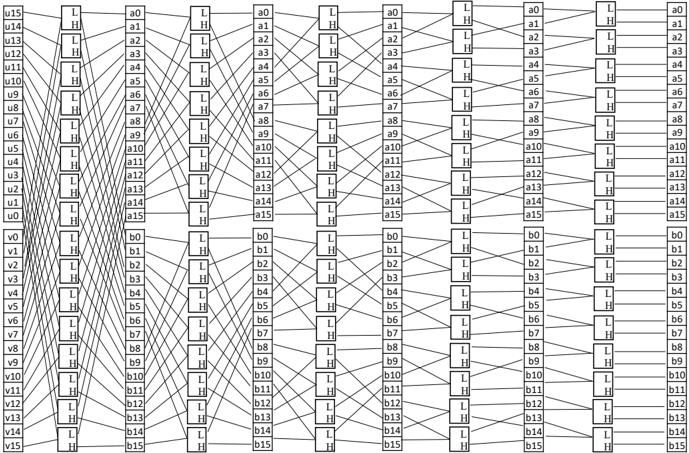
The image depicts a complex, layered network diagram with interconnected nodes and directional lines. It features two primary sections: a left section labeled with "u" nodes (u0–u15) and a right section labeled with "a" nodes (a0–a15). Each node contains a box labeled "L" or "H," and lines connect these nodes in a structured, grid-like pattern. The diagram appears to represent a hierarchical or process-oriented system with multiple layers of interaction.
### Components/Axes
- **Nodes**:
- **Left Section**:
- **u0–u15**: Nodes labeled with "u" followed by a number (e.g., u0, u1, ..., u15). Each node contains a box labeled "L" (e.g., "L H" in the box).
- **a0–a15**: Nodes labeled with "a" followed by a number (e.g., a0, a1, ..., a15). Each node contains a box labeled "H" (e.g., "L H" in the box).
- **Right Section**:
- **b0–b15**: Nodes labeled with "b" followed by a number (e.g., b0, b1, ..., b15). Each node contains a box labeled "H" (e.g., "L H" in the box).
- **Lines**:
- Lines connect "L" nodes (left section) to "H" nodes (middle and right sections).
- Lines also connect "H" nodes (middle section) to "H" nodes (right section).
- **Labels**:
- All nodes have labels (e.g., u0, a0, b0).
- Boxes within nodes contain "L" or "H" (e.g., "L H" in the box).
### Detailed Analysis
- **Left Section (u0–u15)**:
- Each "u" node (e.g., u0) connects to multiple "a" nodes (e.g., a0, a1, a2, etc.) via lines.
- The "L" box in "u" nodes suggests a "Low" or "Left" state, while the "H" box in "a" nodes suggests a "High" or "Right" state.
- **Middle Section (a0–a15)**:
- "a" nodes connect to "b" nodes (right section) via lines.
- The "H" box in "a" nodes indicates a transition or output state.
- **Right Section (b0–b15)**:
- "b" nodes are the final layer, with "H" boxes indicating a terminal or output state.
### Key Observations
1. **Many-to-Many Connections**: Each "L" node (e.g., u0) connects to multiple "H" nodes (e.g., a0, a1, a2), and vice versa.
2. **Layered Structure**: The diagram is divided into three layers: "u" (left), "a" (middle), and "b" (right).
3. **Directional Flow**: Lines flow from left to right, suggesting a process or transformation from "u" to "a" to "b."
4. **Repetitive Pattern**: The connections follow a consistent grid-like structure, with each node linked to multiple nodes in the next layer.
### Interpretation
This diagram likely represents a **hierarchical or layered system** with interconnected components. The "L" and "H" labels may denote **states** (e.g., "Low" vs. "High") or **roles** (e.g., "Left" vs. "Right") within the network. The many-to-many connections suggest **complex dependencies** or **data flow** between layers. For example:
- **u nodes** (left) act as inputs or initial states, connecting to **a nodes** (middle) as intermediate states.
- **a nodes** then connect to **b nodes** (right) as final outputs or terminal states.
- The repetition of "L H" in boxes implies a **binary or dual-state system** (e.g., active/inactive, high/low).
The diagram’s structure resembles a **neural network**, **decision tree**, or **process flow diagram**, where nodes represent entities and lines represent interactions. The absence of numerical data or explicit labels for the lines suggests the focus is on **topological relationships** rather than quantitative metrics.
### Notable Patterns
- **Symmetry**: The left and right sections mirror each other in structure (u/a/b nodes with "L H" boxes).
- **Density**: The left section has the highest density of connections, indicating a critical role in the system’s flow.
- **Terminal Nodes**: The "b" nodes (right section) have no outgoing lines, suggesting they are endpoints.
### Conclusion
This diagram illustrates a **multi-layered, interconnected system** with a clear directional flow from "u" to "a" to "b." The "L" and "H" labels likely represent states or roles, while the lines define the relationships between components. The complexity of connections highlights the system’s **interdependence** and **hierarchical organization**.