## Technical Specification Document: Sudoku Puzzle Rules and Formats
### Overview
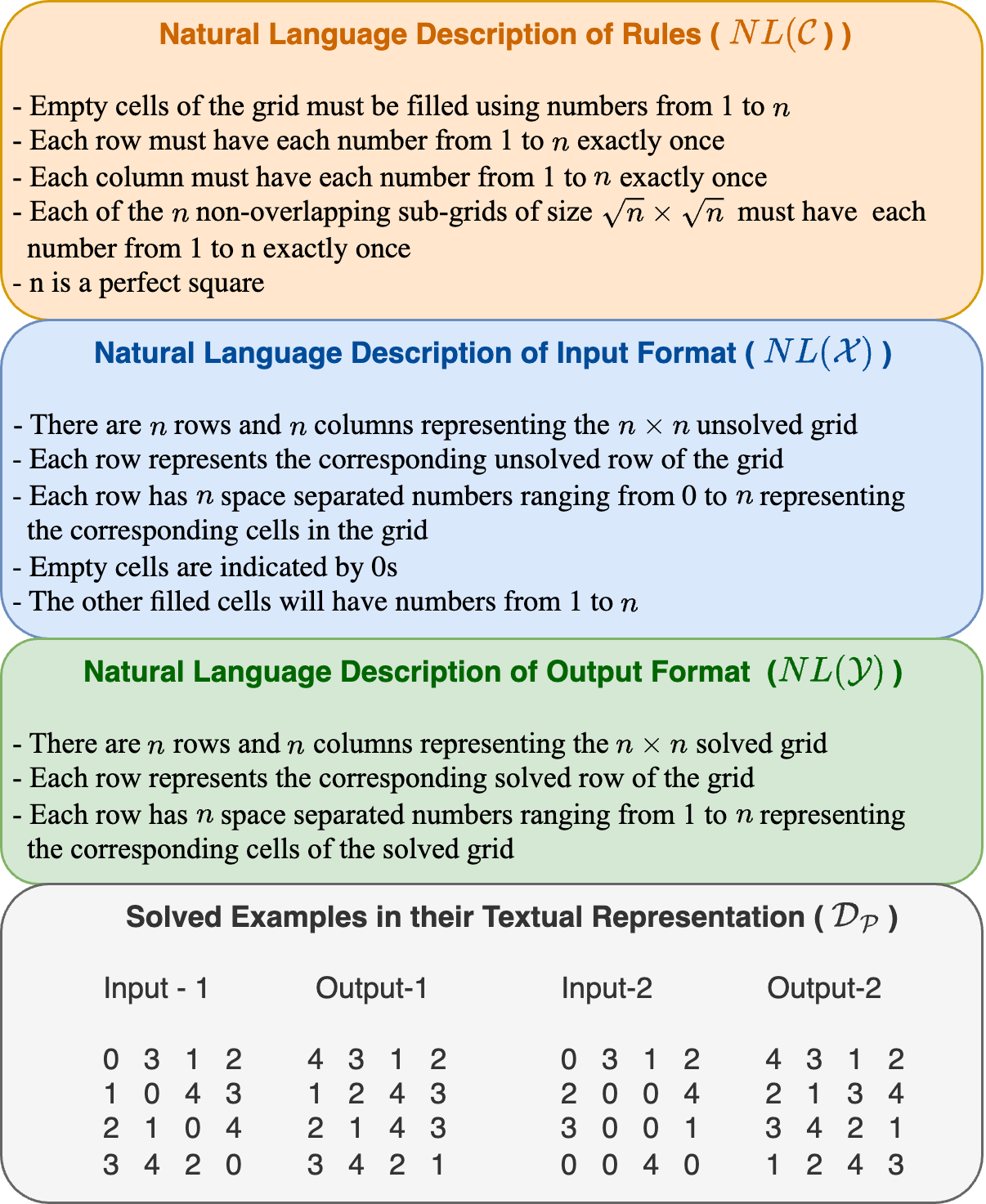
The image is a structured technical document that defines the rules, input format, output format, and provides solved examples for a Sudoku puzzle system. It is organized into four distinct, color-coded sections, each with a title and a list of specifications. The document uses mathematical notation (e.g., `n`, `√n × √n`) and formal labels (`NL(C)`, `NL(X)`, `NL(Y)`, `D_P`).
### Components/Axes
The document is segmented into four horizontal sections:
1. **Top Section (Orange Background):** Titled "Natural Language Description of Rules ( `NL(C)` )". It lists the five core rules for a valid Sudoku grid.
2. **Second Section (Blue Background):** Titled "Natural Language Description of Input Format ( `NL(X)` )". It specifies how an unsolved Sudoku grid is represented as input.
3. **Third Section (Green Background):** Titled "Natural Language Description of Output Format ( `NL(Y)` )". It specifies the format for a solved Sudoku grid as output.
4. **Bottom Section (Gray Background):** Titled "Solved Examples in their Textual Representation ( `D_P` )". It provides two concrete examples, each with an "Input" grid and its corresponding "Output" grid.
### Detailed Analysis
**Section 1: Rules (`NL(C)`)**
* **Rule 1:** Empty cells of the grid must be filled using numbers from 1 to `n`.
* **Rule 2:** Each row must have each number from 1 to `n` exactly once.
* **Rule 3:** Each column must have each number from 1 to `n` exactly once.
* **Rule 4:** Each of the `n` non-overlapping sub-grids of size `√n × √n` must have each number from 1 to `n` exactly once.
* **Rule 5:** `n` is a perfect square.
**Section 2: Input Format (`NL(X)`)**
* The input represents an `n × n` unsolved grid with `n` rows and `n` columns.
* Each row in the input corresponds to a row in the grid.
* Each row consists of `n` space-separated numbers ranging from 0 to `n`.
* The number `0` indicates an empty cell.
* All other filled cells contain numbers from 1 to `n`.
**Section 3: Output Format (`NL(Y)`)**
* The output represents the solved `n × n` grid with `n` rows and `n` columns.
* Each row in the output corresponds to a solved row in the grid.
* Each row consists of `n` space-separated numbers ranging from 1 to `n`.
**Section 4: Solved Examples (`D_P`)**
Two examples are provided for a 4x4 grid (`n=4`, sub-grid size 2x2).
* **Example 1:**
* **Input-1:**
```
0 3 1 2
1 0 4 3
2 1 0 4
3 4 2 0
```
* **Output-1:**
```
4 3 1 2
1 2 4 3
2 1 4 3
3 4 2 1
```
* **Example 2:**
* **Input-2:**
```
0 3 1 2
2 0 0 4
3 0 0 1
0 0 4 0
```
* **Output-2:**
```
4 3 1 2
2 1 3 4
3 4 2 1
1 2 4 3
```
### Key Observations
1. **Consistency:** The rules, input, and output formats are logically consistent. The input uses `0` for blanks, and the output contains only numbers 1-`n`.
2. **Example Validation:** Both solved examples adhere to all stated Sudoku rules for a 4x4 grid. Each row, column, and 2x2 sub-grid contains the numbers 1-4 exactly once.
3. **Variable Definition:** The document formally defines the problem space using the variable `n`, which must be a perfect square (e.g., 4, 9, 16), determining the grid size and sub-grid dimensions.
4. **Notation:** The labels `NL(C)`, `NL(X)`, `NL(Y)`, and `D_P` suggest this is part of a formal system, possibly for a computational or logical framework where `C` represents constraints, `X` represents input space, `Y` represents output space, and `D_P` represents a dataset of problems.
### Interpretation
This document serves as a complete, formal specification for a Sudoku puzzle instance. It defines the **problem constraints** (the rules of Sudoku), the **data representation** for both the problem (input) and the solution (output), and provides **ground truth examples** for validation.
The relationship between the sections is hierarchical and functional:
* The **Rules (`NL(C)`)** are the foundational axioms.
* The **Input Format (`NL(X)`)** defines how to encode a problem that must satisfy a subset of those rules (it will have some pre-filled cells).
* The **Output Format (`NL(Y)`)** defines the structure of a complete solution that must satisfy *all* the rules.
* The **Examples (`D_P`)** demonstrate the correct transformation from a valid input to a valid output, serving as test cases.
The inclusion of mathematical notation and formal labels indicates this specification is likely intended for an audience implementing a Sudoku solver, generator, or for use in a research context involving constraint satisfaction problems. The examples are crucial for verifying that an implementation correctly interprets the formats and applies the rules. The document is self-contained and provides all necessary information to understand the structure of the puzzle data without ambiguity.