\n
## Document: Sudoku Rule and Format Description
### Overview
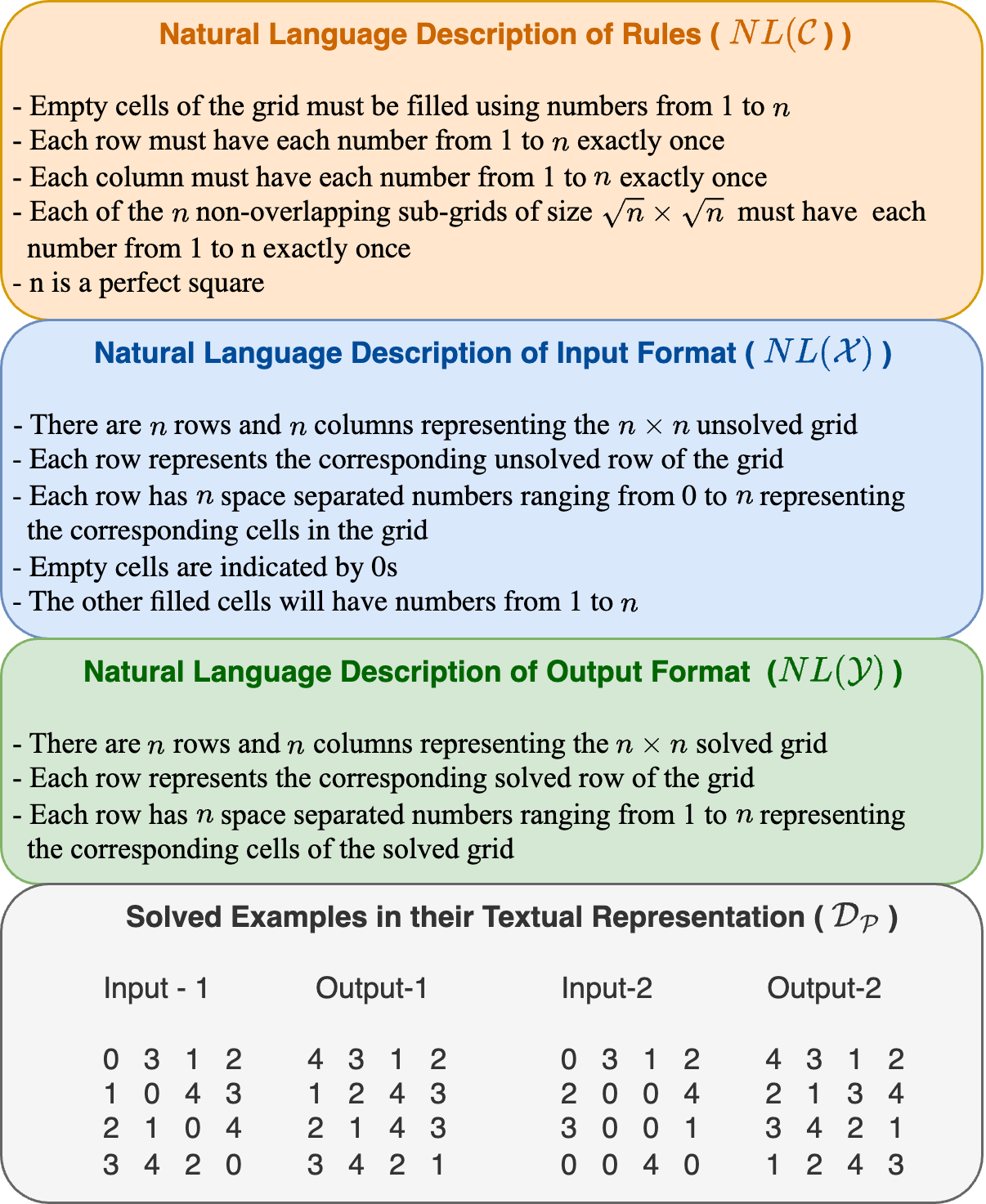
This document outlines the rules, input format, and output format for a Sudoku solver, presented as a technical specification. It includes natural language descriptions of the rules (NL(C)), input format (NL(X)), and output format (NL(Y)), along with solved examples (Dp).
### Components/Axes
The document is structured into four main sections, each with a heading:
1. **Natural Language Description of Rules (NL(C))**: Describes the constraints of a valid Sudoku grid.
2. **Natural Language Description of Input Format (NL(X))**: Describes the expected format of the input grid.
3. **Natural Language Description of Output Format (NL(Y))**: Describes the expected format of the solved grid.
4. **Solved Examples in their Textual Representation (Dp)**: Provides example input grids and their corresponding solved outputs.
### Detailed Analysis or Content Details
**1. Natural Language Description of Rules (NL(C))**
- Empty cells of the grid must be filled using numbers from 1 to n.
- Each row must have each number from 1 to n exactly once.
- Each column must have each number from 1 to n exactly once.
- Each of the n non-overlapping sub-grids of size √n x √n must have each number from 1 to n exactly once.
- n is a perfect square.
**2. Natural Language Description of Input Format (NL(X))**
- There are n rows and n columns representing the n x n unsolved grid.
- Each row represents the corresponding unsolved row of the grid.
- Each row has n space separated numbers ranging from 0 to n representing the corresponding cells in the grid.
- Empty cells are indicated by 0s.
- The other filled cells will have numbers from 1 to n.
**3. Natural Language Description of Output Format (NL(Y))**
- There are n rows and n columns representing the n x n solved grid.
- Each row represents the corresponding solved row of the grid.
- Each row has n space separated numbers ranging from 1 to n representing the corresponding cells of the solved grid.
**4. Solved Examples in their Textual Representation (Dp)**
**Input-1 / Output-1**
Input-1:
```
0 3 1 2
1 0 4 3
2 1 0 4
3 4 2 0
```
Output-1:
```
4 3 1 2
1 2 4 3
2 1 4 3
3 4 2 1
```
**Input-2 / Output-2**
Input-2:
```
0 3 1 2
2 0 0 4
3 0 0 1
0 0 4 0
```
Output-2:
```
4 3 1 2
2 1 3 4
3 4 2 1
1 2 4 3
```
### Key Observations
The document provides a formal description of the Sudoku puzzle, suitable for implementation in a computer program. The examples demonstrate a 4x4 Sudoku grid, implying that 'n' is 4 in these cases. The use of '0' to represent empty cells is consistent across input and output formats.
### Interpretation
This document serves as a specification for a Sudoku solver. It clearly defines the rules of the game, the expected input format, and the desired output format. The inclusion of solved examples aids in understanding and validating the implementation. The constraint that 'n' must be a perfect square suggests that the solver is designed to handle Sudoku grids of varying sizes (e.g., 4x4, 9x9, 16x16), although the examples only illustrate the 4x4 case. The document is written in a formal, technical style, indicating its intended audience is developers or researchers working on Sudoku solving algorithms.