## Textual Representation of Sudoku Solver Rules and Formats
### Overview
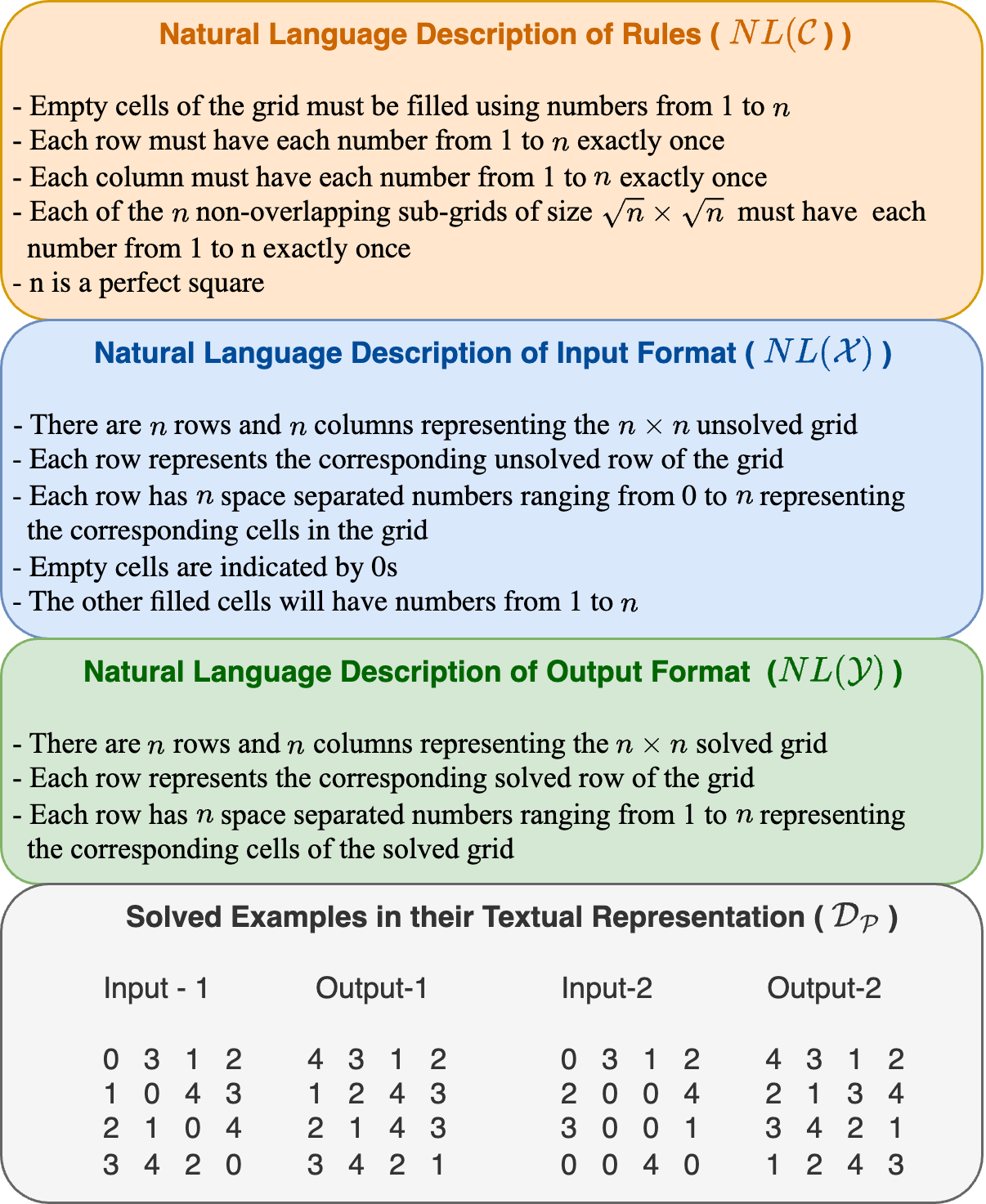
The image presents a structured textual representation of Sudoku solver components, including rules, input/output formats, and solved examples. It uses color-coded sections to organize information about Sudoku constraints, data representation, and solution validation.
### Components/Axes
1. **Natural Language Description of Rules (NL(C))** (Orange Box)
- Contains 5 bullet points defining Sudoku constraints
- Key rules:
- Grid must be filled with numbers 1-n
- Each row/column must contain 1-n exactly once
- Sub-grids of size √n×√n must contain 1-n exactly once
- n must be a perfect square
2. **Natural Language Description of Input Format (NL(X))** (Blue Box)
- Contains 5 bullet points describing input structure
- Specifies:
- n×n grid representation
- Rows represent unsolved grid state
- 0s indicate empty cells
- Filled cells contain numbers 1-n
3. **Natural Language Description of Output Format (NL(Y))** (Green Box)
- Contains 3 bullet points describing output structure
- Specifies:
- n×n grid representation
- Rows represent solved grid state
- Numbers 1-n represent filled cells
4. **Solved Examples in Textual Representation (DP)** (Gray Box)
- Contains 2 input-output pairs
- Each pair shows:
- Input grid with 0s for empty cells
- Corresponding solved grid
### Detailed Analysis
**NL(C) Rules:**
1. Empty cells must be filled with numbers 1-n
2. Each row must contain 1-n exactly once
3. Each column must contain 1-n exactly once
4. Each √n×√n sub-grid must contain 1-n exactly once
5. n must be a perfect square
**NL(X) Input Format:**
- Grid dimensions: n×n
- Cell values: 0 (empty) or 1-n (pre-filled)
- Row representation: Space-separated values
- Example Input-1: