## System Architecture Diagram: Music Processing Pipeline
### Overview
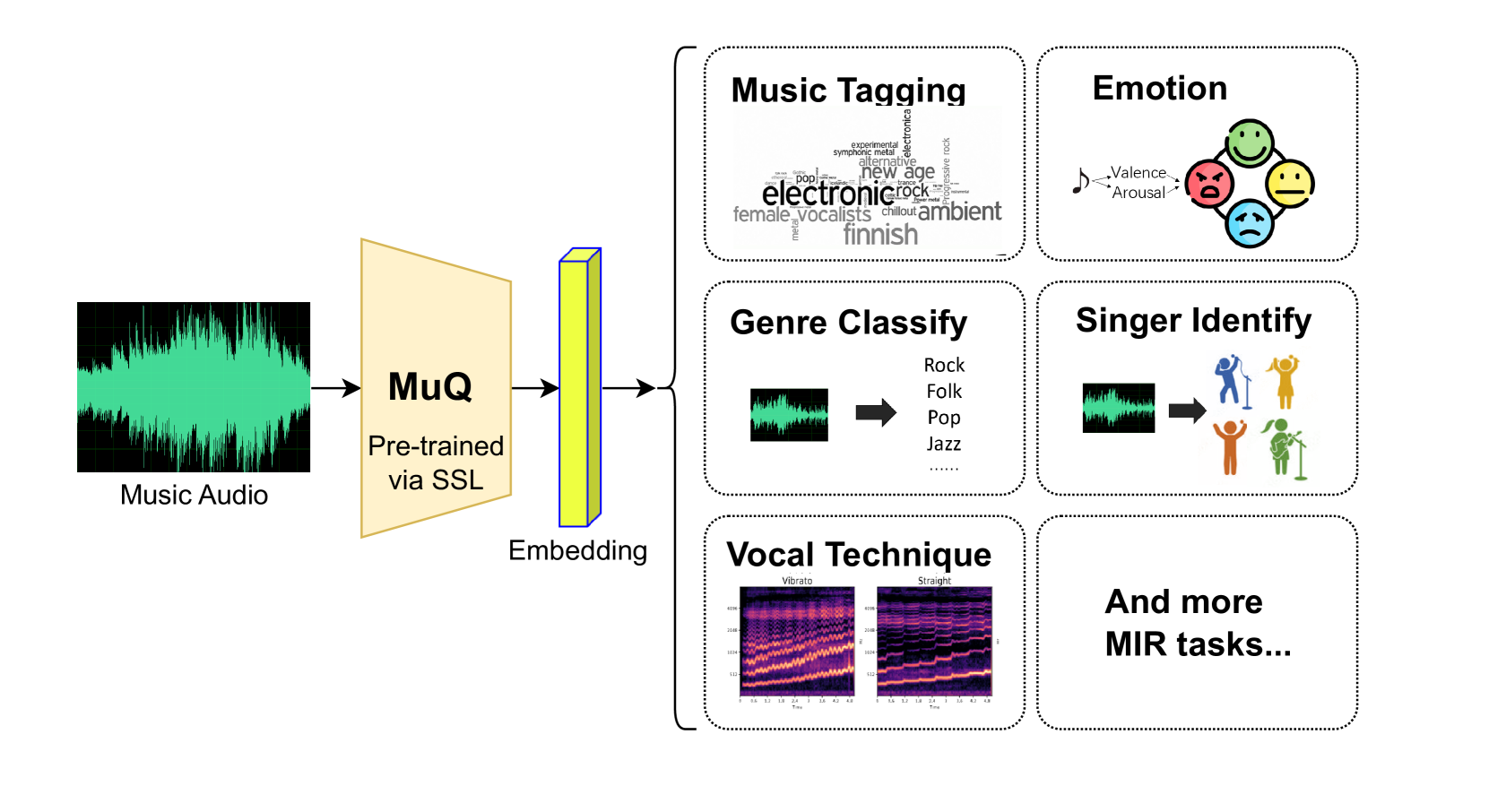
The diagram illustrates a music processing system that converts raw audio input into various music information retrieval (MIR) tasks. The pipeline begins with a spectrogram representation of music audio, processes it through a pre-trained MuQ model via self-supervised learning (SSL), and generates embeddings used for multiple downstream tasks including music tagging, emotion detection, genre classification, singer identification, vocal technique analysis, and additional MIR applications.
### Components/Axes
1. **Input**:
- **Music Audio**: Represented as a spectrogram (black background with green waveform-like pattern)
2. **Processing**:
- **MuQ**: Pre-trained via SSL (beige parallelogram)
- **Embedding**: Vertical yellow bar connecting MuQ to output tasks
3. **Output Tasks** (right-aligned boxes):
- **Music Tagging**: Contains text labels ("electronic", "rock", "new age", "female vocalists", "chillout", "ambient", "Finnish")
- **Emotion**: Circular diagram with four emoji faces (green smiley, red angry, blue sad, yellow neutral) labeled "Valence" and "Arousal"
- **Genre Classify**: Spectrogram input → text labels ("Rock", "Folk", "Pop", "Jazz")
- **Singer Identify**: Stick figure icons (orange male singer, green female singer)
- **Vocal Technique**: Two spectrograms labeled "Vibrato" (left) and "Straight" (right)
- **And more MIR tasks...**: Empty placeholder box
### Detailed Analysis
- **MuQ Processing**: The system uses a pre-trained MuQ model (likely a neural network architecture) that has been fine-tuned through self-supervised learning. This suggests the model was trained on unlabeled data before being adapted for specific tasks.
- **Embedding Generation**: The vertical yellow bar represents the transformation of raw audio features into a compressed, task-agnostic embedding space.
- **Task-Specific Outputs**:
- **Music Tagging**: Demonstrates multi-label classification capabilities, with tags spanning genre, instrumentation, mood, and cultural attributes.
- **Emotion Detection**: Uses a circular valence-arousal model with four discrete emotional states.
- **Genre Classification**: Shows hierarchical genre taxonomy (Rock > Folk > Pop > Jazz).
- **Singer Identification**: Visualizes gender-based singer classification through simplified iconography.
- **Vocal Technique Analysis**: Compares vibrato (periodic amplitude modulation) and straight tone (constant amplitude) through spectrogram visualization.
### Key Observations
1. The system architecture emphasizes modularity, with a single embedding space serving multiple MIR tasks.
2. Emotion detection uses a simplified 2D emotional space (valence × arousal) with discrete states rather than continuous values.
3. Genre classification appears to follow a tree-like taxonomy rather than flat categorization.
4. Vocal technique analysis focuses on amplitude modulation characteristics rather than spectral features.
### Interpretation
This architecture demonstrates a transfer learning approach where a single pre-trained model (MuQ) generates embeddings that can be adapted to various MIR tasks without retraining from scratch. The use of self-supervised learning suggests the system was initially trained on large unlabeled music datasets before being fine-tuned for specific applications. The diagram highlights the system's versatility in handling both categorical (genre, emotion) and continuous (vocal technique) analysis tasks. The inclusion of cultural tags ("Finnish") alongside technical features ("vibrato") indicates the system's capability to capture both acoustic and contextual music attributes. The empty "And more MIR tasks..." box implies extensibility to future applications like tempo detection, key recognition, or lyrical analysis.