## Confusion Matrix: Music Genre Classification Performance
### Overview
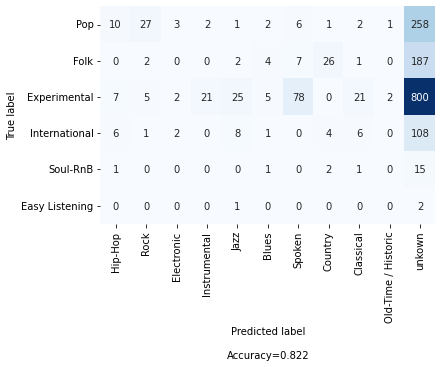
The image displays a confusion matrix visualizing the performance of a music genre classification model. It shows the distribution of true labels (actual genres) versus predicted labels (model's guesses), with numerical counts in each cell. The matrix includes totals for rows (true labels) and columns (predicted labels), along with an overall accuracy metric of 82.2%.
### Components/Axes
- **X-axis (Predicted label)**: Categories include Hip-Hop, Rock, Electronic, Instrumental, Jazz, Blues, Spoken, Country, Classical, Old-Time/Historic, and unknown.
- **Y-axis (True label)**: Categories include Pop, Folk, Experimental, International, Soul-RnB, and Easy Listening.
- **Legend**: Not explicitly visible, but cell colors likely correspond to counts (e.g., darker shades for higher values).
- **Accuracy**: 0.822 (82.2%) displayed at the bottom.
### Detailed Analysis
#### True Labels (Rows)
1. **Pop**
- Total: 258
- Correct: 10 (Pop)
- Misclassifications: 27 (Rock), 3 (Electronic), 2 (Instrumental), 1 (Jazz), 2 (Blues), 6 (Spoken), 1 (Country), 2 (Classical), 1 (Old-Time/Historic).
2. **Folk**
- Total: 187
- Correct: 26 (Country)
- Misclassifications: 2 (Rock), 4 (Blues), 7 (Spoken), 1 (Classical).
3. **Experimental**
- Total: 800
- Correct: 78 (Spoken)
- Misclassifications: 7 (Hip-Hop), 5 (Rock), 2 (Electronic), 21 (Jazz), 5 (Blues), 21 (Classical), 2 (Old-Time/Historic).
4. **International**
- Total: 108
- Correct: 8 (Jazz)
- Misclassifications: 6 (Hip-Hop), 1 (Rock), 2 (Electronic), 4 (Country), 6 (Classical).
5. **Soul-RnB**
- Total: 15
- Correct: 2 (Country)
- Misclassifications: 1 (Hip-Hop), 1 (Classical).
6. **Easy Listening**
- Total: 2
- Correct: 2 (unknown).
#### Predicted Labels (Columns)
- **Hip-Hop**: 10 (Pop), 6 (International), 1 (Soul-RnB), 1 (Easy Listening).
- **Rock**: 27 (Pop), 2 (Folk), 5 (Experimental), 1 (International).
- **Electronic**: 3 (Pop), 2 (Experimental), 2 (International).
- **Instrumental**: 2 (Pop), 21 (Experimental), 8 (International).
- **Jazz**: 1 (Pop), 25 (Experimental), 1 (International).
- **Blues**: 2 (Pop), 4 (Folk), 5 (Experimental), 1 (International).
- **Spoken**: 6 (Pop), 7 (Folk), 78 (Experimental).
- **Country**: 1 (Pop), 26 (Folk), 2 (Experimental), 2 (Soul-RnB).
- **Classical**: 2 (Pop), 1 (Folk), 21 (Experimental), 1 (International), 1 (Soul-RnB).
- **Old-Time/Historic**: 1 (Pop), 2 (Experimental).
- **Unknown**: 2 (Easy Listening).
### Key Observations
1. **Dominant Class**: Experimental has the highest total (800) and correct predictions (78), indicating it is the most frequent and well-classified genre.
2. **Misclassification Hotspots**:
- Pop is frequently misclassified as Rock (27 instances).
- Folk is often predicted as Country (26 correct) or Blues (4 misclassifications).
- Experimental has significant misclassifications in Jazz (25) and Classical (21).
3. **Low-Frequency Classes**: Soul-RnB (15 total) and Easy Listening (2 total) have minimal data, limiting model performance.
4. **Zero Counts**: Many cells contain zeros (e.g., Folk → Hip-Hop, Soul-RnB → Electronic), suggesting strong model confidence in excluding certain genre pairs.
### Interpretation
- **Model Strengths**:
- Experimental is the model's strongest category, likely due to its dominance in the dataset.
- Spoken (a subset of Experimental) is highly accurate (78/800), suggesting the model effectively captures spoken-word features.
- **Weaknesses**:
- Overlap between Pop and Rock (27 misclassifications) indicates similar acoustic features or insufficient training data for distinction.
- Experimental's misclassifications in Jazz and Classical suggest overlapping stylistic elements (e.g., improvisation, instrumentation).
- **Data Imbalance**:
- Experimental (800) dwarfs other genres (e.g., Soul-RnB: 15), which may skew the model toward favoring the majority class.
- Low counts for Soul-RnB and Easy Listening could lead to underrepresentation in predictions.
- **Accuracy Context**:
- 82.2% accuracy is moderate for genre classification, which is inherently complex due to overlapping stylistic boundaries.
- The "unknown" category (2 instances) may represent out-of-distribution data or unclassified samples.
This matrix highlights the need for balanced training data and refined feature engineering to improve performance on underrepresented genres and reduce cross-genre confusion.