\n
## Diagram: Network Pruning Illustration
### Overview
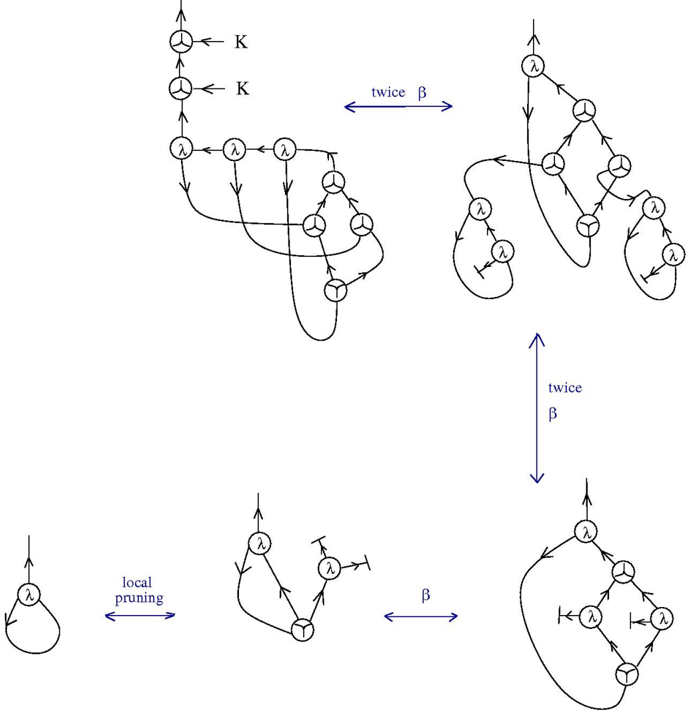
The image presents a series of diagrams illustrating a network pruning process. The diagrams depict directed graphs with nodes and edges, showing how the network structure is modified through operations labeled "twice β", "β", and "local pruning". The diagrams demonstrate a reduction in network complexity over several steps.
### Components/Axes
The diagrams consist of nodes represented by circles. Some circles contain the Greek letter lambda (λ) and some contain the Greek letter gamma (γ). Arrows indicate the direction of connections between nodes. Labels "K", "twice β", "β", and "local pruning" describe the transformations applied to the network. There are no explicit axes or scales.
### Detailed Analysis or Content Details
**Diagram 1 (Top-Left):**
* The diagram shows a network with multiple nodes.
* Two nodes at the top are labeled "K".
* Several nodes are labeled "λ".
* One node is labeled "γ".
* Connections are primarily downward and to the right, with some feedback loops.
**Diagram 2 (Top-Right):**
* This diagram is a transformation of Diagram 1, labeled "twice β".
* The network structure is more complex than Diagram 1, with additional connections and loops.
* Nodes are labeled "λ" and "γ" as in Diagram 1.
* The connections are more convoluted, with several loops.
**Diagram 3 (Bottom-Left):**
* This diagram is a transformation of Diagram 1, labeled "local pruning".
* The network is significantly simplified compared to Diagram 1.
* It consists of a single node labeled "λ" with a self-loop and a downward connection to another node labeled "λ".
**Diagram 4 (Bottom-Center):**
* This diagram is a transformation of Diagram 3, labeled "β".
* The network has been expanded slightly from Diagram 3.
* It consists of two nodes labeled "λ" connected by a downward arrow and a feedback loop.
* A node labeled "γ" is connected to the first "λ" node.
**Diagram 5 (Bottom-Right):**
* This diagram is a transformation of Diagram 4, labeled "twice β".
* The network is more complex than Diagram 4.
* It includes nodes labeled "λ", "γ", and "K".
* The connections are more intricate, with several loops and feedback paths.
### Key Observations
* The "local pruning" operation drastically reduces the network complexity.
* The "β" and "twice β" operations appear to add complexity back into the network, but in a different configuration.
* The presence of "K" nodes suggests a potential initialization or constraint within the network.
* The diagrams demonstrate a cyclical process of pruning and expansion.
### Interpretation
The diagrams illustrate a network pruning and regrowth process, likely used in machine learning or neural network optimization. The "local pruning" step removes connections, simplifying the network. The "β" and "twice β" steps then reintroduce connections, potentially to refine the network's structure or improve its performance. The "K" nodes might represent key parameters or constraints that are maintained throughout the process. The cyclical nature of the process suggests an iterative optimization algorithm. The use of Greek letters (λ and γ) likely represents specific parameters or functions within the network. The diagrams demonstrate a method for reducing network size while attempting to maintain or improve functionality. The process appears to be a form of regularization, preventing overfitting by reducing the number of parameters. The diagrams are conceptual and do not provide specific numerical data, but they effectively convey the overall process of network pruning and regrowth.