## Flowchart Diagram: Process Transformation with Pruning
### Overview
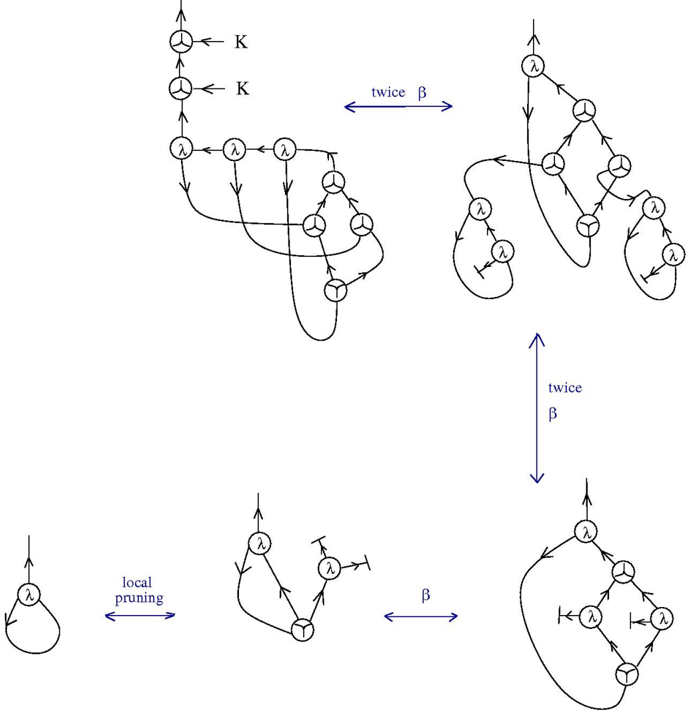
The diagram illustrates a multi-stage process involving nodes labeled **X** and **K**, interconnected by directional arrows. Key operations include transformations labeled **β** and **twice β**, culminating in a "local pruning" step that simplifies the structure. The flow emphasizes iterative refinement and structural reduction.
---
### Components/Axes
1. **Nodes**:
- **X**: Represented as circles with internal arrows (e.g., `X → X` loops).
- **K**: Labeled nodes with bidirectional arrows (e.g., `K ↔ K`).
2. **Arrows**:
- **Directional**: Indicate unidirectional flow (e.g., `X → X`).
- **Bidirectional**: Denote feedback or mutual interaction (e.g., `K ↔ K`).
3. **Labels**:
- **β**: Arrows marked with "β" or "twice β" (e.g., `→ twice β →`).
- **Local Pruning**: A final step simplifying the structure (e.g., `→ local pruning →`).
---
### Detailed Analysis
1. **Top Section**:
- Three **K** nodes are vertically stacked, connected by bidirectional arrows (`K ↔ K`).
- A cluster of **X** nodes forms a loop with internal arrows (`X → X → X`).
- Arrows connect **K** and **X** nodes, suggesting interdependencies.
2. **Middle Section**:
- A transformation labeled **twice β** splits the flow into two paths:
- One path retains the original **X** cluster.
- The other path introduces a new **X** node with a loop (`X → X`).
3. **Bottom Section**:
- **Local Pruning** reduces complexity:
- Original **X** cluster collapses into a single node.
- Bidirectional arrows (`X ↔ X`) replace the loop, indicating simplified interactions.
---
### Key Observations
- **Complexity Reduction**: The process starts with a highly interconnected structure (top) and ends with a minimalized configuration (bottom).
- **Feedback Loops**: Bidirectional arrows (`K ↔ K`, `X ↔ X`) suggest iterative adjustments or mutual dependencies.
- **β Operations**: The "twice β" label implies repeated transformations, possibly scaling or amplifying effects.
---
### Interpretation
This diagram likely represents a **system optimization or data processing pipeline**:
1. **Initial State**: The top section depicts a complex, interdependent system (e.g., a network or algorithm).
2. **Transformation**: The **β** operations introduce controlled changes, possibly refining parameters or relationships.
3. **Pruning**: The final step eliminates redundancy, retaining only essential interactions (e.g., simplifying a model or workflow).
**Notable Patterns**:
- The bidirectional arrows in the pruned structure suggest a balance between efficiency and adaptability.
- The absence of numerical values implies a conceptual rather than quantitative analysis, focusing on structural relationships.
**Underlying Insight**:
The diagram emphasizes **iterative refinement**—starting with complexity, applying transformations, and ending with a streamlined system. This aligns with principles in machine learning (model pruning), systems engineering, or process optimization.