\n
## Diagram: VirtualHome Trajectory - Runtime Error
### Overview
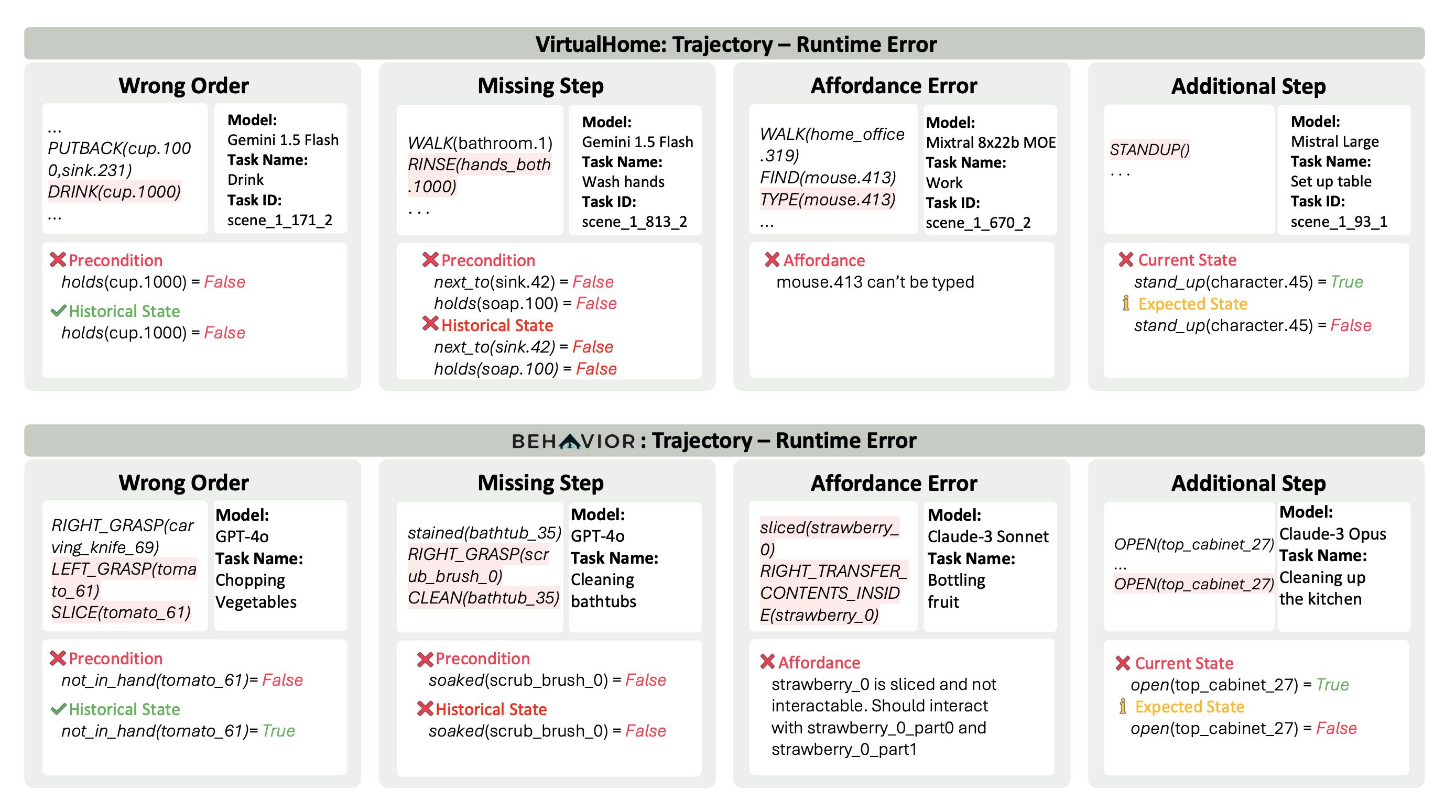
The image presents a diagram detailing runtime errors encountered in a VirtualHome environment, categorized into four types: Wrong Order, Missing Step, Affordance Error, and Additional Step. Each category displays information about the model used, task name, task ID, preconditions, historical state, and current/expected state. The diagram is split into two sections: "VirtualHome: Trajectory - Runtime Error" and "BEHAVIOR: Trajectory - Runtime Error".
### Components/Axes
The diagram is structured into a 2x2 grid for each section (VirtualHome and Behavior), with each cell representing a different error type. Each cell contains the following elements:
* **Model:** The name of the AI model used.
* **Task Name:** A brief description of the task being attempted.
* **Task ID:** A unique identifier for the task.
* **Precondition:** A boolean statement representing a condition that should be true before the task step.
* **Historical State:** A boolean statement representing the state of the environment before the task step.
* **Affordance Error/Current State/Expected State:** Depending on the error type, this section details the specific issue encountered.
### Detailed Analysis or Content Details
**VirtualHome: Trajectory - Runtime Error**
* **Wrong Order:**
* Model: Gemini 1.5 Flash
* Task Name: Drink
* Task ID: scene_1_171_2
* Precondition: holds(cup.1000) = False
* Historical State: DRINK(cup.1000) = False
* **Missing Step:**
* Model: Gemini 1.5 Flash
* Task Name: Wash hands
* Task ID: scene_1_813_2
* Precondition: next_to(sink.42) = False, holds(soap.100) = False
* Historical State: next_to(sink.42) = False, holds(soap.100) = False
* **Affordance Error:**
* Model: Mixtral 8x22b MOE
* Task Name: Work
* Task ID: scene_1_670_2
* Affordance: mouse.413 can't be typed
* **Additional Step:**
* Model: Mistral Large
* Task Name: Set up table
* Task ID: scene_1_93_1
* Current State: stand_up(character.45) = True
* Expected State: stand_up(character.45) = False
**BEHAVIOR: Trajectory - Runtime Error**
* **Wrong Order:**
* Model: GPT-4o
* Task Name: Chopping Vegetables
* Task ID: scene_1_61
* Precondition: next_in_hand(tomato.61) = False, SLICE(tomato.61) = False
* Historical State: next_in_hand(tomato.61) = False, SLICE(tomato.61) = False
* **Missing Step:**
* Model: GPT-4o
* Task Name: Cleaning bathtubs
* Task ID: scene_1_35
* Precondition: clean(scrub_brush.0) = False, soak(scrub_brush.0) = False
* Historical State: clean(scrub_brush.0) = False, soak(scrub_brush.0) = False
* **Affordance Error:**
* Model: Claude-3 Sonnet
* Task Name: Bottling fruit
* Task ID: scene_1_0
* Affordance: strawberry.0 is sliced into affordable. Should instead work with strawberry.0 and strawberry_peeler.0
* **Additional Step:**
* Model: Claude-3 Opus
* Task Name: Cleaning up the kitchen
* Task ID: scene_1_27
* Current State: open(top_cabinet.27) = True
* Expected State: open(top_cabinet.27) = False
### Key Observations
* The errors are diverse, ranging from incorrect task sequencing ("Wrong Order") to missing necessary actions ("Missing Step") and issues with object interaction ("Affordance Error").
* Multiple models are used (Gemini, Mixtral, GPT-4o, Claude), suggesting a comparative analysis of their performance.
* The "Current State" and "Expected State" discrepancies in the "Additional Step" errors indicate the model is performing actions beyond what was intended.
* The "Affordance Error" descriptions are detailed, pinpointing the specific issue with object interaction.
### Interpretation
This diagram illustrates the challenges in creating AI agents that can reliably perform tasks in a virtual environment. The runtime errors highlight the complexities of reasoning about preconditions, historical states, and object affordances. The use of different models suggests an attempt to identify which models are more robust to these types of errors. The errors are not random; they are specific and reveal underlying issues in the agent's planning and execution capabilities. For example, the "Affordance Error" involving the strawberry suggests the model is not correctly understanding the relationship between the object's state (sliced vs. whole) and the appropriate tools for manipulation. The "Additional Step" errors suggest the model is sometimes overzealous in its actions, performing steps that are not necessary or even counterproductive. This data is valuable for debugging and improving the AI models' ability to navigate and interact with the virtual environment effectively. The diagram provides a structured way to categorize and analyze these errors, facilitating targeted improvements to the AI agents' behavior.