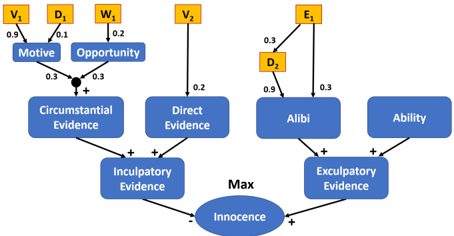
## Flowchart: Innocence Determination Framework
### Overview
The flowchart illustrates a probabilistic model for determining innocence based on evidence types (Circumstantial, Direct, Inculpatory, Exculpatory) and factors (Motive, Opportunity, Alibi, Ability). Arrows represent weighted relationships between components, culminating in a "Max" operation to derive the final Innocence conclusion.
### Components/Axes
- **Nodes**:
- **Motive**: Contains variables `V1` (0.9), `D1` (0.1), `W1` (0.2).
- **Opportunity**: Contains variable `V2` (0.2).
- **Alibi**: Contains variable `E1` (0.3).
- **Ability**: Contains variable `D2` (0.9).
- **Evidence Types**:
- **Circumstantial Evidence**: Sum of `V1` (0.9) and `D1` (0.1) → 0.3.
- **Direct Evidence**: Sum of `V2` (0.2) → 0.2.
- **Inculpatory Evidence**: Sum of Circumstantial (0.3) and Direct (0.2) → 0.5.
- **Exculpatory Evidence**: Sum of Alibi (0.3) and Ability (0.9) → 0.6.
- **Final Output**: "Max" of Inculpatory (0.5) and Exculpatory (0.6) → **Innocence**.
### Detailed Analysis
- **Motive**: Dominated by `V1` (0.9), with minor contributions from `D1` (0.1) and `W1` (0.2).
- **Opportunity**: Weakly supported by `V2` (0.2).
- **Alibi**: Moderately supported by `E1` (0.3).
- **Ability**: Strongly supported by `D2` (0.9).
- **Evidence Flow**:
- Circumstantial and Direct Evidence combine to form Inculpatory Evidence (0.5).
- Alibi and Ability combine to form Exculpatory Evidence (0.6).
- The "Max" operation prioritizes the stronger evidence type (Exculpatory), leading to Innocence.
### Key Observations
1. **High-Weight Variables**:
- `V1` (Motive: 0.9) and `D2` (Ability: 0.9) are the strongest contributors.
- `W1` (Opportunity: 0.2) and `E1` (Alibi: 0.3) are the weakest.
2. **Evidence Balance**:
- Exculpatory Evidence (0.6) outweighs Inculpatory Evidence (0.5), favoring Innocence.
3. **Probabilistic Logic**:
- The "Max" function suggests a threshold-based decision, where the dominant evidence type determines the outcome.
### Interpretation
The flowchart emphasizes that Innocence hinges on the interplay between Inculpatory and Exculpatory Evidence. While Motive and Ability are strongly supported, the model prioritizes Exculpatory Evidence (Alibi + Ability) over Inculpatory Evidence (Circumstantial + Direct). This implies that robust Alibi and Ability claims can override weaker Inculpatory factors, even if Motive is partially disputed (`D1` = 0.1). The use of "Max" introduces ambiguity about whether evidence is aggregated additively or through a threshold mechanism. Notably, Opportunity (`V2` = 0.2) has minimal impact, suggesting it is less critical in this framework.
**Uncertainties**:
- The exact mathematical operation for combining evidence (e.g., additive vs. multiplicative) is unspecified.
- The role of `W1` (Opportunity: 0.2) remains unclear—whether it is a standalone factor or part of a larger calculation.