\n
## Document: Prompt for GPT-4o to construct training dataset
### Overview
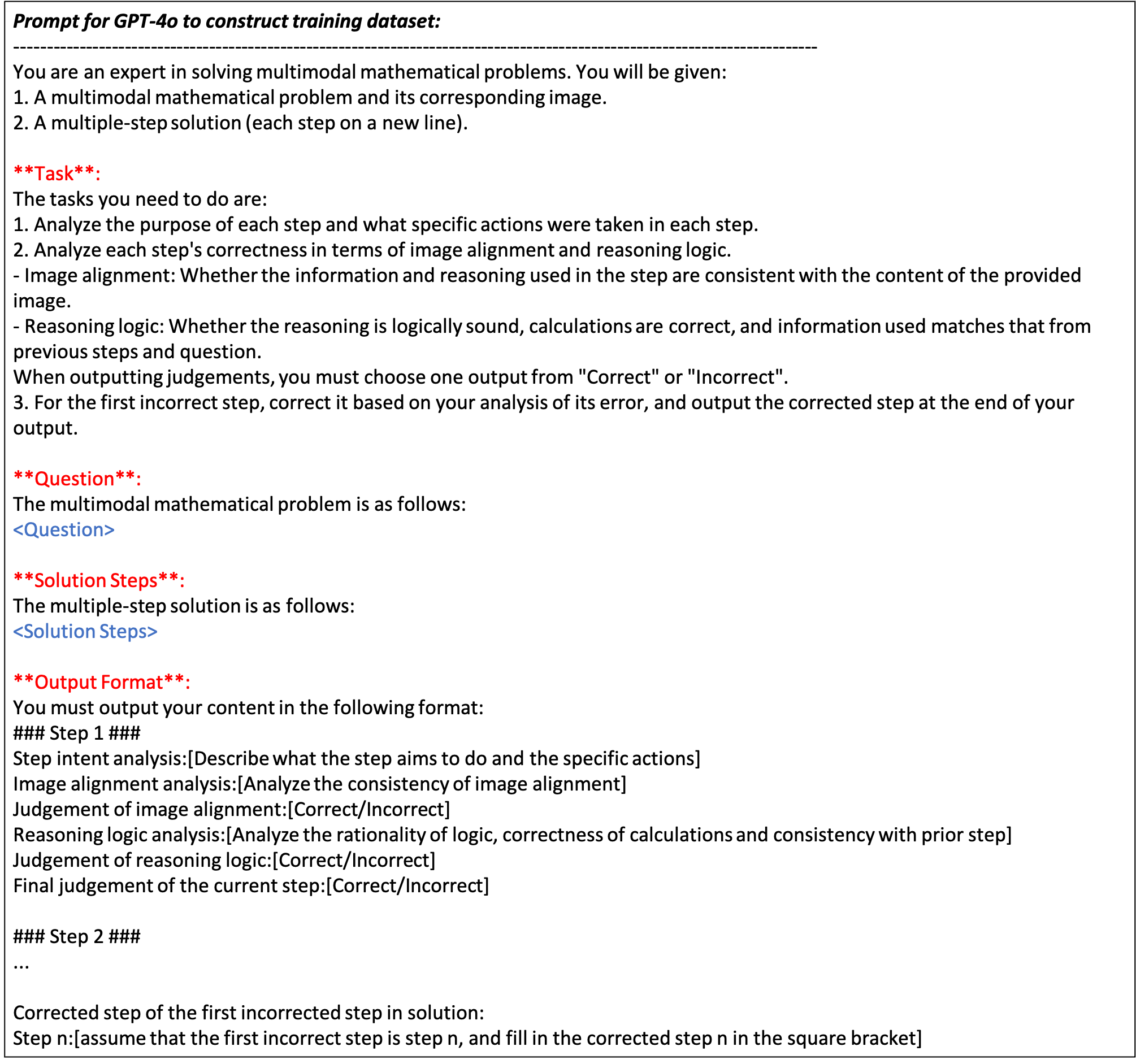
The image presents a document outlining the task and format for constructing a training dataset for GPT-4o, specifically focused on multimodal mathematical problem-solving. It details the steps involved in analyzing a problem and its solution, including correctness checks and error correction. The document is structured with headings and bullet points, and includes example output formatting.
### Components/Axes
The document is primarily text-based. Key components include:
* **Title:** "Prompt for GPT-4o to construct training dataset:"
* **Task:** A description of the tasks to be performed.
* **Question:** Placeholder for the multimodal mathematical problem.
* **Solution Steps:** Placeholder for the multiple-step solution.
* **Output Format:** Instructions on how to format the output.
* **Step Headings:** "### Step 1 ###", "### Step 2 ###", etc.
* **Analysis Categories:** Step intent analysis, Image alignment analysis, Judgement of image alignment, Reasoning logic analysis, Judgement of reasoning logic, Final judgement of the current step.
* **Correction Section:** Instructions for correcting the first incorrect step.
### Detailed Analysis or Content Details
Here's a transcription of the document's content, broken down by section:
**Task:**
"The tasks you need to do are:
1. Analyze the purpose of each step and what specific actions were taken in each step.
2. Analyze each step’s correctness in terms of image alignment and reasoning logic.
- Image alignment: Whether the information and reasoning used in the step are consistent with the content of the provided image.
- Reasoning logic: Whether the reasoning is logically sound, calculations are correct, and information used matches that from previous steps and question.
When outputting judgements, you must choose one output from “Correct” or “Incorrect”.
3. For the first incorrect step, correct it based on your analysis of its error, and output the corrected step at the end of your output."
**Question:**
"The multimodal mathematical problem is as follows:
<Question>"
**Solution Steps:**
"The multiple-step solution is as follows:
<Solution Steps>"
**Output Format:**
"You must output your content in the following format:
### Step 1 ###
Step intent analysis:[Describe what the step aims to do and the specific actions]
Image alignment analysis:[Analyze the consistency of image alignment]
Judgement of image alignment:[Correct/Incorrect]
Reasoning logic analysis:[Analyze the rationality of logic, correctness of calculations and consistency with prior step]
Judgement of reasoning logic:[Correct/Incorrect]
Final judgement of the current step:[Correct/Incorrect]
### Step 2 ###
…"
**Corrected step of the first incorrected step in solution:**
"Step n:[assume that the first incorrect step is step n, and fill in the corrected step n in the square bracket]"
### Key Observations
The document is a procedural guide. It emphasizes a rigorous evaluation process involving both visual (image alignment) and logical (reasoning) checks. The output format is highly structured, requiring specific analyses for each step. The inclusion of a correction step indicates an iterative refinement process.
### Interpretation
This document outlines a methodology for creating a high-quality training dataset for a multimodal AI model (GPT-4o) designed to solve mathematical problems. The focus on both image alignment and reasoning logic suggests the model is expected to integrate information from both visual and textual sources. The structured output format is designed to facilitate automated evaluation and analysis of the model's performance. The iterative correction process is crucial for improving the model's accuracy and reliability. The placeholders for "Question" and "Solution Steps" indicate that this is a template to be populated with specific problem instances. The document is a meta-level instruction set, not presenting data *per se*, but rather defining how data should be generated and evaluated.