## Diagram: bee-resurrection conceptual framework
### Overview
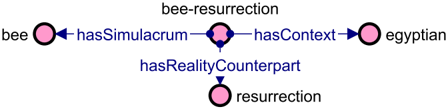
The diagram illustrates a conceptual framework titled "bee-resurrection," depicting relationships between entities through directed arrows and labeled nodes. It combines elements of semiotics, mythology, and philosophical concepts.
### Components/Axes
- **Nodes**:
- `bee` (leftmost node)
- `hasSimulacrum` (central node)
- `hasContext` (right of `hasSimulacrum`)
- `egyptian` (rightmost node)
- `resurrection` (bottom node)
- **Arrows**:
- `bee → hasSimulacrum` (labeled "hasSimulacrum")
- `hasSimulacrum → hasContext` (labeled "hasContext")
- `hasSimulacrum → resurrection` (labeled "hasRealityCounterpart")
- `hasContext → egyptian` (labeled "hasContext")
### Detailed Analysis
- **Node Relationships**:
- The `bee` node initiates the flow, connecting to `hasSimulacrum`, which acts as a central hub.
- `hasSimulacrum` branches into two paths:
1. To `hasContext`, which then links to `egyptian`.
2. Directly to `resurrection` via "hasRealityCounterpart."
- **Labels**:
- All arrow labels are explicit and unambiguous (e.g., "hasSimulacrum," "hasRealityCounterpart").
- No numerical data or scales are present.
### Key Observations
- The diagram emphasizes hierarchical and associative relationships, with `hasSimulacrum` serving as a pivotal node.
- The term "resurrection" is positioned as a reality counterpart to the simulacrum, suggesting a philosophical contrast between simulation and authenticity.
- The inclusion of "egyptian" implies a cultural or symbolic context tied to the concept of resurrection.
### Interpretation
This diagram appears to explore the idea of "bee-resurrection" as a metaphorical or conceptual process. The `bee` (a symbol of industriousness or community) generates a *simulacrum* (a copy without an original), which then acquires contextual meaning through its association with "egyptian" (possibly referencing Egyptian mythology, where resurrection is a central theme). The "resurrection" node, linked via "hasRealityCounterpart," suggests a tension between simulated existence and genuine revival.
The structure aligns with Jean Baudrillard’s theory of simulacra, where copies precede and replace the original, while the "resurrection" node introduces a counterpoint to this cycle. The "egyptian" context may allude to the myth of Osiris or the afterlife, framing resurrection as both a cultural narrative and a philosophical inquiry.
No numerical data or trends are present; the diagram focuses on abstract relationships rather than empirical analysis.