## Violin Plot: F1 Score of Human Classifier
### Overview
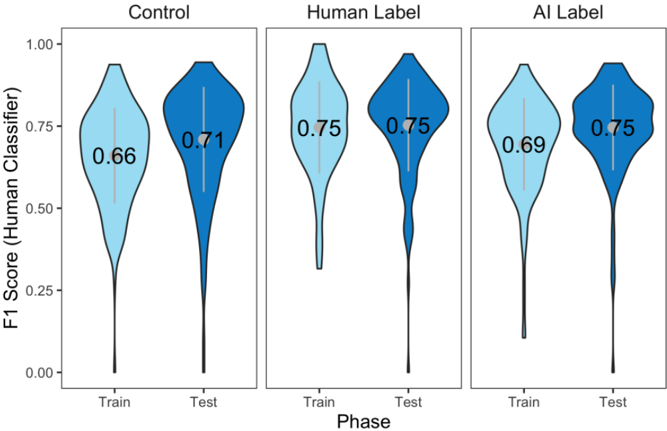
The image presents three violin plots comparing the F1 scores of a human classifier under different labeling conditions: "Control", "Human Label", and "AI Label". Each plot shows the distribution of F1 scores for both the training and testing phases. The y-axis represents the F1 score, ranging from 0.00 to 1.00, while the x-axis indicates the phase (Train or Test). The violin plots are colored in light blue for the training phase and dark blue for the testing phase.
### Components/Axes
* **Title:** Control, Human Label, AI Label (placed above each violin plot)
* **Y-axis Label:** F1 Score (Human Classifier)
* **Y-axis Scale:** 0.00, 0.25, 0.50, 0.75, 1.00
* **X-axis Label:** Phase
* **X-axis Categories:** Train, Test
* **Violin Plot Colors:** Light Blue (Train), Dark Blue (Test)
### Detailed Analysis
**Control:**
* **Train (Light Blue):** The violin plot for the training phase is centered around 0.66.
* **Test (Dark Blue):** The violin plot for the testing phase is centered around 0.71.
**Human Label:**
* **Train (Light Blue):** The violin plot for the training phase is centered around 0.75.
* **Test (Dark Blue):** The violin plot for the testing phase is centered around 0.75.
**AI Label:**
* **Train (Light Blue):** The violin plot for the training phase is centered around 0.69.
* **Test (Dark Blue):** The violin plot for the testing phase is centered around 0.75.
### Key Observations
* The "Human Label" condition shows the highest and most consistent F1 scores (0.75 for both train and test).
* The "Control" condition has the lowest F1 score during the training phase (0.66).
* The "AI Label" condition shows a noticeable increase in F1 score from the training (0.69) to the testing phase (0.75).
* The F1 scores for the "Test" phase are consistently higher than the "Train" phase, except for the "Human Label" condition where they are equal.
### Interpretation
The violin plots suggest that human labeling leads to the best performance for the human classifier, as indicated by the consistently high F1 scores in the "Human Label" condition. The "Control" condition, presumably without any specific labeling intervention, results in the lowest training performance. The "AI Label" condition shows a performance improvement from training to testing, suggesting that the AI-generated labels might be beneficial for generalization. The fact that the "Test" phase generally has higher F1 scores than the "Train" phase indicates that the classifier is generalizing well, except in the "Human Label" condition where the performance is already optimal during training.