TECHNICAL ASSET FINGERPRINT
fcd9b6bbed6fd947e8d328a1
Click to view fullscreen
Press ESC or click to close
FOUND IN PAPERS
EXPERT: gemini-2.5-flash-free VERSION 1
RUNTIME: google-free/gemini-2.5-flash
INTEL_VERIFIED
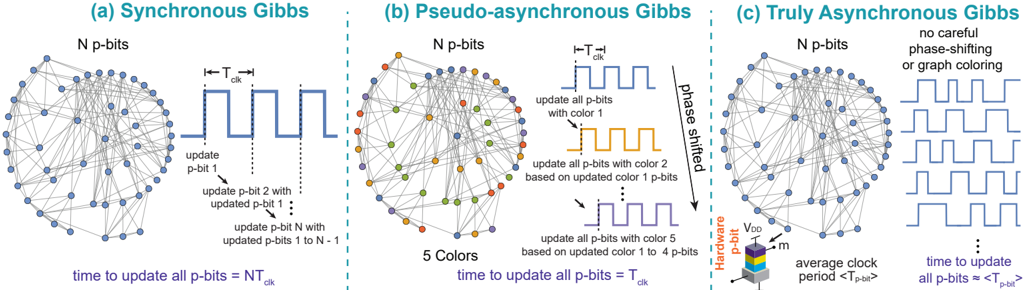
## Diagram: Comparison of Gibbs Sampling Architectures
### Overview
This image is a comparative technical diagram illustrating three different approaches to Gibbs sampling: (a) Synchronous Gibbs, (b) Pseudo-asynchronous Gibbs, and (c) Truly Asynchronous Gibbs. Each section presents a graphical representation of 'N p-bits' (probabilistic bits) and associated timing diagrams or hardware concepts, highlighting the differences in their update mechanisms and overall execution time.
### Components/Axes
The image is divided into three main vertical sections, labeled (a), (b), and (c) at the top. Each section features a graph of interconnected nodes (p-bits) and a representation of their update timing or hardware.
**Common Elements Across Sections:**
* **Graph of p-bits:** Each section displays a graph composed of approximately 35-40 circular nodes, labeled "N p-bits" at the top-center of each graph. These nodes are interconnected by numerous grey lines, representing dependencies or connections between the p-bits.
**Section (a) Synchronous Gibbs:**
* **Title:** (a) Synchronous Gibbs (top-left, teal text)
* **Graph:** Located on the left, all nodes are colored blue.
* **Timing Diagram:** To the right of the graph, a blue square wave clock signal is shown.
* **Clock Period:** A horizontal double-headed arrow above the square wave indicates "T_clk".
* **Update Descriptions:** Vertical dotted lines extend from the falling edges of the clock signal to text labels below:
* "update p-bit 1"
* "update p-bit 2 with updated p-bit 1"
* A vertical ellipsis "⋮"
* "update p-bit N with updated p-bits 1 to N - 1"
* **Total Update Time:** At the bottom-center of section (a), the text "time to update all p-bits = N T_clk" is present.
**Section (b) Pseudo-asynchronous Gibbs:**
* **Title:** (b) Pseudo-asynchronous Gibbs (top-center, teal text)
* **Graph:** Located on the left, the nodes are colored with five distinct colors: blue, orange, green, purple, and red.
* **Color Count Label:** Below the graph, the text "5 Colors" is present.
* **Timing Diagrams:** To the right of the graph, three distinct square wave clock signals are shown, vertically stacked and phase-shifted.
* **Top Clock (Blue):** "update all p-bits with color 1"
* **Middle Clock (Orange):** Phase-shifted to the right relative to the blue clock. "update all p-bits with color 2 based on updated color 1 p-bits"
* **Bottom Clock (Purple):** Phase-shifted further to the right. A vertical ellipsis "⋮" is shown above it. "update all p-bits with color 5 based on updated color 1 to 4 p-bits"
* **Phase Shift Indicator:** A large vertical arrow on the right side of the clock signals points downwards, labeled "phase shifted".
* **Total Update Time:** At the bottom-center of section (b), the text "time to update all p-bits = T_clk" is present.
**Section (c) Truly Asynchronous Gibbs:**
* **Title:** (c) Truly Asynchronous Gibbs (top-right, teal text)
* **Graph:** Located on the left, all nodes are colored blue, similar to section (a).
* **Timing Diagrams:** To the right of the graph, four blue square wave clock signals are stacked vertically, appearing unsynchronized.
* **Description:** Above the clock signals, the text "no careful phase-shifting or graph coloring" is present.
* A vertical ellipsis "⋮" is shown below the fourth clock signal.
* **Hardware Diagram:** Below the graph, a small 3D representation of a hardware stack is shown.
* It consists of a grey base, a blue block, a yellow block, and a purple block stacked vertically.
* An arrow points from the top of the purple block to "V_DD".
* An arrow points from the bottom of the grey base to "m".
* A label "Hardware" is placed vertically to the left of the stack.
* An arrow points from the yellow middle block to "p-bit".
* **Total Update Time:** At the bottom-center of section (c), the text "average clock period <T_p-bit>" and "time to update all p-bits ≈ <T_p-bit>" are present.
### Detailed Analysis
**Section (a) Synchronous Gibbs:**
* **Graph:** Represents a fully connected or densely connected network of p-bits, where all p-bits are treated uniformly (indicated by uniform blue coloring).
* **Timing:** The clock signal is a regular square wave. The update process is strictly sequential: p-bit 1 is updated, then p-bit 2 using the *new* value of p-bit 1, and so on, up to p-bit N using the *new* values of p-bits 1 through N-1. This implies a serial computation where each p-bit update takes one clock cycle (`T_clk`).
* **Performance:** The total time to update all N p-bits is directly proportional to N, specifically `N * T_clk`.
**Section (b) Pseudo-asynchronous Gibbs:**
* **Graph:** The p-bits are partitioned into 5 distinct groups, each represented by a different color (blue, orange, green, purple, red). This suggests a graph coloring approach, where nodes of the same color are independent and can be updated concurrently.
* **Timing:** There are 5 distinct clock signals, one for each color group. These clocks are phase-shifted, meaning the update for one color group begins only after the previous color group has completed its update.
* Color 1 p-bits are updated first (blue clock).
* Color 2 p-bits are updated next, *based on the updated color 1 p-bits* (orange clock).
* This sequential dependency continues up to color 5 p-bits, which are updated based on the updated p-bits of colors 1 through 4 (purple clock).
* **Performance:** Despite the sequential dependencies between color groups, the update of *all* p-bits within a single color group happens concurrently within one clock cycle. Therefore, the total time to update all p-bits is reduced to a single clock period, `T_clk`, assuming the number of colors is fixed and the updates for each color group can complete within one `T_clk`.
**Section (c) Truly Asynchronous Gibbs:**
* **Graph:** Similar to section (a), all p-bits are uniformly blue, indicating no explicit graph coloring is used for synchronization.
* **Timing:** Multiple clock signals are shown, but they are explicitly stated to have "no careful phase-shifting or graph coloring". This implies that each p-bit (or a small group of p-bits) operates with its own independent, unsynchronized clock.
* **Hardware:** The hardware diagram illustrates a single "p-bit" as a component within a stack, potentially representing a memory or processing unit. "V_DD" likely refers to the supply voltage, and "m" could represent a ground or another control signal. The "Hardware" label suggests that this asynchronous operation is enabled by specific hardware design.
* **Performance:** The update time for all p-bits is approximated by the "average clock period `<T_p-bit>`". This suggests that updates happen continuously and in parallel across the system, with the overall completion time being dictated by the average time it takes for an individual p-bit to update.
### Key Observations
* **Synchronization vs. Speed:** The diagram clearly shows a progression from highly synchronous and slow (`N * T_clk`) to fully asynchronous and fast (`≈ <T_p-bit>`).
* **Graph Coloring:** Graph coloring is introduced in the pseudo-asynchronous method to enable parallel updates within color groups, but still requires sequential processing between groups. It is explicitly absent in the truly asynchronous method.
* **Phase Shifting:** Careful phase-shifting is a characteristic of the pseudo-asynchronous method, ensuring ordered updates between color groups. It is absent in the truly asynchronous method.
* **Hardware Implications:** The "Truly Asynchronous Gibbs" section explicitly introduces a hardware component, suggesting that achieving true asynchronous operation requires specific hardware design beyond just timing protocols.
### Interpretation
This diagram illustrates different strategies for implementing Gibbs sampling, a Markov Chain Monte Carlo (MCMC) algorithm often used in statistical inference and machine learning. The core challenge addressed is how to efficiently update a large number of interdependent probabilistic variables (p-bits).
1. **Synchronous Gibbs (a):** Represents a naive, serial implementation. Each p-bit is updated one by one, with each update potentially depending on the *latest* values of previously updated p-bits. This ensures correctness but is computationally expensive, scaling linearly with the number of p-bits (N). This approach is simple to implement but slow for large N.
2. **Pseudo-asynchronous Gibbs (b):** This method introduces parallelism by grouping p-bits into "colors" such that p-bits of the same color are independent and can be updated simultaneously. However, dependencies still exist *between* color groups, necessitating a sequential, phase-shifted update schedule. This significantly reduces the total update time from `N * T_clk` to `T_clk` (assuming the number of colors is constant and the update for each color group fits within `T_clk`), making it much faster than the synchronous approach. This is a common optimization technique in parallel computing, often relying on graph coloring algorithms to identify independent sets.
3. **Truly Asynchronous Gibbs (c):** This represents the most advanced and potentially fastest approach. It eliminates the need for global synchronization, careful phase-shifting, or even explicit graph coloring. Each p-bit (or local cluster of p-bits) updates independently whenever it's ready, potentially using its own local clock or event-driven mechanism. This approach leverages the inherent parallelism of the system to its maximum, with the total update time approaching the average time for a single p-bit update. The explicit mention of "Hardware" suggests that achieving this level of asynchronicity often requires specialized hardware design, such as self-timed circuits or event-driven architectures, which can be more complex to design but offer significant performance benefits for certain types of computations.
In essence, the diagram demonstrates a trade-off between implementation complexity and computational speed, moving from a simple, slow synchronous model to a complex, fast asynchronous model for Gibbs sampling. The pseudo-asynchronous method offers a practical intermediate step, balancing parallelism with manageable synchronization.
DECODING INTELLIGENCE...