## Diagram: Comparison of Naive Chain-of-Thought (CoT) and CCoT Reasoning Paths for a Word Problem
### Overview
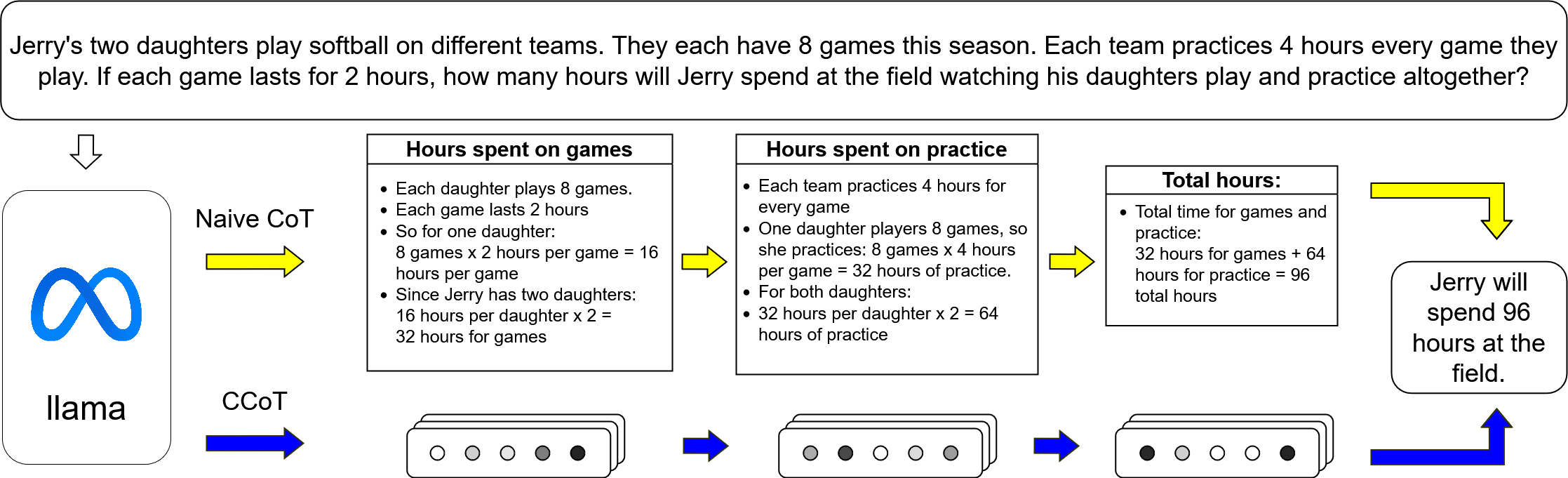
The image is a technical diagram illustrating and comparing two different reasoning pathways—labeled "Naive CoT" (Chain-of-Thought) and "CCoT"—used by a language model (represented by a "llama" icon) to solve a multi-step arithmetic word problem. Both pathways originate from the same problem statement and arrive at the same final numerical answer, but they are depicted with different visual representations of their internal reasoning processes.
### Components/Axes
The diagram is structured into three main horizontal regions:
1. **Header (Top):** A rounded rectangle containing the full text of the word problem.
2. **Main Diagram (Center):** Two parallel, horizontal flowcharts.
* **Left Origin:** A rounded rectangle containing a blue infinity-like logo and the text "llama".
* **Upper Path (Naive CoT):** A sequence of three rectangular boxes connected by yellow arrows, detailing explicit mathematical steps.
* **Lower Path (CCoT):** A sequence of three graphical elements (each a stack of five circles with varying shades) connected by blue arrows, representing an abstract reasoning process.
3. **Footer/Conclusion (Right):** A final rounded rectangle containing the answer, connected by both a yellow arrow (from Naive CoT) and a blue arrow (from CCoT).
**Textual Elements & Labels:**
* **Problem Statement:** "Jerry's two daughters play softball on different teams. They each have 8 games this season. Each team practices 4 hours every game they play. If each game lasts for 2 hours, how many hours will Jerry spend at the field watching his daughters play and practice altogether?"
* **Pathway Labels:** "Naive CoT" (above a yellow arrow) and "CCoT" (above a blue arrow).
* **Box Titles (Naive CoT Path):**
* "Hours spent on games"
* "Hours spent on practice"
* "Total hours:"
* **Final Answer Box:** "Jerry will spend 96 hours at the field."
### Detailed Analysis
**Naive CoT Path (Explicit Calculation):**
This path breaks the problem into discrete, calculable steps.
1. **Hours spent on games:**
* Each daughter plays 8 games.
* Each game lasts 2 hours.
* So for one daughter: 8 games x 2 hours per game = 16 hours per game.
* Since Jerry has two daughters: 16 hours per daughter x 2 = 32 hours for games.
2. **Hours spent on practice:**
* Each team practices 4 hours for every game.
* One daughter plays 8 games, so she practices: 8 games x 4 hours per game = 32 hours of practice.
* For both daughters: 32 hours per daughter x 2 = 64 hours of practice.
3. **Total hours:**
* Total time for games and practice: 32 hours for games + 64 hours for practice = 96 total hours.
**CCoT Path (Abstract Representation):**
This path uses a visual metaphor instead of explicit numbers.
* It consists of three stages, each depicted as a stack of five circles.
* The circles have varying fill shades: white, light gray, dark gray, and black.
* The pattern of shading changes from the first to the third stage, suggesting a transformation or progression of internal states or reasoning tokens.
* The final stage connects directly to the same answer box, indicating it reaches the same conclusion.
### Key Observations
1. **Convergent Outcome:** Despite different visual representations, both the Naive CoT and CCoT pathways lead to the identical, correct answer of 96 hours.
2. **Representation Dichotomy:** The Naive CoT is presented as a transparent, step-by-step arithmetic proof. The CCoT is presented as a "black box" process, using abstract symbols (shaded circles) to imply a different, possibly more efficient or constrained, internal reasoning mechanism.
3. **Spatial Flow:** The diagram uses a clear left-to-right flow for both paths, with color-coded arrows (yellow for Naive CoT, blue for CCoT) to distinguish the processes. The final answer box is positioned as the convergence point for both methods.
4. **Model Reference:** The "llama" icon and label strongly suggest this diagram is contextualized within research or discussion about the LLaMA family of large language models.
### Interpretation
This diagram serves as a pedagogical or explanatory tool to contrast two prompting or reasoning techniques for AI language models.
* **What it demonstrates:** It shows that a complex word problem can be solved correctly by a model using either an explicit, human-readable chain-of-thought (Naive CoT) or an alternative, more opaque method (CCoT). The core message is that different internal processes can yield the same valid output.
* **Relationship between elements:** The "llama" is the common source of reasoning. The two paths represent different "modes" or "strategies" the model can employ. The identical final answer validates the effectiveness of both approaches for this specific problem.
* **Underlying implication:** The CCoT path, by being visually abstract, may represent a more advanced, efficient, or "constrained" form of reasoning that doesn't require generating full intermediate text steps. The diagram likely aims to highlight research into making model reasoning more efficient or to explain observed behaviors where models solve problems without showing all their work.
* **Notable pattern:** The problem itself is a straightforward arithmetic task (8 games * 2 hours * 2 daughters + 8 games * 4 hours * 2 daughters = 96). The diagram's value is not in the math, but in illustrating the *process* of arriving at that math through different AI reasoning paradigms.