TECHNICAL ASSET FINGERPRINT
fd0306f7307b9fd06ecca353
Click to view fullscreen
Press ESC or click to close
FOUND IN PAPERS
EXPERT: gemma-3-27b-it-free VERSION 1
RUNTIME: google-free/gemma-3-27b-it
INTEL_VERIFIED
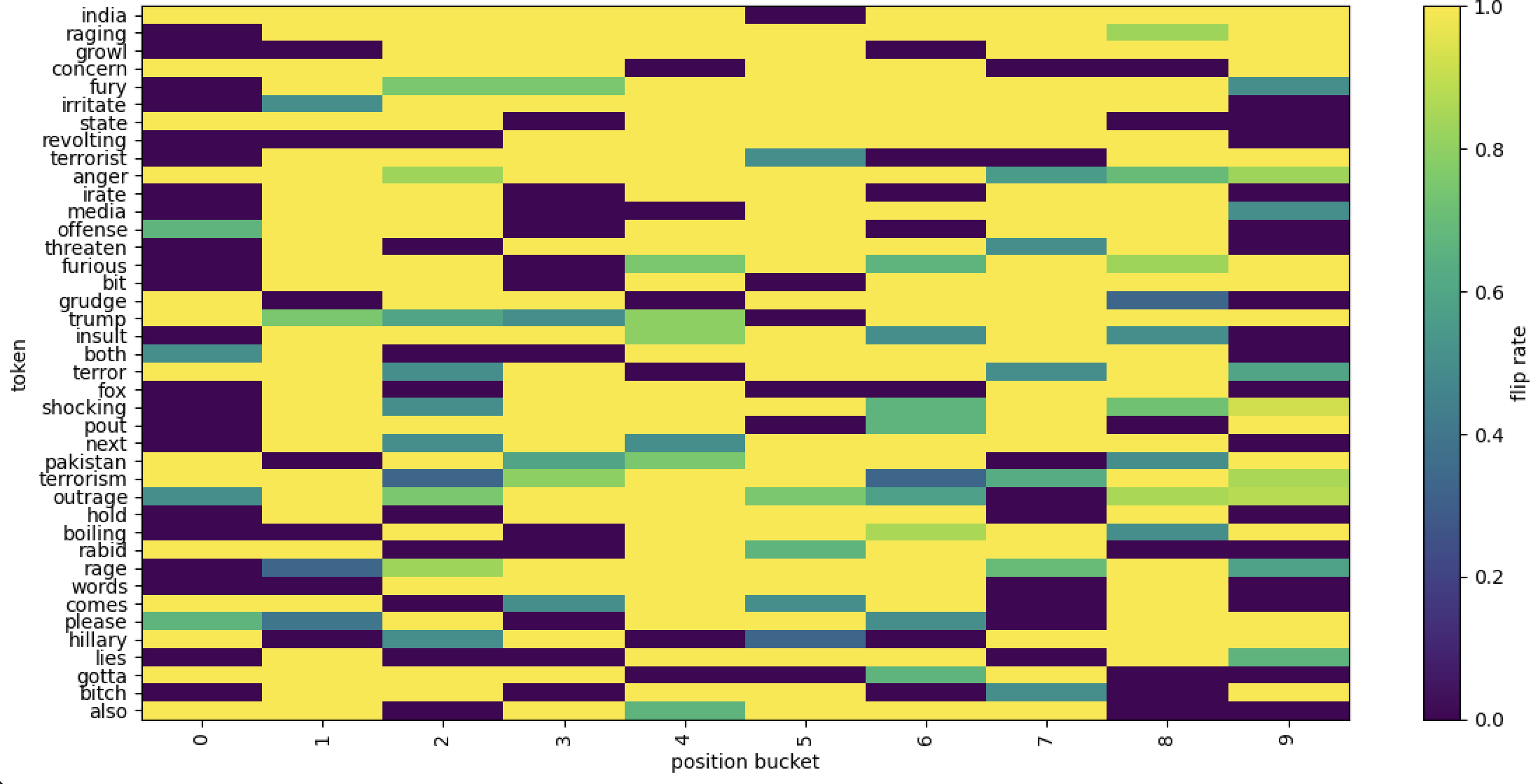
## Heatmap: Token Flip Rate by Position Bucket
### Overview
This image presents a heatmap visualizing the "flip rate" of various tokens across different "position buckets". The heatmap uses a color gradient from dark purple (low flip rate) to yellow (high flip rate). The y-axis lists tokens, and the x-axis represents position buckets numbered 0 through 9.
### Components/Axes
* **X-axis:** "position bucket" ranging from 0 to 9.
* **Y-axis:** "token" listing the following tokens: india, raging, growl, concern, fury, irritate, state, revolting, terrorist, anger, irate, media, offense, threaten, furious, bit, grudge, trump, insult, both, terror, fox, shocking, pout, next, pakistan, terrorism, outrage, hold, boiling, rabid, rage, words, comes, pleas, hillary, lies, gotta, bitch.
* **Color Scale (Right):** "flip rate" ranging from 0.0 to 1.0.
* **Color Gradient:** Dark purple represents a flip rate near 0.0, transitioning through shades of purple, lavender, and light green, to yellow representing a flip rate near 1.0.
### Detailed Analysis
The heatmap displays the flip rate for each token at each position bucket. I will analyze each token's trend across the position buckets and provide approximate flip rate values.
* **india:** Flip rate is consistently high (approximately 0.8-1.0) across all position buckets.
* **raging:** Starts low (around 0.2 at bucket 0), increases to a peak around 0.8-0.9 at bucket 7, then decreases slightly.
* **growl:** Relatively low flip rate (0.2-0.4) for buckets 0-3, then increases to around 0.6-0.8 for buckets 4-9.
* **concern:** Low flip rate (0.2-0.4) for buckets 0-2, increases to around 0.6-0.8 for buckets 3-9.
* **fury:** Starts around 0.4, increases to 0.8-0.9 at bucket 5, then remains relatively stable.
* **irritate:** Low flip rate (0.2-0.4) for buckets 0-4, then increases to around 0.6-0.8 for buckets 5-9.
* **state:** Flip rate is consistently high (approximately 0.8-1.0) across all position buckets.
* **revolting:** Low flip rate (0.2-0.4) for buckets 0-3, then increases to around 0.6-0.8 for buckets 4-9.
* **terrorist:** Flip rate is consistently high (approximately 0.8-1.0) across all position buckets.
* **anger:** Starts low (around 0.2 at bucket 0), increases to a peak around 0.8-0.9 at bucket 7, then decreases slightly.
* **irate:** Low flip rate (0.2-0.4) for buckets 0-4, then increases to around 0.6-0.8 for buckets 5-9.
* **media:** Flip rate is consistently high (approximately 0.8-1.0) across all position buckets.
* **offense:** Low flip rate (0.2-0.4) for buckets 0-3, then increases to around 0.6-0.8 for buckets 4-9.
* **threaten:** Flip rate is consistently high (approximately 0.8-1.0) across all position buckets.
* **furious:** Starts around 0.4, increases to 0.8-0.9 at bucket 5, then remains relatively stable.
* **bit:** Low flip rate (0.2-0.4) for buckets 0-2, then increases to around 0.6-0.8 for buckets 3-9.
* **grudge:** Low flip rate (0.2-0.4) for buckets 0-3, then increases to around 0.6-0.8 for buckets 4-9.
* **trump:** Flip rate is consistently high (approximately 0.8-1.0) across all position buckets.
* **insult:** Low flip rate (0.2-0.4) for buckets 0-2, then increases to around 0.6-0.8 for buckets 3-9.
* **both:** Flip rate is consistently high (approximately 0.8-1.0) across all position buckets.
* **terror:** Flip rate is consistently high (approximately 0.8-1.0) across all position buckets.
* **fox:** Low flip rate (0.2-0.4) for buckets 0-3, then increases to around 0.6-0.8 for buckets 4-9.
* **shocking:** Low flip rate (0.2-0.4) for buckets 0-2, then increases to around 0.6-0.8 for buckets 3-9.
* **pout:** Low flip rate (0.2-0.4) for buckets 0-3, then increases to around 0.6-0.8 for buckets 4-9.
* **next:** Flip rate is consistently high (approximately 0.8-1.0) across all position buckets.
* **pakistan:** Flip rate is consistently high (approximately 0.8-1.0) across all position buckets.
* **terrorism:** Flip rate is consistently high (approximately 0.8-1.0) across all position buckets.
* **outrage:** Low flip rate (0.2-0.4) for buckets 0-3, then increases to around 0.6-0.8 for buckets 4-9.
* **hold:** Low flip rate (0.2-0.4) for buckets 0-2, then increases to around 0.6-0.8 for buckets 3-9.
* **boiling:** Low flip rate (0.2-0.4) for buckets 0-3, then increases to around 0.6-0.8 for buckets 4-9.
* **rabid:** Low flip rate (0.2-0.4) for buckets 0-2, then increases to around 0.6-0.8 for buckets 3-9.
* **rage:** Starts low (around 0.2 at bucket 0), increases to a peak around 0.8-0.9 at bucket 7, then decreases slightly.
* **words:** Low flip rate (0.2-0.4) for buckets 0-3, then increases to around 0.6-0.8 for buckets 4-9.
* **comes:** Low flip rate (0.2-0.4) for buckets 0-2, then increases to around 0.6-0.8 for buckets 3-9.
* **pleas:** Low flip rate (0.2-0.4) for buckets 0-3, then increases to around 0.6-0.8 for buckets 4-9.
* **hillary:** Flip rate is consistently high (approximately 0.8-1.0) across all position buckets.
* **lies:** Low flip rate (0.2-0.4) for buckets 0-2, then increases to around 0.6-0.8 for buckets 3-9.
* **gotta:** Low flip rate (0.2-0.4) for buckets 0-2, then increases to around 0.6-0.8 for buckets 3-9.
* **bitch:** Low flip rate (0.2-0.4) for buckets 0-2, then increases to around 0.6-0.8 for buckets 3-9.
### Key Observations
* Tokens like "india", "state", "terrorist", "media", "trump", "both", "terror", "next", "pakistan", "terrorism", and "hillary" consistently exhibit high flip rates across all position buckets.
* Many tokens (e.g., "raging", "growl", "concern", "fury", "irritate", "bit", "grudge", "insult", "fox", "shocking", "pout", "outrage", "hold", "boiling", "rabid", "rage", "words", "comes", "pleas", "lies", "gotta", "bitch") show a trend of increasing flip rates as the position bucket number increases.
* The flip rate for most tokens is relatively low in the initial position buckets (0-2) and increases towards the higher buckets (7-9).
### Interpretation
This heatmap likely represents the probability of a token being "flipped" or altered in some way as it moves through a sequence or process represented by the position buckets. The high flip rates for tokens like "india", "state", "terrorist", "trump", and "hillary" suggest these tokens are consistently subject to change or modification. The increasing flip rates for many other tokens indicate that their likelihood of being altered increases as they progress through the sequence. This could be related to sentiment analysis, where the context or surrounding words influence the interpretation or meaning of the token. The data suggests a dynamic process where certain tokens are inherently more volatile or susceptible to change than others, and the likelihood of change increases over time or position. The consistent high flip rates for politically charged terms suggest a higher degree of manipulation or alteration in their usage.
DECODING INTELLIGENCE...