## Document Analysis: Receipt and Solution Breakdown
### Overview
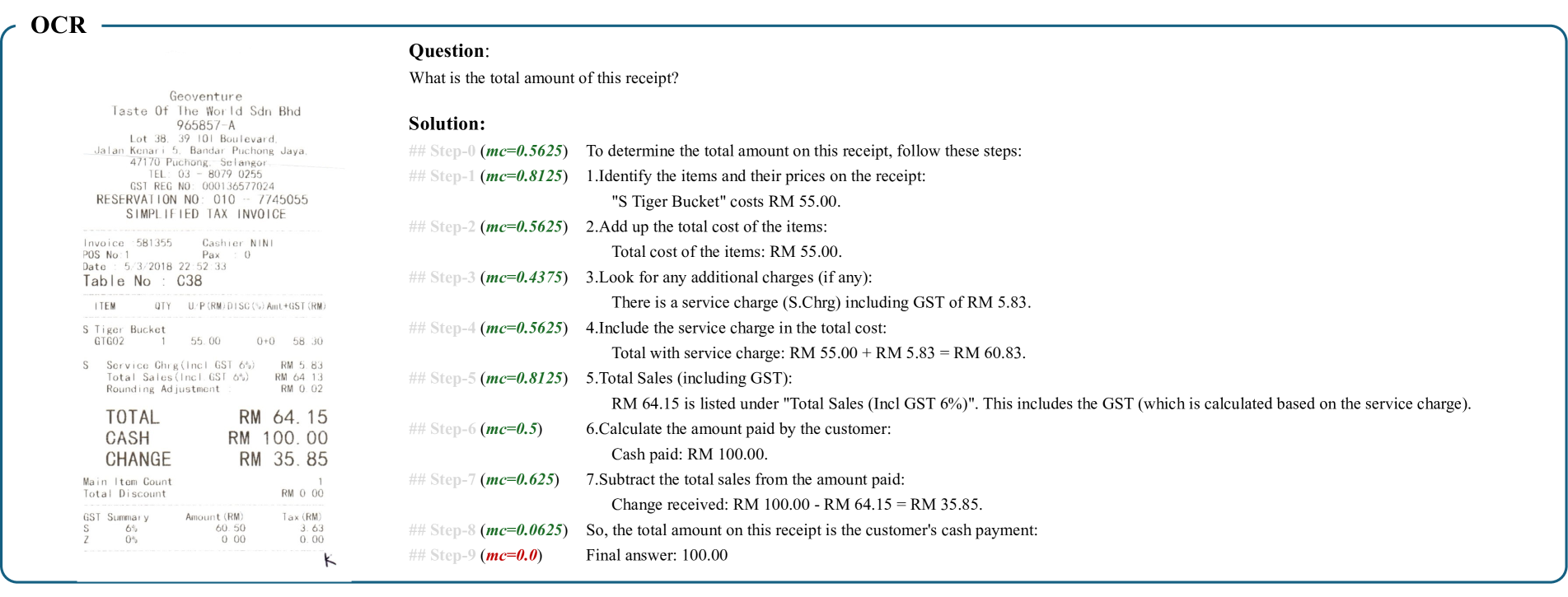
The image is a composite technical document displaying two primary components side-by-side. On the left is a scanned copy of a commercial receipt. On the right is a structured, step-by-step solution to a question derived from the receipt, complete with confidence scores for each step. The document appears to be an example from an OCR (Optical Character Recognition) or automated reasoning system, as indicated by the "OCR" header at the top.
### Components/Axes
The image is divided into two main vertical panels.
**Left Panel (Receipt):**
* **Header Information:** Contains business details, invoice metadata, and table number.
* **Itemized List:** A table with columns for ITEM, QTY (Quantity), U/P (Unit Price), DISC (Discount), Amt+GST (Amount including Goods and Services Tax).
* **Totals Section:** Lists subtotals, service charge, total sales, rounding adjustment, final TOTAL, CASH tendered, and CHANGE given.
* **Footer:** Contains item count, discount total, and a GST Summary table.
**Right Panel (Solution):**
* **Question:** A single-line query about the receipt.
* **Solution:** A numbered list of steps (Step-0 to Step-9). Each step is prefixed with a confidence score in the format `(mc=0.XXXX)`, where `mc` likely stands for "model confidence." The steps logically break down the process of extracting the answer from the receipt.
### Detailed Analysis
#### **Receipt Content (Left Panel)**
* **Business Header:**
* `Geoventure`
* `Taste Of The World Sdn Bhd`
* `965857-A`
* `Lot 38, 39 1st Boulevard,`
* `Jalan Kenari 5, Bandar Puchong Jaya,`
* `47170 Puchong, Selangor`
* `TEL: 03 - 8079 0255`
* `GST REG NO: 000136577024`
* `RESERVATION NO: 010 - 7745055`
* `SIMPLIFIED TAX INVOICE`
* **Invoice Details:**
* `Invoice: 581355`
* `Cashier: NINI`
* `POS No: 1`
* `Pax: 0`
* `Date: 5/3/2018 22:52:33`
* `Table No: C38` (This appears to be stamped or handwritten).
* **Itemized Table:**
* **Item 1:** `S Tiger Bucket`, `GTG02`, Qty: `1`, U/P: `55.00`, DISC: `0+0`, Amt+GST: `55.00`.
* **Item 2:** `S Service Chrg(Incl GST 6%)`, Amount: `RM 5.83`.
* **Subtotal Line:** `Total Sales (Incl GST 6%)`, Amount: `RM 64.13`.
* **Adjustment:** `Rounding Adjustment`, Amount: `RM 0.02`.
* **Payment Summary:**
* `TOTAL`: `RM 64.15`
* `CASH`: `RM 100.00`
* `CHANGE`: `RM 35.85`
* **Footer Details:**
* `Main Item Count`: `1`
* `Total Discount`: `RM 0.00`
* **GST Summary Table:**
* Header: `GST Summary`, `Amount (RM)`, `Tax (RM)`
* Row 1: `S`, `6%`, `60.50`, `3.63`
* Row 2: `Z`, `0%`, `0.00`, `0.00`
#### **Solution Content (Right Panel)**
* **Question:** `What is the total amount of this receipt?`
* **Solution Steps:**
* `## Step-0 (mc=0.5625)`: To determine the total amount on this receipt, follow these steps:
* `## Step-1 (mc=0.8125)`: 1. Identify the items and their prices on the receipt: "S Tiger Bucket" costs RM 55.00.
* `## Step-2 (mc=0.5625)`: 2. Add up the total cost of the items: Total cost of the items: RM 55.00.
* `## Step-3 (mc=0.4375)`: 3. Look for any additional charges (if any): There is a service charge (S.Chrg) including GST of RM 5.83.
* `## Step-4 (mc=0.5625)`: 4. Include the service charge in the total cost: Total with service charge: RM 55.00 + RM 5.83 = RM 60.83.
* `## Step-5 (mc=0.8125)`: 5. Total Sales (including GST): RM 64.15 is listed under "Total Sales (Incl GST 6%)". This includes the GST (which is calculated based on the service charge).
* `## Step-6 (mc=0.5)`: 6. Calculate the amount paid by the customer: Cash paid: RM 100.00.
* `## Step-7 (mc=0.625)`: 7. Subtract the total sales from the amount paid: Change received: RM 100.00 - RM 64.15 = RM 35.85.
* `## Step-8 (mc=0.0625)`: So, the total amount on this receipt is the customer's cash payment:
* `## Step-9 (mc=0.0)`: Final answer: 100.00
### Key Observations
1. **Data Consistency:** The numerical data in the solution steps (RM 55.00, RM 5.83, RM 64.15, RM 100.00, RM 35.85) is perfectly consistent with the corresponding values on the receipt.
2. **Confidence Score Trend:** The model's confidence (`mc`) fluctuates significantly. It is highest (0.8125) for steps involving direct data extraction (Step-1, Step-5) and lowest (0.0) for the final answer step, suggesting uncertainty in the interpretation of the question.
3. **Logical Discrepancy in Solution:** The solution's final conclusion (Step-8 & Step-9) states the "total amount" is the cash payment of RM 100.00. However, the receipt's explicit `TOTAL` is RM 64.15. The solution interprets "total amount" as the amount tendered by the customer, not the invoice total. This is a critical semantic ambiguity.
4. **Receipt Anomaly:** The `Total Sales (Incl GST 6%)` is listed as `RM 64.13`, but the final `TOTAL` is `RM 64.15`. The difference of `RM 0.02` is accounted for by the `Rounding Adjustment` line, which is a common practice for cash transactions.
### Interpretation
This document serves as a case study for an automated system processing a financial document. The receipt itself is a standard Malaysian tax invoice, detailing a single item purchase with a service charge and GST. The solution panel demonstrates a reasoning chain attempting to answer a natural language question about the receipt.
The core investigative finding is the **interpretation gap**. The question "What is the total amount of this receipt?" is ambiguous. A human would almost certainly answer RM 64.15 (the invoice total). The automated system, however, follows a logical path that culminates in identifying the cash payment (RM 100.00) as the answer. This highlights a key challenge in AI: moving from accurate data extraction (which the system does well) to correct contextual interpretation of human language. The plummeting confidence score in the final steps (`mc=0.0625` then `mc=0.0`) may indicate the model's internal uncertainty about this interpretive leap. The document thus illustrates not just OCR capability, but the complexities of automated reasoning and the importance of precise question formulation.