\n
## Logical Reasoning Flowchart: Automated Theorem Proving Process
### Overview
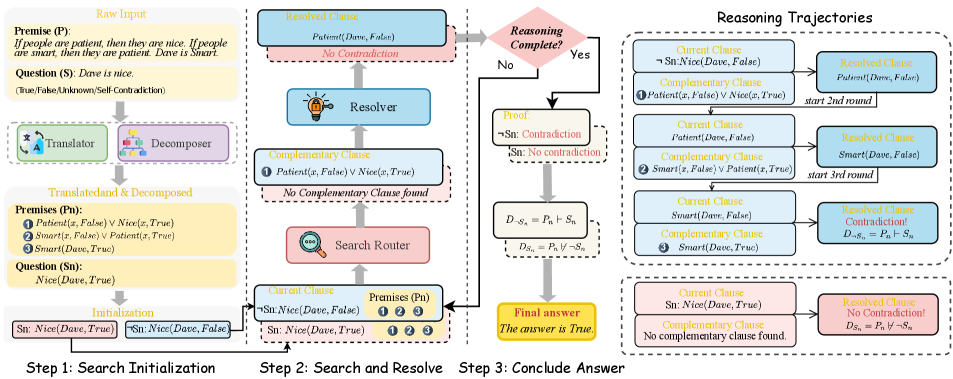
This image is a detailed flowchart illustrating a multi-step automated logical reasoning system designed to evaluate a given premise and question. The system decomposes natural language into formal logic, searches for contradictions through iterative resolution, and concludes whether a statement is true or false. The process is divided into three main phases: Search Initialization, Search and Resolve, and Conclude Answer.
### Components/Axes
The diagram is organized into three vertical columns corresponding to the three main steps. Key components include:
- **Raw Input**: Contains the initial natural language premise and question.
- **Translated and Decomposed**: Shows the logical formalization of the input.
- **Initialization**: Defines the starting logical clauses for the reasoning engine.
- **Search and Resolve**: The core processing loop containing a **Resolver**, **Search Router**, and mechanisms for checking **Current Clauses** against **Complementary Clauses**.
- **Reasoning Complete?**: A decision diamond that checks for contradictions.
- **Proof**: A box showing the logical proof structure.
- **Reasoning Trajectories**: A detailed side panel showing the step-by-step evolution of clauses across three reasoning rounds.
- **Final answer**: The concluding output.
**Visual Elements & Spatial Grounding:**
- **Colors**: Blue boxes represent resolved or current clauses. Pink boxes represent complementary clauses or contradiction states. Yellow boxes represent inputs, outputs, or key decisions. Green and purple boxes represent processing modules (Translator, Decomposer).
- **Arrows**: Gray arrows indicate the primary flow of data and control between steps. Dashed arrows indicate feedback loops or secondary data flow.
- **Layout**: The main process flows from top-left (Raw Input) down through the center column. The "Reasoning Trajectories" panel is positioned to the right of the main flow, providing a detailed audit trail.
### Detailed Analysis
#### Step 1: Search Initialization
* **Raw Input (Top-Left)**:
* **Premise (P):** "If people are nice, then they are nice. If people are smart, then they are patient. Dave is Smart."
* **Question (S):** "Dave is nice."
* **(True/False/Unknown/Self-Contradiction)**
* **Translated and Decomposed (Below Raw Input)**:
* The premise and question are processed by a **Translator** and **Decomposer**.
* **Premises (Pn):**
1. `Patient(x, False) ∨ Nice(x, True)`
2. `Patient(x, False) ∨ Patient(x, True)`
3. `Smart(x, False) ∨ Patient(x, True)`
* **Question (Sn):** `Nice(Dave, True)`
* **Initialization (Bottom-Left)**:
* **Sn:** `Nice(Dave, True)`
* **¬Sn:** `Nice(Dave, False)` (The negation of the question).
* The system initializes with the question and its negation, along with the list of premises (Pn) ①, ②, ③.
#### Step 2: Search and Resolve (Center Column)
This is an iterative loop.
1. **Search Router** selects a **Current Clause** (starting with `¬Sn: Nice(Dave, False)`) and the set of **Premises (Pn)**.
2. The **Resolver** attempts to find a **Complementary Clause** from the premises that can be resolved with the current clause.
3. The system checks for contradictions.
* **First Pass:** With `Current Clause: ¬Sn: Nice(Dave, False)`, it finds **Complementary Clause ①:** `Patient(x, False) ∨ Nice(x, True)`. The result is `Resolved Clause: Patient(Dave, False)` with the note "No Contradiction".
* The process loops back ("Reasoning Complete? -> No") with the new resolved clause as the current clause.
#### Step 3: Conclude Answer & Reasoning Trajectories (Right Panel)
The right panel details the three rounds of reasoning that occur within the "Search and Resolve" loop.
* **Start 2nd Round:**
* **Current Clause:** `¬Sn: Nice(Dave, False)` (This appears to be a reset or carry-over; the main flow had `Patient(Dave, False)`).
* **Complementary Clause ①:** `Patient(x, False) ∨ Nice(x, True)`
* **Resolved Clause:** `Patient(Dave, False)` (No contradiction).
* **Start 3rd Round:**
* **Current Clause:** `Patient(Dave, False)`
* **Complementary Clause ②:** `Smart(x, False) ∨ Patient(x, True)`
* **Resolved Clause:** `Smart(Dave, False)` (No contradiction).
* **Final Round (Implied):**
* **Current Clause:** `Smart(Dave, False)`
* **Complementary Clause ③:** `Smart(x, False) ∨ Patient(x, True)`
* **Resolved Clause:** `Contradiction!` (Resolving `Smart(Dave, False)` with `Smart(x, False) ∨ Patient(x, True)` yields `Patient(Dave, True)`, which contradicts the earlier derived `Patient(Dave, False)`).
* **Proof:** `D_Sn = Pn ⊢ Sn` and `D_¬Sn = Pn ⊢ ¬Sn`. The system has derived both the question (`Sn`) and its negation (`¬Sn`) from the premises, indicating a self-contradiction in the original premise set.
**Final Answer (Bottom Center):** "The answer is **True**." This is derived from the proof box `D_Sn = Pn ⊢ Sn`, meaning the premises logically entail the question `Sn: Nice(Dave, True)`.
### Key Observations
1. **Self-Contradictory Premises:** The logical decomposition reveals that the original natural language premise "If people are nice, then they are nice" is a tautology (always true) and adds no constraint. The core issue arises from the interaction of the other premises, which ultimately lead to a contradiction (`Patient(Dave, False)` and `Patient(Dave, True)`).
2. **Reasoning Path:** The system does not directly prove `Nice(Dave, True)`. Instead, it attempts to prove the negation (`Nice(Dave, False)`), fails by deriving a contradiction, and therefore concludes the original statement must be true (a form of proof by contradiction or reductio ad absurdum).
3. **Visual Audit Trail:** The "Reasoning Trajectories" panel is crucial for debugging and understanding the step-by-step logical inferences, showing exactly which clauses were combined at each stage.
### Interpretation
This flowchart demonstrates a **resolution-based theorem prover** applied to a logical puzzle. It showcases the core challenges in automated reasoning: translating ambiguous natural language into precise formal logic and navigating complex inference chains.
The process highlights that the initial premise set is **inconsistent**. The statement "Dave is nice" is deemed **True** not because it is directly supported, but because assuming its opposite (`Dave is not nice`) leads to a logical impossibility given the other premises. This is a classic example of how formal systems handle contradictions—they expose them rather than ignore them.
The diagram serves as a technical specification for such a system, detailing the data structures (clauses), control flow (search and resolve loop), and proof logging (trajectories). It emphasizes the importance of **clause management** and **contradiction detection** as the engine of logical deduction. The final answer "True" is a consequence of the system's design to return the original statement if its negation is unsatisfiable, even if the underlying premise set is flawed.