## Diagram: Reasoning Trajectories for Logical Deduction
### Overview
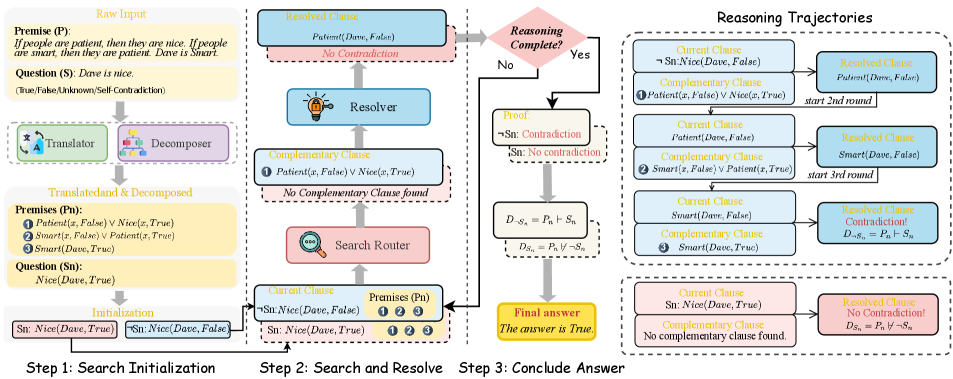
The image presents a diagram illustrating a reasoning process to determine the truth value of a question based on given premises. It outlines the steps involved in translating, decomposing, searching, resolving, and concluding an answer. The diagram is divided into three main steps: Search Initialization, Search and Resolve, and Conclude Answer, with a parallel "Reasoning Trajectories" section showing the detailed steps.
### Components/Axes
* **Raw Input:** Contains the initial premises and the question to be answered.
* **Premise (P):** "If people are patient, then they are nice. If people are smart, then they are patient. Dave is Smart."
* **Question (S):** "Dave is nice. (True/False/Unknown/Self-Contradiction)"
* **Translator:** A component that translates the raw input.
* **Decomposer:** A component that decomposes the translated input.
* **Translated and Decomposed:** The result of translation and decomposition.
* **Premises (Pn):**
1. Patient(x, False) ∨ Nice(x, True)
2. Smart(x, False) ∨ Patient(x, True)
3. Smart(Dave, True)
* **Question (Sn):** Nice(Dave, True)
* **Initialization:** Sets up the initial states for the search.
* Sn: Nice(Dave, True)
* ¬Sn: Nice(Dave, False)
* **Search Router:** Routes the search based on available information.
* **Resolver:** Resolves clauses to derive new information.
* **Reasoning Complete?:** A decision point to determine if the reasoning process is complete.
* **Proof:** Indicates whether a contradiction or no contradiction is found.
* ¬Sn: Contradiction
* Sn: No contradiction
* **Final Answer:** The conclusion reached after the reasoning process.
* The answer is True.
* **Reasoning Trajectories:** Shows the step-by-step reasoning process.
* **Current Clause:** The current clause being considered.
* **Complementary Clause:** The clause used to resolve with the current clause.
* **Resolved Clause:** The result of resolving the current and complementary clauses.
### Detailed Analysis
**Step 1: Search Initialization**
* The process starts with the question "Nice(Dave, True)" and its negation "Nice(Dave, False)".
**Step 2: Search and Resolve**
* The "Search Router" directs the process based on the current clauses and premises.
* The "Resolver" attempts to resolve clauses to derive new information.
* The "Reasoning Trajectories" section shows the detailed steps:
* **Round 1:**
* Current Clause: ¬Sn: Nice(Dave, False)
* Complementary Clause: Patient(x, False) ∨ Nice(x, True)
* Resolved Clause: Patient(Dave, False)
* **Round 2:**
* Current Clause: Patient(Dave, False)
* Complementary Clause: Smart(x, False) ∨ Patient(x, True)
* Resolved Clause: Smart(Dave, False)
* **Round 3:**
* Current Clause: Smart(Dave, False)
* Complementary Clause: Smart(Dave, True)
* Resolved Clause: Contradiction!
* If a contradiction is found, the process moves to the "Proof" stage.
**Step 3: Conclude Answer**
* If a contradiction is found (¬Sn: Contradiction), the final answer is "True".
* If no contradiction is found (Sn: No contradiction), the final answer would be "False" (though this path isn't fully shown).
### Key Observations
* The diagram illustrates a logical deduction process using resolution.
* The "Reasoning Trajectories" section provides a detailed view of the steps involved in resolving clauses.
* The process aims to find a contradiction to prove the truth of the initial question.
### Interpretation
The diagram demonstrates a method for automated reasoning. It starts with premises and a question, translates and decomposes them into logical clauses, and then uses a resolution-based search to determine the truth value of the question. The "Reasoning Trajectories" section is crucial as it shows the step-by-step derivation of new clauses until a contradiction is found, which confirms the truth of the initial question. The diagram highlights the importance of logical deduction in artificial intelligence and knowledge representation. The process effectively shows how a computer can "think" through a problem and arrive at a logical conclusion.