\n
## Diagram: Reasoning Trajectories for Knowledge Representation
### Overview
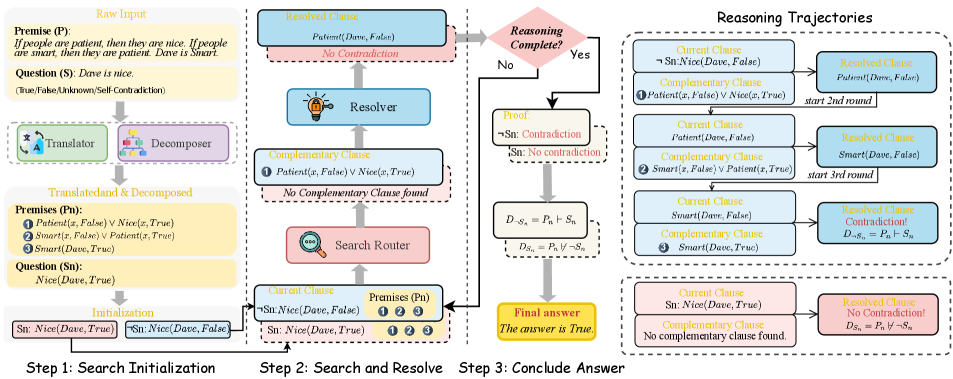
This diagram illustrates a three-step process for answering a question based on a given premise using a reasoning system. The process involves translating and decomposing the premise and question, searching for complementary clauses, and concluding with an answer. The diagram depicts the flow of information and the reasoning trajectories involved in this process.
### Components/Axes
The diagram is divided into three main steps: Step 1: Search Initialization, Step 2: Search and Resolve, and Step 3: Conclude Answer. Each step contains several components, including:
* **Raw Input:** Contains the premise (P) and question (S).
* **Translator:** Converts the input into a suitable format.
* **Decomposer:** Breaks down the premise and question into smaller clauses.
* **Premises (Pn):** The decomposed premise.
* **Question (Sn):** The decomposed question.
* **Resolver:** Identifies contradictions and resolves clauses.
* **Search Router:** Guides the search for complementary clauses.
* **Reasoning Complete?:** A decision point indicating whether the reasoning process is finished.
* **Proof:** Indicates whether a contradiction or no contradiction was found.
* **Current Clause:** The clause being currently evaluated.
* **Complementary Clause:** A clause that complements the current clause.
* **Resolved Clause:** The result of resolving the current and complementary clauses.
* **Final Answer:** The answer to the question.
The diagram also includes labels for the input, intermediate steps, and output.
### Detailed Analysis or Content Details
**Step 1: Search Initialization**
* **Raw Input:**
* Premise (P): "If people are patient, then they are nice. If people are smart, then they patient. Dave is smart."
* Question (S): "Dave is nice."
* (True/False/Unknown) Self-Contradiction
* **Translator & Decomposer:** These components transform the raw input.
* **Translated & Decomposed Premises (Pn):**
1. Patient(x, False) v Nice(x, True)
2. Smart(x, False) v Patient(x, True)
3. Smart(Dave, True)
* **Question (Sn):** Nice(Dave, True)
* **Initialization:** Sn: Nice(Dave, True) and ~Sn: Nice(Dave, False)
**Step 2: Search and Resolve**
* **Current Clause:** ~Sn: Nice(Dave, False)
* **Premises (Pn):** 1, 2, 3 (as listed above)
* **Search Router:** Guides the search for complementary clauses.
* **Complementary Clause:** Patient(x, False) v Nice(x, True)
* **No Complementary Clause found.**
**Step 3: Conclude Answer**
* **Reasoning Complete?:** No -> Yes
* **Reasoning Trajectories (Right Side of Diagram):** This section shows multiple reasoning paths.
* **Round 2:**
* Current Clause: ~Sn: Nice(Dave, False)
* Complementary Clause: Patient(x, False) v Nice(x, True)
* Resolved Clause: Patient(Dave, False)
* Start 2nd round
* **Round 3:**
* Current Clause: Smart(Dave, False)
* Complementary Clause: Smart(x, False) v Patient(x, True)
* Resolved Clause: Contradiction!
* D<sub>s</sub> = P<sub>n</sub> + S<sub>n</sub>
* **Final Round:**
* Current Clause: Sn: Nice(Dave, True)
* Complementary Clause: No complementary clause found.
* Resolved Clause: No Contradiction
* D<sub>s</sub> = P<sub>n</sub> +/~S<sub>n</sub>
* **Final Answer:** The answer is True.
**Resolved Clause Boxes (Orange):** These boxes show the result of resolving clauses.
### Key Observations
The diagram demonstrates a logical reasoning process. The reasoning trajectories show how the system explores different paths to arrive at an answer. The presence of "Contradiction!" in one trajectory suggests that the system can identify inconsistencies. The final answer being "True" indicates that the premise supports the question.
### Interpretation
The diagram illustrates a knowledge representation and reasoning system. The system takes a premise and a question as input, decomposes them into logical clauses, and searches for complementary clauses to resolve contradictions. The reasoning trajectories show the different paths the system can take to arrive at an answer. The system's ability to identify contradictions and provide a final answer suggests that it is capable of performing logical inference. The diagram highlights the importance of decomposing complex statements into smaller, manageable clauses for effective reasoning. The use of "D<sub>s</sub>" suggests a formal representation of the derived statement based on the premise and question. The diagram is a visual representation of a formal logic process, likely used in artificial intelligence or knowledge-based systems.