## Flowchart: Logical Reasoning Process for Answer Determination
### Overview
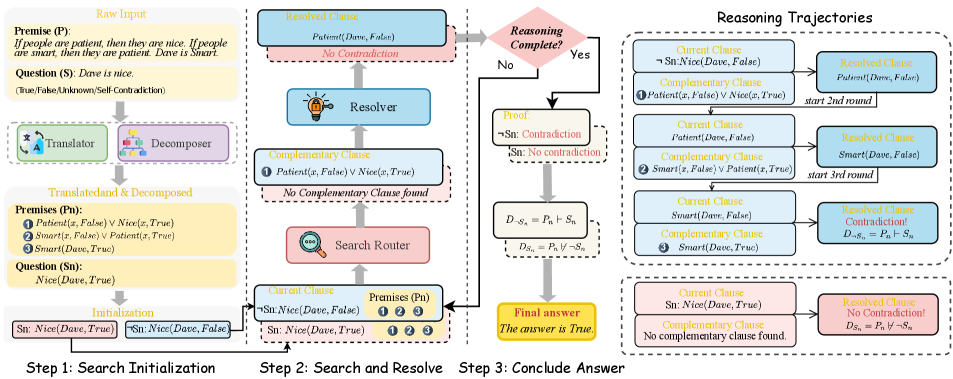
This flowchart illustrates a multi-step logical reasoning process to determine the truth value of a statement ("Dave is nice") based on given premises. The process involves translation, decomposition, clause resolution, contradiction detection, and iterative reasoning trajectories. The final output is a binary answer (True/False/Unknown/Self-Contradiction).
---
### Components/Axes
1. **Key Components**:
- **Translator**: Converts raw input into translated/decomposed premises and questions.
- **Decomposer**: Breaks down premises into logical clauses (e.g., `Patient(x, False) ∨ Nice(x, True)`).
- **Resolver**: Checks for contradictions between current clauses and complementary clauses.
- **Search Router**: Routes clauses to relevant premises for resolution.
- **Reasoning Trajectories**: Visualizes iterative clause resolution across multiple rounds.
2. **Flow Direction**:
- Left-to-right progression through steps: **Search Initialization → Search and Resolve → Conclude Answer**.
- Vertical arrows indicate iterative refinement of clauses (e.g., "start 2nd round").
3. **Color Coding**:
- **Blue**: Resolved clauses (e.g., `Patient(Dave, False)`).
- **Pink**: Contradictions or unresolved states.
- **Yellow**: Final answer box.
---
### Detailed Analysis
#### Step 1: Search Initialization
- **Input**: Raw premises and question (e.g., "If people are patient, then they are nice...").
- **Output**: Translated/decomposed premises and question:
- Premises:
1. `Patient(x, False) ∨ Nice(x, True)`
2. `Smart(x, False) ∨ Patient(x, True)`
3. `Smart(Dave, True)`
- Question: `Nice(Dave, True)`.
#### Step 2: Search and Resolve
- **Current Clause**: Initialized as `¬Sn:Nice(Dave, False)`.
- **Process**:
1. **Complementary Clause Search**: Finds `Patient(x, False) ∨ Nice(x, True)`.
2. **Resolver**: Determines no contradiction initially.
3. **Premises Routing**: Matches clauses to premises (e.g., `Smart(Dave, True)` resolves to `Smart(Dave, False)` contradiction).
#### Step 3: Conclude Answer
- **Final Answer**: Derived from resolved clauses:
- `Patient(Dave, False)` → Contradiction with `Smart(Dave, True)`.
- `Smart(Dave, False)` → Final answer: **True** (no contradiction found).
---
### Key Observations
1. **Iterative Reasoning**: The process involves multiple rounds of clause refinement (e.g., "start 2nd round," "start 3rd round").
2. **Contradiction Handling**: Explicitly flags contradictions (e.g., `Smart(Dave, False)` vs. `Smart(Dave, True)`).
3. **Binary Logic**: All clauses are resolved to True/False values, with no intermediate states.
---
### Interpretation
This flowchart represents a formalized logical deduction system, likely inspired by resolution-based theorem proving. The process systematically:
1. **Decomposes** natural language premises into formal clauses.
2. **Resolves** clauses iteratively to eliminate contradictions.
3. **Concludes** the truth value of the target statement based on resolved premises.
The use of color coding and directional arrows emphasizes the algorithmic nature of the process, where each step depends on the output of the previous. The final answer (`True`) emerges only after all contradictions are resolved or deemed irrelevant. The system prioritizes logical consistency over heuristic reasoning, adhering strictly to formal rules of inference.