## Line Graph: Cost Comparison of Natural Language and Agora Processing
### Overview
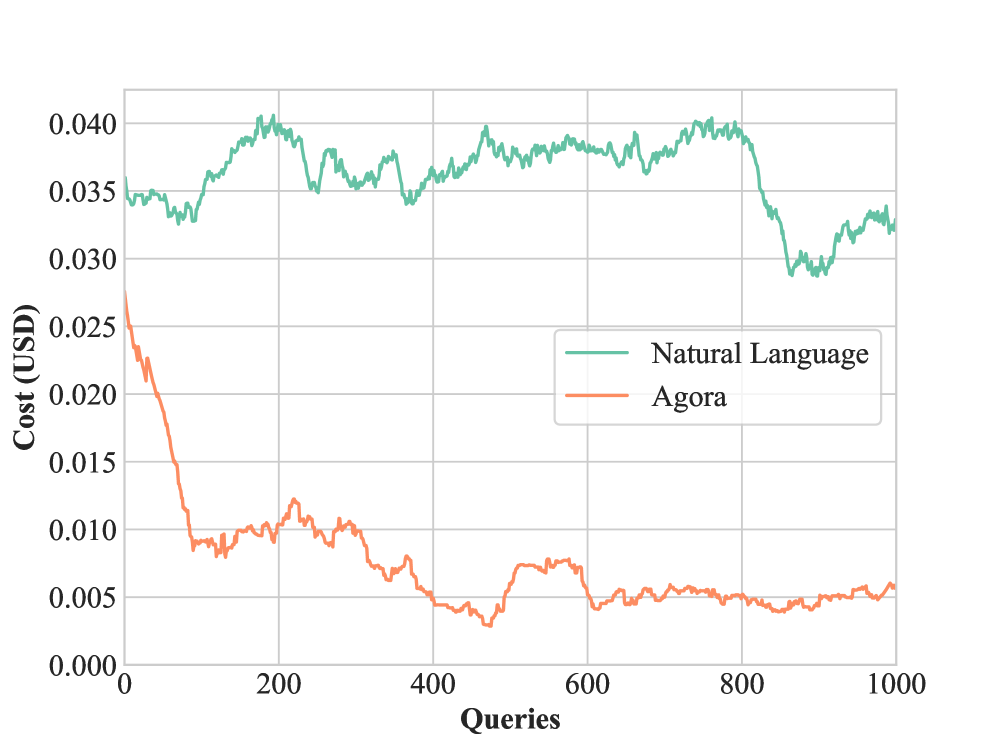
The graph compares the cost (in USD) of processing queries using two methods: "Natural Language" (teal line) and "Agora" (orange line) across 1,000 queries. The y-axis represents cost per query, while the x-axis represents the number of queries processed.
### Components/Axes
- **X-axis (Queries)**: Ranges from 0 to 1,000 in increments of 200.
- **Y-axis (Cost, USD)**: Ranges from 0.000 to 0.040 in increments of 0.005.
- **Legend**: Located in the bottom-right corner, with:
- Teal line labeled "Natural Language"
- Orange line labeled "Agora"
### Detailed Analysis
1. **Natural Language (Teal Line)**:
- Starts at ~0.035 USD/query.
- Peaks at ~0.040 USD/query near 200 queries.
- Experiences fluctuations but stabilizes around ~0.035 USD/query after 400 queries.
- Ends at ~0.033 USD/query at 1,000 queries.
2. **Agora (Orange Line)**:
- Begins at ~0.025 USD/query.
- Drops sharply to ~0.005 USD/query by 200 queries.
- Remains below 0.010 USD/query for the remainder of the graph.
- Ends at ~0.005 USD/query at 1,000 queries.
### Key Observations
- **Cost Disparity**: Natural Language consistently costs 3–8× more than Agora across all query volumes.
- **Agora Efficiency**: Agora’s cost plummets rapidly and stabilizes at a low value, suggesting scalability.
- **Natural Language Volatility**: Fluctuations in Natural Language’s cost may indicate variable processing demands or resource allocation.
### Interpretation
The data demonstrates that Agora is significantly more cost-effective for query processing, particularly at scale. Natural Language’s higher and more variable costs suggest it may require more computational resources or face inefficiencies in handling queries. The sharp decline in Agora’s cost implies optimized algorithms or infrastructure, making it preferable for high-volume applications. The lack of intersection between the lines confirms Natural Language remains the pricier option throughout.