## Screenshot: Technical Document Analysis & Answer Comparison
### Overview
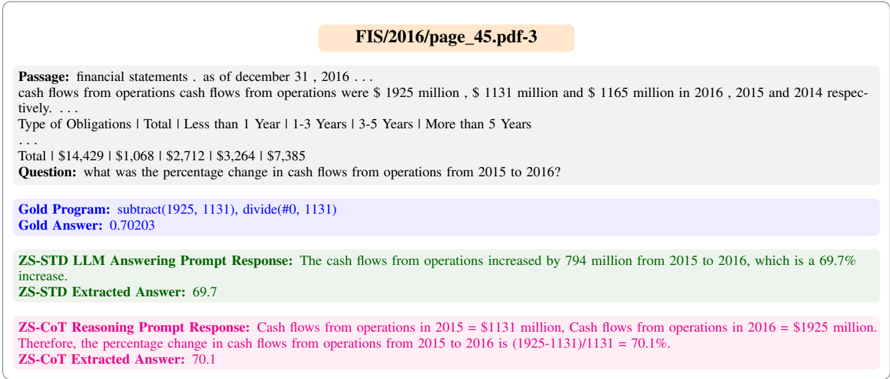
The image is a screenshot displaying an analysis of a financial document excerpt. It presents a passage from a PDF, a related question, and three different computed answers to that question from different methods (a "Gold Program," a "ZS-STD" LLM, and a "ZS-CoT" LLM). The primary purpose is to compare the accuracy and reasoning of these automated systems against a ground truth calculation.
### Components/Axes
The image is structured into distinct horizontal sections, each with a specific background color and content type.
1. **Header (Beige Box):**
* Text: `FIS/2016/page_45.pdf-3`
2. **Source Passage & Question (Light Gray Box):**
* **Passage Label:** `Passage:`
* **Passage Text:** `financial statements. . as of december 31, 2016 . . .`
`cash flows from operations cash flows from operations were $ 1925 million , $ 1131 million and $ 1165 million in 2016 , 2015 and 2014 respectively.`
`Type of Obligations | Total | Less than 1 Year | 1-3 Years | 3-5 Years | More than 5 Years`
`...`
`Total | $14,429 | $1,068 | $2,712 | $3,264 | $7,385`
* **Question Label:** `Question:`
* **Question Text:** `what was the percentage change in cash flows from operations from 2015 to 2016?`
3. **Gold Standard Answer (Purple Box):**
* **Label:** `Gold Program:`
* **Program Logic:** `subtract(1925, 1131), divide(#0, 1131)`
* **Label:** `Gold Answer:`
* **Value:** `0.70203`
4. **ZS-STD Model Response (Green Box):**
* **Label:** `ZS-STD LLM Answering Prompt Response:`
* **Response Text:** `The cash flows from operations increased by 794 million from 2015 to 2016, which is a 69.7% increase.`
* **Label:** `ZS-STD Extracted Answer:`
* **Value:** `69.7`
5. **ZS-CoT Model Response (Pink Box):**
* **Label:** `ZS-CoT Reasoning Prompt Response:`
* **Response Text:** `Cash flows from operations in 2015 = $1131 million, Cash flows from operations in 2016 = $1925 million. Therefore, the percentage change in cash flows from operations from 2015 to 2016 is (1925-1131)/1131 = 70.1%.`
* **Label:** `ZS-CoT Extracted Answer:`
* **Value:** `70.1`
### Detailed Analysis
* **Source Data:** The passage provides cash flow from operations for three years: 2016 ($1925 million), 2015 ($1131 million), and 2014 ($1165 million). It also includes a separate table of financial obligations by time horizon, which is not directly relevant to the posed question.
* **The Question:** Asks for the percentage change from 2015 to 2016.
* **Gold Program Calculation:** The logic is explicit: subtract the 2015 value from the 2016 value (`1925 - 1131 = 794`), then divide that result by the 2015 value (`794 / 1131`). The output is the precise decimal `0.70203`.
* **ZS-STD Response:** The model first correctly identifies the absolute increase (`794 million`). It then states the percentage increase as `69.7%`. The extracted answer is this percentage value.
* **ZS-CoT Response:** The model explicitly states the 2015 and 2016 values, shows the formula `(1925-1131)/1131`, and calculates the result as `70.1%`. The extracted answer is this percentage value.
### Key Observations
1. **Answer Discrepancy:** The three answers are numerically close but not identical.
* Gold Answer (decimal): `0.70203` (equivalent to 70.203%)
* ZS-STD Answer: `69.7%`
* ZS-CoT Answer: `70.1%`
2. **Calculation Method:** All three methods use the same fundamental formula: `(New Value - Old Value) / Old Value`. The discrepancy likely arises from rounding at different stages or slight differences in the division operation.
3. **Response Style:** The ZS-STD provides a natural language summary first, then extracts the number. The ZS-CoT provides a step-by-step reasoning chain before extracting the number. The Gold Program provides only the computational steps and final value.
4. **Data Consistency:** The cash flow values (`$1925 million` for 2016, `$1131 million` for 2015) are consistently used across all sections.
### Interpretation
This screenshot is likely from an evaluation framework for testing Large Language Models (LLMs) on numerical reasoning tasks from financial documents. The "Gold Program" represents the ground truth or correct computational answer. The "ZS-STD" (Zero-Shot Standard) and "ZS-CoT" (Zero-Shot Chain-of-Thought) represent two different prompting strategies given to an LLM.
The data demonstrates that while both LLM approaches correctly identify the relevant numbers and the correct formula, they produce slightly different final percentages. The ZS-CoT answer (`70.1%`) is closer to the Gold Answer (`70.203%`) than the ZS-STD answer (`69.7%`). This suggests that the chain-of-thought prompting, which encourages the model to show its work, may lead to a more accurate final calculation in this instance, possibly by reducing rounding errors or improving intermediate step handling.
The inclusion of the unrelated obligations table in the source passage tests the models' ability to extract only the pertinent information (`cash flows from operations`) and ignore distracting data. Both models successfully did this. The core finding is the comparison of accuracy between different AI reasoning methods on a precise financial calculation task.