## Line Chart: Number of Operations vs. Reasoning Steps for CoT, ToT, and GoT
### Overview
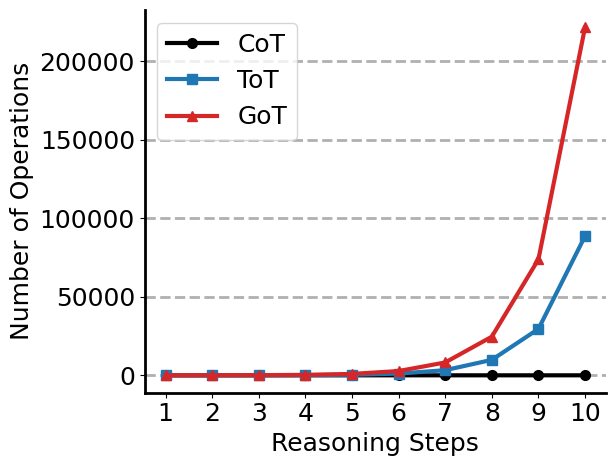
The image is a line chart comparing the number of operations required by three different methods (CoT, ToT, and GoT) across 10 reasoning steps. The x-axis represents the number of reasoning steps, and the y-axis represents the number of operations. The chart shows how the number of operations changes with an increasing number of reasoning steps for each method.
### Components/Axes
* **X-axis:** Reasoning Steps, labeled from 1 to 10 in increments of 1.
* **Y-axis:** Number of Operations, ranging from 0 to 200000, with gridlines at intervals of 50000.
* **Legend (Top-Left):**
* Black line with circle marker: CoT
* Blue line with square marker: ToT
* Red line with triangle marker: GoT
### Detailed Analysis
* **CoT (Black Line):** The number of operations remains relatively constant at approximately 1000, with minor fluctuations, across all 10 reasoning steps.
* Step 1: ~1000
* Step 10: ~1000
* **ToT (Blue Line):** The number of operations remains low for the first 7 reasoning steps, then increases significantly from step 8 to step 10.
* Step 1: ~1000
* Step 7: ~1000
* Step 8: ~5000
* Step 9: ~30000
* Step 10: ~90000
* **GoT (Red Line):** The number of operations remains low for the first 7 reasoning steps, then increases exponentially from step 8 to step 10.
* Step 1: ~1000
* Step 7: ~2000
* Step 8: ~10000
* Step 9: ~50000
* Step 10: ~220000
### Key Observations
* CoT maintains a consistent number of operations regardless of the number of reasoning steps.
* ToT and GoT exhibit a similar trend, with a sharp increase in the number of operations after step 7.
* GoT requires significantly more operations than ToT as the number of reasoning steps increases beyond 7.
### Interpretation
The chart suggests that CoT is more efficient in terms of the number of operations required, as it remains constant regardless of the number of reasoning steps. ToT and GoT, on the other hand, become increasingly computationally expensive as the number of reasoning steps increases, with GoT showing a much steeper increase than ToT. This implies that for tasks requiring a large number of reasoning steps, CoT might be a more suitable choice due to its lower computational cost. The sharp increase in operations for ToT and GoT after step 7 could indicate a threshold where the complexity of these methods starts to significantly impact their performance.