## Diagram: MCTS Node Generation Actions
### Overview
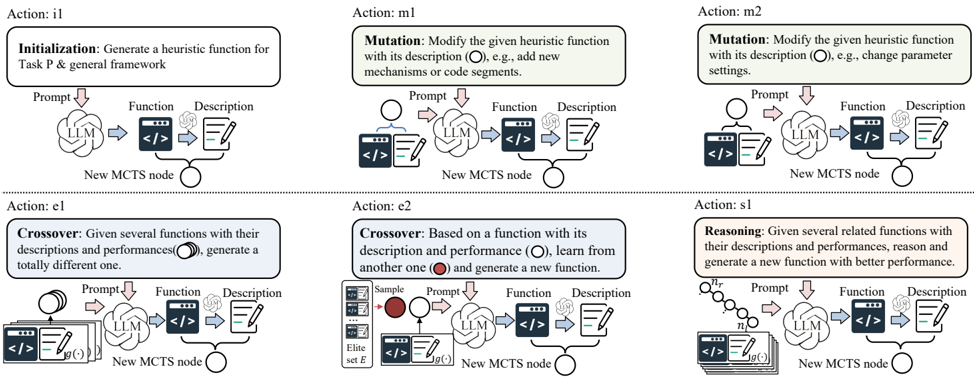
The image presents a diagram illustrating different actions for generating new nodes in a Monte Carlo Tree Search (MCTS) algorithm. Each action involves a Large Language Model (LLM) and manipulates functions and their descriptions. The actions are: Initialization, Mutation (two variants), Crossover (two variants), and Reasoning.
### Components/Axes
Each action diagram consists of the following components:
- **Action Title:** Indicates the type of action being performed (e.g., "Action: i1 Initialization").
- **Action Description:** A brief textual description of the action.
- **Prompt:** An input to the LLM.
- **LLM:** A cloud-like icon representing the Large Language Model.
- **Function:** Represented by a code icon (`</>`).
- **Description:** Represented by a document icon with a pen.
- **New MCTS node:** Indicates the output of the action.
- **Arrows:** Indicate the flow of information and transformations.
### Detailed Analysis
**1. Action: i1 - Initialization**
- **Description:** "Generate a heuristic function for Task P & general framework."
- **Flow:** A "Prompt" is fed into the "LLM", which generates a "Function" and a "Description". These are combined to form a "New MCTS node".
**2. Action: m1 - Mutation**
- **Description:** "Modify the given heuristic function with its description (O), e.g., add new mechanisms or code segments."
- **Flow:** A "Prompt" is fed into the "LLM", which generates a "Function" and a "Description". These are combined to form a "New MCTS node".
**3. Action: m2 - Mutation**
- **Description:** "Modify the given heuristic function with its description (O), e.g., change parameter settings."
- **Flow:** A "Prompt" is fed into the "LLM", which generates a "Function" and a "Description". These are combined to form a "New MCTS node".
**4. Action: e1 - Crossover**
- **Description:** "Given several functions with their descriptions and performances(O), generate a totally different one."
- **Flow:** Multiple "Function/Description" pairs (represented as stacked icons) serve as input. A "Prompt" is fed into the "LLM", which generates a "Function" and a "Description". These are combined to form a "New MCTS node".
**5. Action: e2 - Crossover**
- **Description:** "Based on a function with its description and performance (O), learn from another one (red circle) and generate a new function."
- **Flow:** A "Sample" (red circle) and an "Elite set E" (represented as stacked icons) are used. A "Prompt" is fed into the "LLM", which generates a "Function" and a "Description". These are combined to form a "New MCTS node".
**6. Action: s1 - Reasoning**
- **Description:** "Given several related functions with their descriptions and performances, reason and generate a new function with better performance."
- **Flow:** Multiple "Function/Description" pairs (represented as stacked icons) serve as input. A "Prompt" is fed into the "LLM", which generates a "Function" and a "Description". These are combined to form a "New MCTS node".
### Key Observations
- All actions utilize an LLM to generate or modify functions and their descriptions.
- The actions differ in their input and the specific manipulation performed on the functions.
- Mutation actions (m1, m2) modify existing functions, while Initialization (i1) creates a new one.
- Crossover actions (e1, e2) combine or learn from existing functions.
- Reasoning (s1) uses related functions to generate a new function with better performance.
### Interpretation
The diagram illustrates different strategies for exploring the search space in an MCTS algorithm using an LLM. The actions represent different ways to generate new candidate solutions (functions) by either creating them from scratch (Initialization), modifying existing ones (Mutation), combining them (Crossover), or reasoning about them (Reasoning). The use of an LLM allows for the generation of diverse and potentially high-performing functions, guided by prompts and descriptions. The "performance" metric (indicated by the circles in Crossover actions) suggests that the algorithm considers the quality of the functions during the search process.