## Diagram: Heuristic Function Generation Actions in an LLM-MCTS Framework
### Overview
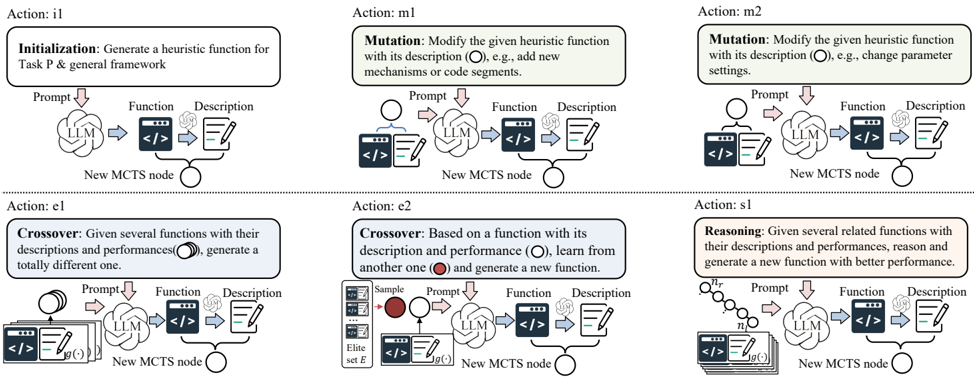
The image is a technical diagram illustrating six distinct actions (i1, m1, m2, e1, e2, s1) within a process that uses a Large Language Model (LLM) to generate or modify heuristic functions, likely for a Monte Carlo Tree Search (MCTS) algorithm. The diagram is organized into two rows, each containing three action panels. Each panel follows a consistent visual structure: an action label, a title, a descriptive text box, and a flow diagram showing inputs, the LLM processing step, and the output leading to a "New MCTS node."
### Components/Axes
The diagram is not a chart with axes but a process flow diagram. Its components are:
* **Action Labels:** Located at the top-left of each panel (e.g., "Action: i1").
* **Action Titles:** Bold text within each panel (e.g., "Initialization", "Mutation").
* **Description Boxes:** Rounded rectangles containing explanatory text for each action.
* **Flow Diagrams:** Visual representations of the process for each action, containing:
* **Icons:** Representing a user/person, a prompt, code (`</>`), a document, and a cloud-like shape labeled "LLM".
* **Arrows:** Indicating the flow of information (Prompt, Function, Description) into and out of the LLM.
* **Output Node:** A circle labeled "New MCTS node" at the end of each flow.
* **Connecting Dotted Line:** A horizontal dotted line separates the top row (Actions i1, m1, m2) from the bottom row (Actions e1, e2, s1).
### Detailed Analysis
The diagram details six specific actions:
**Top Row:**
1. **Action: i1 - Initialization**
* **Description:** "Generate a heuristic function for Task P & general framework"
* **Flow:** A "Prompt" is fed into the "LLM". The LLM outputs a "Function" (represented by a code icon `</>`) and a "Description" (represented by a document icon). These lead to a "New MCTS node".
2. **Action: m1 - Mutation**
* **Description:** "Modify the given heuristic function with its description (O), e.g., add new mechanisms or code segments."
* **Flow:** A "Prompt" and an existing "Function" (code icon) and its "Description" (document icon) are inputs to the "LLM". The LLM outputs a modified "Function" and "Description", leading to a "New MCTS node".
3. **Action: m2 - Mutation**
* **Description:** "Modify the given heuristic function with its description (O), e.g., change parameter settings."
* **Flow:** Identical in structure to Action m1. A "Prompt", "Function", and "Description" go into the "LLM", resulting in a new "Function", "Description", and "New MCTS node".
**Bottom Row:**
4. **Action: e1 - Crossover**
* **Description:** "Given several functions with their descriptions and performances (O), generate a totally different one."
* **Flow:** A "Prompt" and multiple inputs (represented by a stack of code/document icons labeled `g(·)`) are fed into the "LLM". The LLM outputs a new "Function" and "Description", leading to a "New MCTS node".
5. **Action: e2 - Crossover**
* **Description:** "Based on a function with its description and performance (O), learn from another one (O) and generate a new function."
* **Flow:** A "Prompt", a primary "Function" (`g(·)`), and a "Sample" from an "Elite set E" (represented by a red circle and a list icon) are inputs to the "LLM". The LLM outputs a new "Function" and "Description", leading to a "New MCTS node".
6. **Action: s1 - Reasoning**
* **Description:** "Given several related functions with their descriptions and performances, reason and generate a new function with better performance."
* **Flow:** A "Prompt" and a chain of related functions (represented by connected circles labeled `n₁`, `n₂`, `n₃`) are inputs to the "LLM". The LLM outputs a new "Function" and "Description", leading to a "New MCTS node".
### Key Observations
* **Common Output:** All six actions culminate in the creation of a "New MCTS node," indicating they are all part of a tree search or iterative optimization process.
* **Input Evolution:** The complexity of inputs increases from left to right and top to bottom. Action i1 starts with only a prompt. Actions m1/m2 add an existing function and description. Actions e1/e2/s1 incorporate performance data (`O`) and multiple functions.
* **Action Taxonomy:** The actions are categorized into Initialization (i1), Mutation (m1, m2), Crossover (e1, e2), and Reasoning (s1), suggesting an evolutionary or genetic algorithm-inspired approach to function optimization.
* **Role of the LLM:** The LLM is the central processing unit in every action, transforming prompts and existing artifacts (functions, descriptions, performance data) into new heuristic functions.
### Interpretation
This diagram outlines a sophisticated framework for automated heuristic function design. It suggests a system where an LLM acts as a "function generator" within an MCTS loop. The process begins with an initial function (i1). It then explores the design space through small modifications (Mutation: m1, m2) and larger, recombination-based changes (Crossover: e1, e2). The "Reasoning" step (s1) implies a higher-order synthesis, where the LLM analyzes patterns across multiple related functions to propose an improved version.
The inclusion of "performance" data (`O`) in the crossover and reasoning actions is critical. It indicates this is not a blind search; the system uses feedback (likely from evaluating the heuristic's performance in the MCTS) to guide the LLM's generation process towards more effective functions. The framework essentially automates the iterative, trial-and-error process a human programmer might use to develop a good heuristic, leveraging the LLM's pattern recognition and code generation capabilities to explore the vast space of possible function implementations. The ultimate goal is to discover heuristic functions that lead to better-performing MCTS agents for a given task (Task P).